Sicklepod is a familiar problem plant across northern Australia – a woody shrub that crowds watercourses and dominates pastures.
Travel to its native range in Central and South America, though, and you might struggle to find it. There, it’s relatively rare.
This story is not unusual in the world of weeds. Of the thousands of plants classified as weeds, around 300 are also on the International Union for Conservation of Nature (IUCN) Red List of Threatened Species.
So why does a plant that struggles at home run riot on the other side of the world?
Dr Daniel Montesinos from JCU’s Centre for Tropical Biosecurity and Australian Tropical Herbarium investigates this question – and the answer is helping inform biosecurity efforts on the ground.
How plants go from surviving in one place to thriving elsewhere
“My work has a strong biogeographical component – I compare what’s happening in the native range of a plant with what’s happening in Australia, to understand why the plant is so invasive here,” Montesinos says.
He explains that in its native range, a plant will have evolved alongside predators, herbivores and diseases. On a new continent, it is often free from those pressures that keep its numbers in check.
“Once a plant no longer has to invest resources in producing chemicals to defend against a herbivore, for example, it can put those resources into something else – growing faster, or producing more seeds.”
Over generations, invasive populations can evolve to become measurably different from the same species back home. JCU’s quarantine glasshouse allows Montesinos to bring in seeds from a species’ native and invaded ranges for a direct comparison.
“It’s typical that individual plants from the invaded range are much larger,” Montesinos says. “Even when you grow them in a glasshouse under identical conditions – same food, same water – they are genetically larger, and may produce more flowers than the plants from the native range.”
Montesinos also asks why these differences occur.
“A quarantine glasshouse is a great opportunity to bring in seeds from different parts of the world and study their physiology, their morphology, and the actual evolution invasive plants go through once they’re introduced into Australia,” he says.
PhD candidate Anita Owino is applying this approach to sicklepod.
“We’ll grow seeds from America, Africa and Australia together in the same common garden, and analyse the chemistry to understand whether chemical differences between regions explain why it becomes invasive,” Montesinos says.
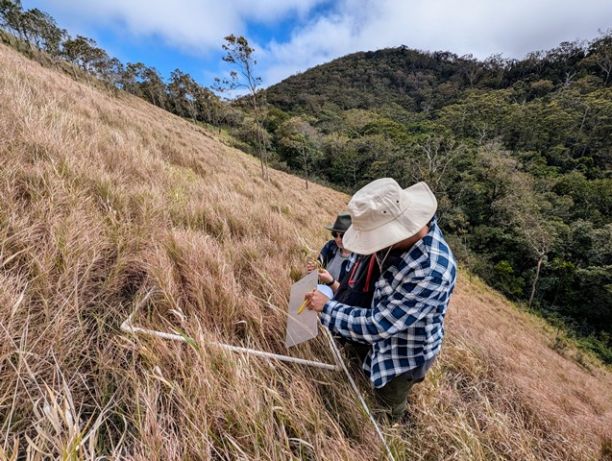
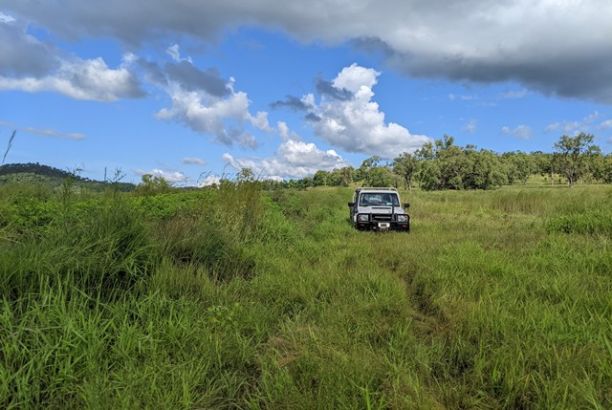
Unexpected advantages in a new place
Sicklepod shows just how thoroughly plants, with a little luck, can make themselves at home in a new place. Its pollen sits locked inside stamens that can only be opened when certain bees vibrate at the right frequency.
“That’s very uncommon for an invasive plant,” Montesinos says.
Those bees aren’t present in Australia, so how did the plant thrive?
Research by Dr Laura Lopresti, undertaken as a PhD project in Montesinos’s group, found the answer: sicklepod had landed on its feet twice over. Some native bees use the same buzz-pollination trick at the right frequency. Other insects just cheat.
“A lot of Australian insects completely ignore the mechanism,” Montesinos says. “They just bite through, or break in some other way, get to the pollen and end up pollinating the plant anyway.
“Sicklepod struggles more to find pollinators in its native range than it does here in Australia. It’s fascinating.”
The right place to make a difference
His location in Far North Queensland places Montesinos alongside those working on the front line of the biosecurity fight – land managers, biosecurity officers, Traditional Owners.
This proximity keeps him close to the challenges those on the ground are dealing with, and allows knowledge to flow both ways, such as in the case of using fire to control invasive plants.
“Weeds are a big concern for Traditional Owners, and fire is one of the tools they use to manage invasive plants," Montesinos says. "Fire sometimes controls a species and sometimes helps it spread – so it's an area of collaboration, exchanging knowledge to improve management.”
Access to the right people is one reason he has stayed. The landscape is the other.
“Nature is all around you – the ocean, the rainforest, the dry forest – within a two-hour drive I can reach so many different habitats and ecosystems.”
For an ecologist who wants his work to make a difference, there are few better places to be.
The big questions behind the front line
Most of the effort in biosecurity goes to the front line: the monitoring, control and eradication work. Montesinos credits the people doing this work – but he has a different role to play.
“There aren’t many people doing fundamental research on biosecurity,” he says. “There’s a lot of applied research – I have this weed, I’ll try this treatment – and people are very good at it. “But not many are asking the big questions about how and why weeds become so invasive in the first place.
Without those answers, control work can end up aimed at the wrong target.
”At the university, we train industry workers – such as our weed identification workshops – and investigate,” Montesinos says.
“I do the research and make it available to the people on the ground.”
One of his projects asks whether invasive plants in the wet tropics – from roadside colonisers like grader grass to rainforest invaders such as Miconia – are harming endangered species directly, or whether the weeds are simply following a disturbance – a new road or trail – that is the real culprit.
The answer informs whether the response is to fight the weed, or fix the disturbance.