For more than a decade, James Cook University (JCU) ecologists Professor Lori Lach and Dr Peter Yeeles have helped fight one of the world’s worst invasive species.
Now they are tackling the hardest part: knowing when the job is done.
Step out of a vehicle at the edge of a highly active yellow crazy ant infestation, and it doesn’t take long. Within 30 seconds the ants are crawling up your thighs – a shifting orange-yellow carpet pouring out of the leaf litter.
JCU researchers are supporting the Wet Tropics Management Authority (WTMA) to rid northern Queensland of these rampaging ants and answer the question that decides every eradication: not whether the invaders can be knocked down, but whether they are truly gone.
What makes yellow crazy ants so damaging
Professor Lori Lach, Director of JCU’s Centre for Tropical Biosecurity, is one of the world’s foremost experts on invasive ant ecology.
“Yellow crazy ants are considered one of the most damaging invasive species in the world because they affect multiple sectors in multiple ways – agriculture, natural systems, and homes and public spaces,” she says.
“They can do a lot of damage if left unchecked.”
Yellow crazy ants wiped out more than a million red land crabs on Christmas Island, and reshaped the forest that depends on the crabs, a cascade that reached birds and lizards and is thought to have played a part in the extinction of the island’s only native bat.
In Australia’s Wet Tropics, the ants were first detected near Cairns in 2001, possibly arriving in shipments of timber from South-East Asia.
“In the Wet Tropics, we’ve been fortunate enough to prevent some of the longer-term effects,” Lach says.
“But we have found, in a study published in 2022, that some species of small native skinks that were all but wiped out by the yellow crazy ants still hadn’t come back years after heavy infestations had been eliminated,” Lach says.
A 12-year partnership tackling the tiny threat
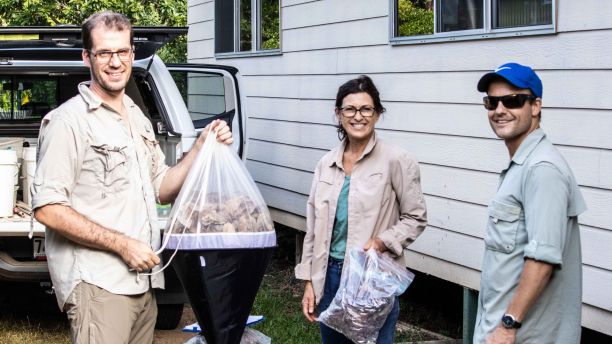
Credit for preventing some of the worst effects of the ants belongs to the Yellow Crazy Ant Eradication Program, run by the WTMA. Their officers carry out the front-line work of baiting and surveillance, while Lach and Centre colleague Dr Peter Yeeles provide research support so decision-making is informed by evidence.
Lach says some of their early projects in support of the eradication program were to figure out the seasonality of ant activity and queen reproduction, what kinds of lures the workers were attracted to - such as cat food and jam flavours and other proteins and sugars – and how they responded to different types of bait.
WTMA’s investment in the research and ongoing scientific support from JCU, which few eradication programs have the resources to do, has had further benefits.
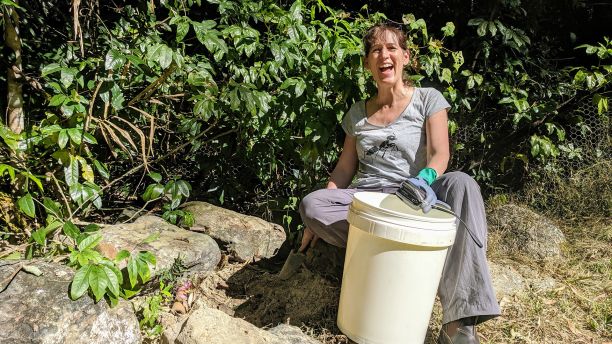
In surveying the rainforest for the effects of both the yellow crazy ants and the baiting, the researchers have collected and identified more than 200 species of ant – around a tenth of which are unnamed and may be new to science.
They’ve also built close to 10 years of data on how native species respond, not just to the invasion but also to the management meant to counter it.
Yeeles says one of their projects with WTMA assessed how native ant communities change with yellow crazy ant invasion and baiting. “It’s a game of trade-offs between the effects of treatment, and the effects of leaving the invader to go completely unmanaged,” he says.
“The whole thing is really a story about the importance of biosecurity and preventing the invasion of a species that would otherwise require an eradication effort, or ongoing control.”
Lach agrees there’s no question about which way to go in the trade-off.
"The bigger the infestation, the less likely you're ever going to be able to do anything permanent about it," she says. "When you have the biodiversity value of the World Heritage Area at stake, you need to do everything you can to protect it before the problem is too big."
The hardest part: knowing when an invasive species is gone
How do you have confidence an ant a few millimetres long is no longer there, across kilometres of rainforest?
Yeeles has investigated how often surveys need to be conducted and how much surveillance is required to conclude that the ants are gone.
“It’s easy to detect yellow crazy ants when they’re present in high densities,” Yeeles says. “But when you’ve baited them six times, any ants remaining are obviously very difficult to find.
“If you only have a low chance of detecting yellow crazy ants on any one survey, you’re going to need a lot more surveys to get a decent level of confidence that the ants aren’t there anymore.”
Yeeles and Lach measured the odds that a given method – sticky traps, detector dogs, or lures of cat food and jam left out for an hour – would turn up ants when they’re only present in low numbers.
Yeeles then developed a tool that helps the WTMA decide where and how often to survey and determine how confident it can be that an infestation is gone.
“Eradication programs spend probably 99 per cent of their effort on getting rid of the last one per cent of ants,” he says.
Lach agrees and cites the tremendous amount of work that the WTMA crews do conducting post-treatment surveys in steamy tropical conditions, knowing that spotting even one yellow crazy ant will restart the clock.
“If you’ve ever taken a walk in the rainforest and just thought of all the life around you that you’re not even aware of, you realise it’s pretty easy not to see your ant of interest,” she says.
“That’s why eradication programs can take so long – you need time to let any remaining colonies grow to the point that they can be detected.
“No one can speed up time—or ant reproduction.”
Careers spent studying the far-reaching impact of invasive ants
Lach’s interest in ants was sparked while doing a PhD in ecology.
“I wanted to apply ecology to achieve an outcome, and I also had a general interest in working on things that are easily overlooked,” she says.
During a stint in Hawai’i – which has seen significant impacts from invasive species – Lach asked every conservation scientist she met there which invader was the least appreciated, but potentially most destructive.
“One of the 10 said rats,” Lach says. “The other nine said ants.”
For Yeeles, the appeal of studying ants stretches back to childhood.
“I’ve been interested in insects since I was a kid, and I did a PhD on ants,” he says.
What’s kept him in northern Queensland is the potential for new discoveries, whether uncovering fascinating ecological processes or documenting species new to science.
“I published a paper on a species of insect found in my backyard, underneath a rock – from a family rare to the Australian mainland that hadn’t been described in Queensland before,” Yeeles says.
“Anybody could go outside and discover a new species. If you just took a walk, you’d pass some that aren’t named yet.”
Yellow crazy ants threaten to erase some of these species before they’re even known. But the work of James Cook University’s Professor Lach, Dr Yeeles and the Wet Tropics Management Authority is delivering a better chance not only to stop today’s invasion, but to protect the Wet Tropics from whatever comes next.