JCU the new home of NQ Simulation Park
North Queensland’s ground-breaking advanced simulation training centre has found a permanent headquarters, with the $32.2 million training facility soon to undergo a high tech fit-out at James Cook University.
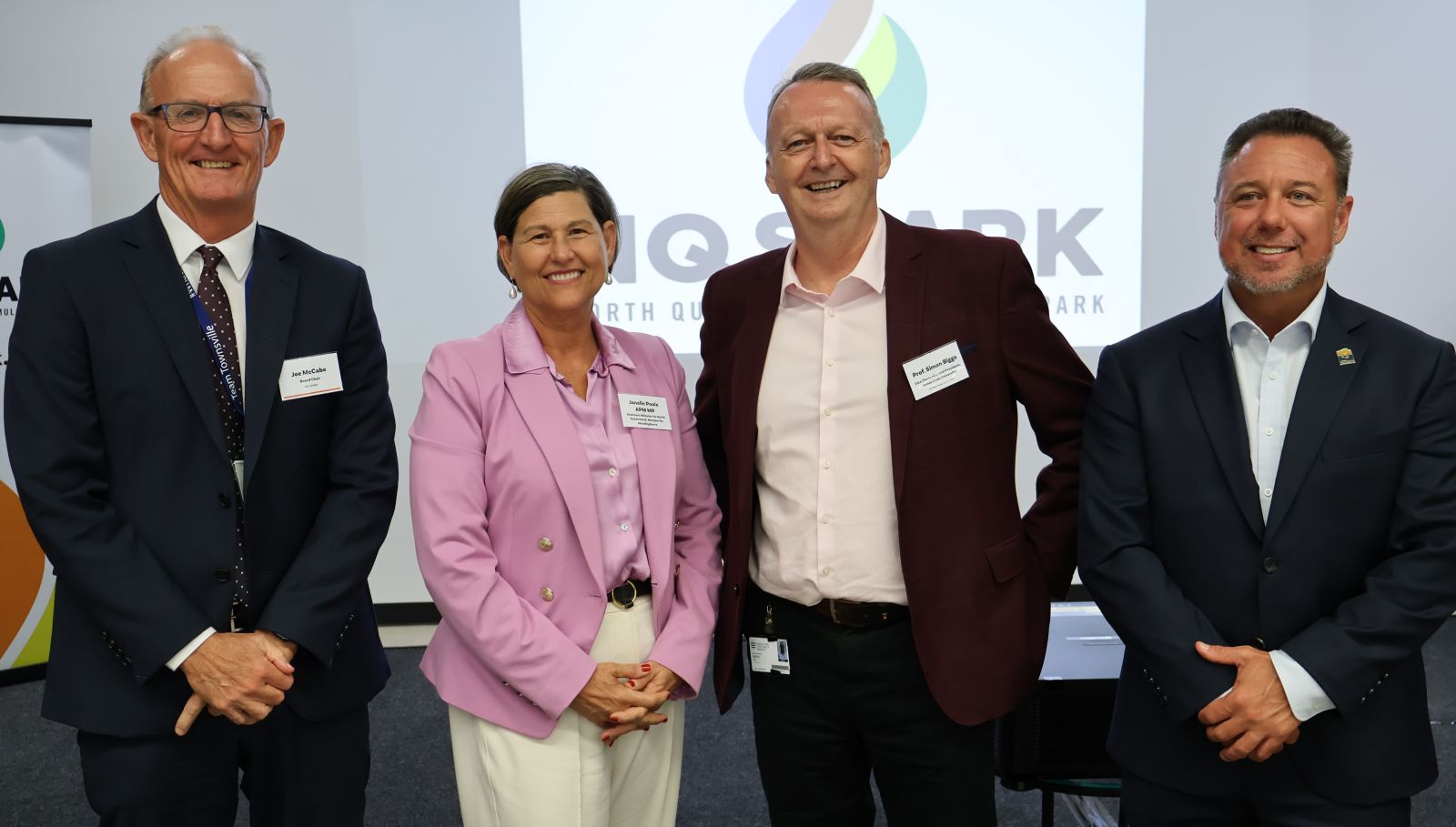
A joint venture of JCU and Townsville City Council, North Queensland Simulation Park (NQ SPARK) will combine advanced simulation, virtual and augmented reality, and high‑performance computing to give key organisations faster decision‑making, safer operation and richer data insights, all without the real‑world risk of live training.
After a period of operation at temporary premises, NQSPARK has taken possession of its new 1000m2 space on the ground floor of the Clinical Practice Building at James Cook University’s Bebegu Yumba campus in Douglas.
Speaking at the soft launch of the centre this week, JCU Vice Chancellor and President Professor Simon Biggs said the opening of NQ SPARK marks the arrival of something truly unique in Australia, a national centre of excellence that places Townsville at the forefront of simulation and immersive technology.
“NQ SPARK exists because the real world comes with limits,” Prof Biggs said.
“Training, research, and testing in high risk or complex environments can be slow, resource intensive, and sometimes dangerous. Simulation changes that.
“By integrating advanced simulation, augmented and virtual reality, and high-performance computing, NQ SPARK allows us to safely explore scenarios that would otherwise be impossible.
“What makes this so powerful is not just the technology, but the purpose behind it.”
NQSPARK Chair and Townsville City Council CEO Joe McCabe said the new facility would position the region as a national hub for simulation-based training, research and testing.
“At NQSPARK, teams can safely rehearse high‑risk scenarios, from military operations and emergency responses to specialised vehicle and crisis management in controlled but realistic virtual environments, then receive detailed, data‑driven feedback to improve performance,” he said.
“Organisations can trial new approaches in controlled environments, monitor outcomes in real time, and capture high‑value data to inform future operations.”
This joint initiative of was made possible through grant funding from the Australian Department of Defence and support from the Queensland Department of the Environment, Tourism, Science and Innovation.
NQSPARK also enables the creation of digital twins of complex environments, extending physical infrastructure into fully interactive virtual spaces.
Prof Biggs said these environments allow researchers, industry and end‑users to test theories, validate equipment and collaborate remotely at scale.
“NQ SPARK will support education, training, research, and evaluation across medicine, science, defence, emergency response, and industry,” he said.
“It will help students learn more effectively, researchers push boundaries, and practitioners prepare for real‑world challenges with greater confidence and capability.
“JCU is proud to host NQ SPARK within our technology precinct and we are grateful for the support of the Australian and Queensland Governments, Townsville City Council, the Australian Defence Force and our industry partners.”