Written By
Rachelle McCabe
College
College of Science and Engineering
Publish Date
10 December 2024
Related Study Areas
The flies the limit
Could a species of Black Soldier Fly (BSF) be the answer to aquaculture’s sustainability challenges? JCU PhD student Kishor Bommalingegowda thinks so and he’s deep into research that proves it.
Kishor’s research, titled Breeding Super Black Soldier Flies at Scale for Sustainable Food Production, has been funded by an Australian Research Council Linkage Project grant with JCU and FlyFarm Australia Ltd as industry partners. The project aims to breed larger, more resilient Black Soldier Fly (BSF) larvae for use in aquaculture and animal production industries as an alternative and sustainable protein source for feed. BSF larvae are rich in protein and fat, contain antimicrobial peptides (AMPs), and can feed on various organic wastes, making them an eco-friendly, high-quality protein source for fish, prawns/shrimps, poultry, pigs and other commercial aquaculture species.
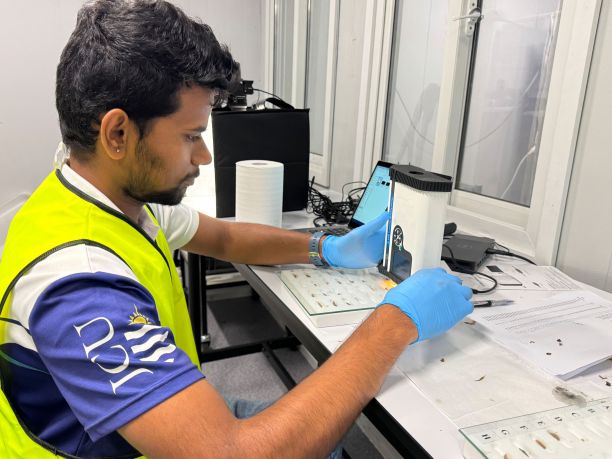
Recently, Kishor's research led him to FlyFarm's R&D centre in Brisbane for a 70-day placement, where he conducted breeding trials and reared BSF larvae on various diets in a bid to ascertain the key factors to growing larger, more productive larvae for animal feed.
Ultimately, Kishor hopes his research will contribute to the development of this fledgling industry and help ensure the long-term sustainability and resilience of the aquaculture and animal production sectors. With a growing global population and an ever-increasing demand for protein-rich food, innovative solutions like BSF-based feed could be a game changer in creating an upscaled aquaculture industry.
“Everyone knows the population is increasing. In Australia alone, the food waste is unbelievable. If we can repurpose even just 10 per cent of that waste and use it for something like this, then we are part of the solution,” he says.


A focus on BSF larvae as a feed source
Kishor’s research began well before his placement in Brisbane. He wanted genetically diverse BSF populations to establish the founder population for breeding trails at FlyFarm, so he traversed vast parts of Australia, collecting wild BSF larvae samples. At FlyFarm, he crossbred these populations in a bid to create a genetically diverse founder population, enabling the implementation of selective breeding for improved productivity.
“We will need thriving aquaculture and animal production industries to meet future food demands. My objective is to improve the size of the larvae using selective breeding as a tool. To do that, we need a broad genetic base to start with, which is why I collected the samples and conducted breeding trials. We are also testing varying diets to see how BSF genetics interact with them to develop diet-specific breeding strategies to produce bigger larvae,” Kishor explains.
“This insect larvae can grow on various organic waste – including household food waste and industrial food processing by-products. They transform it into a high-protein feed source. This protein is then used to feed fish, prawns/shrimp, pigs or poultry, re-entering the food cycle for human consumption.
“I gained practical experience in automated BSF breeding, nursery management, grow-out, and post-processing operations while on placement,” he adds.
Kishor conducted breeding trials with BSF populations collected from across Australia. To assess the larvae's performance in terms of production traits, he used advanced tools such as Near Infrared Spectroscopy (NIR) and digital imaging for phenotyping. He also collected tissue samples for further genotyping.
“The findings from this will provide essential baseline information for establishing a selective breeding program for Australian BSF, aimed at enhancing productivity and supporting the circular economy,” he says.
Kishor believes increasing the size of BSF larvae is crucial for commercialising FlyFarm’s product, as larger larvae lead to increased productivity.
“The focus for FlyFarm is currently on aquaculture, with BSF larvae not only a high-protein diet for fish but also offering antimicrobial properties to help combat disease - a concern in the industry. The larvae serve as both feed and immunity,” he says.
So far, Kishor’s research has involved collecting and recording data, including the weight, NIR readings for protein, and digital images for morphometric analysis. The next stage will involve extracting DNA from around 3,600 BSF larvae samples, genotyping them on the genome-wide SNP array, and conducting genetic data analysis.
“Using quantitative genomics and statistical analysis, I will be able to come up with genetic parameters and genomic predictions. We will also have data showing how this broad genetic line performs on three different diets: soy-okara, brewers’ spent grain (BSG), and fruit and vegetable waste,” Kishor says.
"We will need thriving aquaculture and animal production industries to meet future food demands. My objective is to improve the size of the larvae using selective breeding as a tool."
JCU PhD student Kishor Bommalingegowda

The future is in the genes for Kishor
Kishor, an international student from India, chose to study his PhD at JCU after completing his master’s degree in Aquaculture Genetics and Breeding in his home country.
He says he was drawn to JCU because of its progressive aquaculture program and focus on aquaculture genetics. Kishor says his time at JCU has been enjoyable and academically rewarding, with the hands-on training in a real-world setting like FlyFarm and the partnerships with the ARC and industry a clear highlight.
After his PhD studies, Kishor hopes to secure work that applies his genetics expertise.
“As a geneticist, I can adapt to many industries. I’d like to get involved with genetic improvement programs in aquaculture, poultry, livestock, or insects. Alternatively, I may continue in academia, collaborating with researchers on these programs. There are plenty of exciting developments happening in this space,” he says.
Kishor acknowledges that his research was made possible through a JCU postgraduate research scholarship from JCU’s College of Science and Engineering.
“That funding allowed me to travel to Brisbane for my placement and research at FlyFarm. I was there for two months and appreciated that the funding helped pay for my travel and accommodation expenses,” he says.
Find out more about the scholarships on offer at JCU here.