Fast Facts
Location
Commencing
- Townsville: February, September
- Cairns: February, September
The Animal and Veterinary Bioscience major is only offered for Trimester 1 intake.
Fees
From $8,960+
+
estimated annual Commonwealth Supported Fee for a full-time study load, based on 24 credit points. Please note this estimate is variable and subject to fluctuation depending on choice of elective subjects.
Plus Student Services and Amenities fee. Fee deferral and scholarships available if eligible
Currently displaying fees for 2026, which are subject to change in following years.
Duration
3 years full-time
6 years part-time
Entry Requirements
ATAR 66.5
Animal and Veterinary Bioscience Major only Required: English, Mathematical Methods, Chemistry (Units 3/4,C) Recommended: Biology (Units 3/4,C)
Recommended Knowledge
All Majors (except the Animal and Veterinary Bioscience Major) : English (Units 3/4,C), Chemistry, General Maths or Mathematical Methods (Units 3/4,C)
QTAC Codes
- 316061, 316131
- 326061
Please note 316131 is for Animal and Veterinary Bioscience major applications.
Course detail
With a Bachelor of Science at JCU, you can pursue the scientific study that aligns with your interest, aptitude and career goals. JCU’s Bachelor of Science has 12 majors to choose from. Build a fundamental understanding of key scientific fields, and then explore areas of specialisation that align with core industry opportunities.
Tailor your science degree to suit your interests
Learn the fundamentals of science in your first year, then select one or two specialisations to continue building knowledge and skills in your chosen discipline.
You can also expand your knowledge by choosing to enrol in a minor or include elective subjects available per semester or trimester. This versatility allows you to gain a breadth of insights, knowledge bases and experiences while studying science at university.
Small class sizes allow you to make strong connections with your peers and with expert academics who are committed to your success. Throughout your degree, you will develop professional networks as well as key employability skills, relevant to your discipline, that will equip you to kickstart your career upon graduation.
Hands-on learning in practical classrooms
When you study science in North Queensland at JCU, you’ll undertake real-world projects and research in unrivalled locations, including the World Heritage-listed Great Barrier Reef, the Daintree Rainforest and the Australian Outback. JCU’s contemporary facilities provide you with dynamic spaces within which to learn and grow, such as The Science Place (LEED Gold Certified), the Orpheus Island Research Station and the Daintree Rainforest Observatory.
Gain the confidence to initiate and conduct research, with opportunities to design reliable, evidence-based laboratory and field experiments. You’ll learn the keys for determining the best methods, techniques and tools to support your investigations. Learn side-by-side with leading academics and industry experts both in class and in professional settings.
Upon completing this Bachelor of Science course, you will be equipped with advanced skills and a knowledge base relevant to a vast range of settings, including the global Tropics.
Students who are based in Townsville and have completed at least one year of their degree are eligible to apply for an Australian Public Service Academy Campus position. With opportunities in the Digital and Data spheres, you can align your studies to part-time work, that may translate into a full-time job offer upon graduation. Explore the APS Data and Digital Programs page for more information.
View the handbook for a detailed overview of available subjects.
Inherent requirements
Inherent requirements are the identified abilities, attributes, skills, and behaviours that must be demonstrated, during the learning experience, to successfully complete a course. These abilities, attributes, skills, and behaviours preserve the academic integrity of the University’s learning, assessment,and accreditation processes, and where applicable, meet the standards of a profession. For more information please review the inherent requirements for the Bachelor of Science.
Majors
A major is your area of expertise. There are 12 majors within the Bachelor of Science, and you can choose to study one or two majors. Not all majors are available at all campuses.
Animal and Veterinary Bioscience
Guaranteed Admission Plan does not apply to this major.
This major is built for students serious about animal and veterinary science. You'll study the same subjects as JCU's veterinary students in your first two years, then choose the direction that suits you.
Students who complete the first 45 prescribed credit points of the Bachelor of Science (Animal and Veterinary Bioscience) major may be eligible to transfer to the Bachelor of Veterinary Science (Honours) if the student meets the admission requirements via GPA, written application and external tests.
Students who continue in the Bachelor of Science can choose major electives in aquaculture or veterinary science, with professional placements in real-world animal and veterinary settings built into the degree.
Aquaculture Science and Technology
Explore the science behind the large-scale production of aquatic species with the Aquaculture Science and Technology major. Throughout this major, you will explore the scientific, technological, and practical applications of domesticating, breeding, rearing, and harvesting of aquatic animals and plants for food, aquarium, pearl and pharmaceutical applications.
Through course work, field trips to aquaculture enterprises and work experience, you will understand how a diverse range of species are farmed and studied. Learn the science and biotechnology approaches to support improved production including physiology, nutrition and diet optimisation, genetic selection and disease management. Through this Bachelor of Science, Queensland, you will get hands-on experience in handling animals, systems design and the rearing of various live organisms to feed class-spawned larval fish.
With a focus on tropical species, our researchers’ links to industry will give you a strong professional network when you graduate. Career opportunities include jobs in hatcheries, stock nutrition programs and management, fresh water and marine farming, professional scientific advisory services, NGOs, government policy or aquaculture research to ensure secure protein sources into the future.
Bioinformatics
Bioinformatics brings biology, genomic data and technology together. At JCU, you can pair it with marine biology, aquaculture, or mathematics and data science, a range of directions not available anywhere else in Australia.
Throughout this major you'll build skills across genetics, programming and statistics, with core subjects including Bioinformatics I: Decoding DNA and Bioinformatics II: Mastering Big Genomic Data, alongside Data Mining and Programming. You can pair it further with genetics and cell biology options.
The real strength of this major is how far you can take it. Combine it with marine biology or zoology and you'll use DNA tools to understand and protect the reef and rainforest ecosystems on JCU's doorstep. Pair it with aquaculture or molecular biology and you'll work on genomic challenges facing industries and societies that matter most in the tropics. Take it toward mathematics or data science and you'll develop the algorithms the field itself depends on.
Through JCU's partnership with the Australian Institute of Marine Science, high-performing students get access to industry-led research in genetics, molecular biology and environmental DNA through the AIMS@JCU program.
Chemistry
Chemistry is the science of matter - what it’s made of, how it behaves, and how it changes. From organic compounds to inorganic structures, chemistry uncovers the properties and interactions of substances and the energy behind every transformation. As the ‘central science’, chemistry forms the backbone of discovery across STEM including biology, environmental and marine science, biomedical research, and engineering.
At JCU, you’ll get hands-on experience in cutting-edge labs and build real-world skills through Work Integrated Learning. Explore key areas like analytical chemistry, organic and inorganic synthesis, environmental chemistry, marine chemistry and instrumental techniques used across industry and research.
In your third year, dive deep into advanced instrumentation and techniques used globally in chemical industries. JCU’s Chemistry major is fully accredited by the Royal Australian Chemical Institute (RACI), setting you up for careers across Australia and worldwide.
Please note: mid-year entry is not available for the Chemistry major.
Data Science
Data science is the art of taking disorganised, raw data and crafting it into powerful insights and accurate predictions. Data science empowers a wide range of users, from individuals, scientists and health professionals to businesses, research organisations, and governments. Data Science also offers the crucial knowledge and know-how to grasp current trends, optimise how things work, and predict future outcomes.
At JCU, studying Data Science as a major in Bachelor of Science, will equip you with a powerful toolkit. You’ll learn all the skills to be an effective data scientist in the workforce. Beyond just technical skills, JCU focuses on making you a well-rounded professional. You’ll develop essential science communication, advanced analytical, and problem-solving skills that are vital for any career. Our expert academics are dedicated to boosting your professional capacity, helping you stand out to employers and truly make a difference in the world.
From defence departments to health departments, and financial institutions to sporting teams, almost every industry and profession in the world now uses data and data science to enhance its operations and outcomes.
Environmental Earth Science
Study Environmental Earth Science and gain practical skills related to biodiversity, climate management and relevant scientific processes.
Gain a thorough understanding of rocks, soils, rivers, coasts and climate and how they affect people and are influenced by human activities. With access to the diverse environments of North Queensland, including JCU Fletcherview Research Station, JCU Orpheus Island Research Station, the Daintree Rainforest Observatory, and the Environmental Research Complex, your learning will be grounded in real-world applications.
Through this specialisation, you’ll develop expertise within field work processes, data analysis and report writing, preparing you for diverse and exciting career opportunities across many sectors. Graduates with a major in Environmental Earth Science may work in consultancy, government or industry. You could pursue a career as a geologist, geographer, hydrologist, soil scientist, climatologist, environmental scientist or oceanographer, to name a few.
Explore Environmental Earth Science
Geology
Become an innovative problem-solver and explore the broad applications of geology, a field concerned with the structure and composition of the earth.
Build an in-depth understanding of geoscience with a focus on sedimentology, geographical mapping and structural geology. You’ll benefit from flexibility through subject choices, equipping you to explore a combination of geochemistry, critical mineral exploration or environmental process, depending on your interests.
JCU’s unique location and strong connections with industry mean you’ll find numerous opportunities for hands-on learning. Develop your on-site experience through field trips and build connections with industry partners in mining, engineering and conservation. Seize the opportunity to participate in current geological research projects through JCU’s on-campus Economic Geology Research Centre.
Graduate with practical analysis and investigation skills that will equip you to take on opportunities within the mining and minerals sector, renewable energy or environmental assessment. Those with a specialisation in Geology excel in roles such as geoscientist, environmental geologist, management consultant, palaeontologist, teacher or academic.
Marine Biology
Be equipped to address critical challenges facing marine and coastal ecosystems. You will study in a location that gives you access to one of the most diverse and fragile marine ecosystems in the world, the Great Barrier Reef.
By studying the surrounding habitats of the Great Barrier Reef, you will discover the impact that humans have on the marine environment and how the oceans and atmosphere interact. You will gain valuable employability skills through practical experiments and opportunities to visit the JCU Orpheus Island Research Station.
Benefit from our researchers’ strong links with industry, including the Great Barrier Reef Marine Park Authority (GBRMPA), TropWater and CSIRO Townsville. As a marine biologist, you could work in conservation biology and policy, environmental and resource management, fisheries biology, ecosystem restoration and marine impact assessments.
Mathematics
Develop the problem-solving, analytical and quantitative reasoning skills that are highly sought-after by employers worldwide. With small class sizes, you will receive the one-on-one support required to excel as a mathematician.
Understand advanced mathematical techniques, data analysis and multivariate statistical methods. You will learn how to formulate mathematical models to illustrate science and engineering problems and use various techniques to help find solutions.
To enhance your employability skills, you have the flexibility to combine this major with another Bachelor of Science major. As a mathematician, you can work in many sectors such as information technology, animated films, business and finance, astronomy and space exploration, climate study or meteorology, cryptography and applied research.
Molecular and Cell Biology
Learn how to amplify and edit DNA sequences and conduct laboratory-based projects. Throughout your degree, you will study the basis of health and disease at a molecular level and analyse the functions of a whole cell.
Benefit from hands-on experience using cutting-edge equipment and techniques. Study biochemistry, microbiology, biotechnology and bioinformatics and gain an in-depth understanding of molecular genetics. These structures and processes form the basis of all living matter and provide insights into complex biological interactions.
Develop the foundations needed to work towards developments of modern medicine and biotechnology.
You will have the knowledge to work across a breadth of industries — job opportunities include working in research laboratories, hospital and diagnostic departments and biotech or pharmaceutical companies.
Explore Molecular and Cell Biology
Physics
Explore some of the universe’s most challenging questions. Accredited by the Australian Institute of Physics, this major will give you a broad range of practical and theoretical skills across various physics disciplines.
Physicists study the laws of nature; you will learn the fundamentals of energy, quantum mechanics, relativity, antimatter, weather and climate. Develop your ability to think critically and explore biophysics, geophysics, molecular electronics, organic solar cells or astrophysics. You will study the structure of matter, atomic and nuclear physics, quantum physics, oceanography and meteorology and thermodynamics.
As a physicist, your skills are relevant to a diverse number of careers. Job opportunities exist in industrial, scientific and educational occupations in fields such as health, meteorology, mining, environmental monitoring, energy production, telecommunications and aerospace.
Please note: mid-year entry is not available for the Physics major.
Zoology and Ecology
Learn from academics with global standing. Study amazing rainforests and diverse species and go on field trips to Borneo, the amazing local Queensland rainforests, islands and outback. Offered at both our JCU Townsville, Bebegu Yumba, Douglas and JCU Cairns, Nguma-bada, Smithfield campuses, you will study in one of the most biodiverse regions in Australia.
Study the biology of plants and animals and their natural habitats. Discover many of the environmental threats to the Tropics by studying the effects of deforestation, infrastructure expansion, habitat fragmentation, over-hunting and invasive species.
You will access the various environments of the Wet Tropics and our Daintree Rainforest Observatory to learn about biosecurity, behavioural ecology, conservation biology and ecological modelling. You could find work as a wildlife or environmental consultant, zoologist or ecologist for a conservation, quarantine or biosecurity organisation.
Refer to the handbook for a detailed overview of each major and minor available.
Honours
The Bachelor of Science (Honours) degree is available for high-achieving students. It consists of extra study and the development of a personal research project and thesis. An Honours degree is usually essential for entry to research higher degrees. Please refer to the Bachelor of Science (Honours) [End on] Handbook for eligibility information.
JCU Science graduates are broadly skilled and equipped to work across a variety of fields. They have the advanced analytical skills needed to enter the workforce and make a meaningful impact on the world.
Depending on your area of specialisation, you could work in a growing number of fields including aquaculture, fisheries management, agriculture, chemistry, pharmaceuticals, mining, or biotechnology. The connections you make during placements and internships or with academics, researchers, and organisations that facilitate your field trips provide opportunities to connect with experts in your area of specialisation and allow you to leverage professional networking for future employment.
You could be employed in roles such as geologist, environmental scientist, oceanographer, mathematician, marine or molecular and cell biologist, physicist, ecologist, conservationist or rehabilitation scientist, environmental and policy consultant, wildlife consultant or chemist.
Entry score threshold
These are the lowest adjusted scores we made an offer to in Trimester 1, 2026. Entry scores are based on the most recent Trimester 1 intake and are updated in June each year. Meeting the threshold doesn't guarantee admission.
ATAR/Selection Rank: 66.50
Entry score range
This table shows the range of entry scores for recent secondary students offered a place in the Bachelor of Science for Trimester 1, 2026. The table includes offers deferred to Trimester 1, 2026 which may have been assessed using the entry score threshold of an earlier year.
JCU Townsville
Without adjustments | With adjustments* | |
|---|---|---|
Highest | 97.65 | 99.95 |
Median | 82.05 | 83.55 |
Lowest | 62.9 | 66.6 |
JCU Cairns
Without adjustments | With adjustments* | |
|---|---|---|
Highest | 95.6 | 99.3 |
Median | 80.5 | 82.15 |
Lowest | 62.9 | 68.9 |
Notes:
<5 – indicates less than 5 OP/ATAR-based offers made.
* Refer to Adjustment Factors
Find out more about who you might study with by viewing this course’s student profile.
Adjustment factors
James Cook University applies bonus ranks under the Regional Preference Scheme and QTAC’s Educational Access Scheme (EAS). Learn more about JCU’s adjustment factors.
Estimated annual Commonwealth Supported fee: $8,960
A variety of Scholarships are available to suit different student types.
Learn more about fees and financial support
JCU Prep provides a pathway into this course. Enrolling in this flexible program will enable you to meet entry requirements including subject pre-requisites and ATARs. Introductory academic subjects are also available to prepare you for tertiary study.
*Excludes entry into the Bachelor of Advanced Science, Bachelor of Dental Surgery, Bachelor of Medicine, Bachelor of Surgery, Bachelor of Physiotherapy, and Bachelor of Veterinary Science (Honours).
Note the course QTAC code for the location you've chosen. You'll need to enter it as part of your QTAC application.
Application dates vary between courses, whether they're delivered in semester, trimester or carousel study modes. View our Application due dates page for more information.
ATAR score is indicative only. Entry scores will be finalised in the major offer round.
Webinars
Studying Science at JCU
Watch our free on-demand course webinars and gain further insights into a range of topics such as course structure, study modes, entry requirements, application processes and more. Presented by academic experts and current students, our webinars also provide information on practical learning and career pathways, and how you can benefit from support services and flexible study options.
Watch Now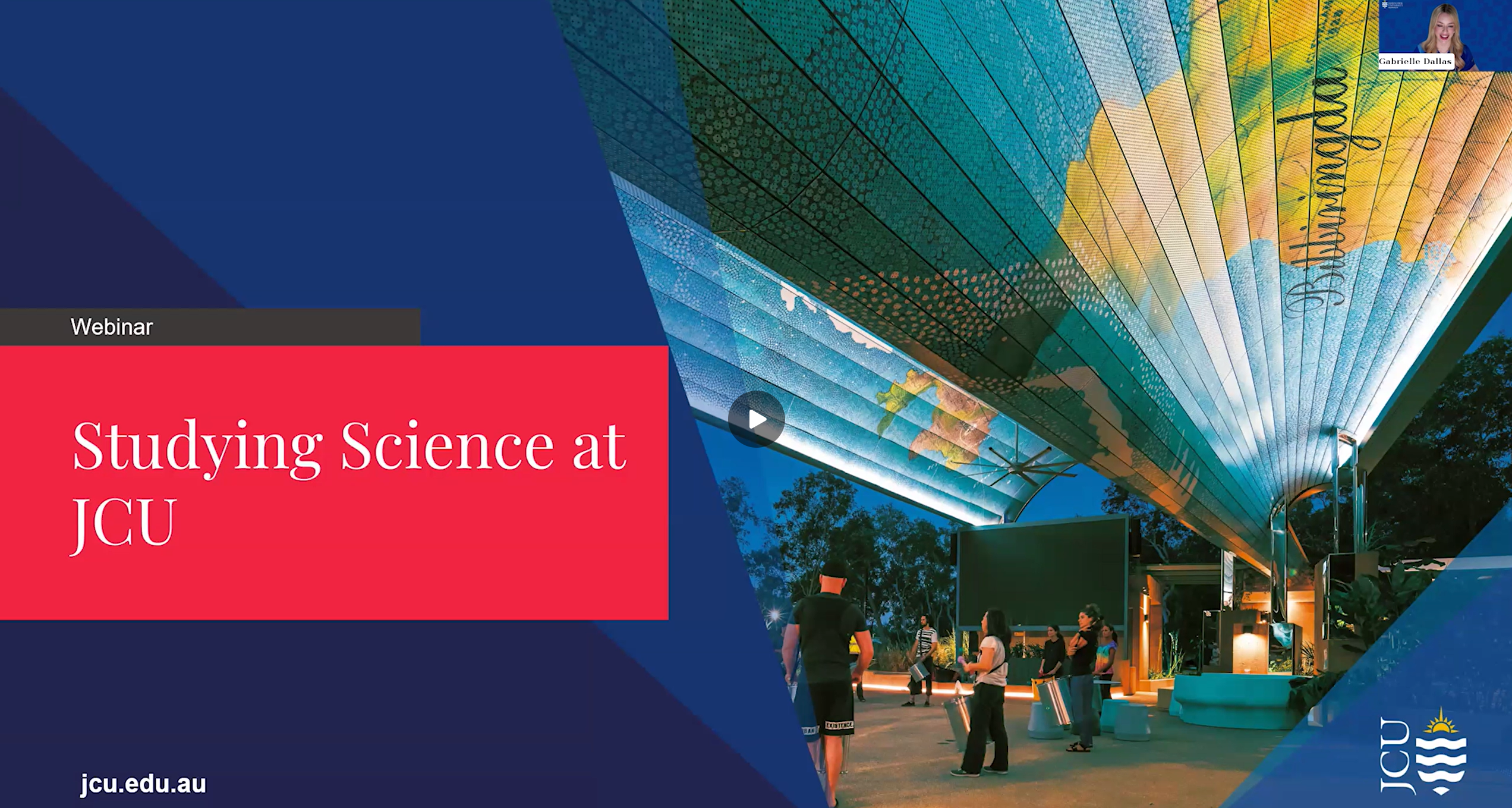
Real stories
-

Student
Jim MacLean
Bachelor of Science
I have always loved the intricacies of the natural world and knew that I wanted to further my understanding as much as possible. At JCU, I especially enjoy the practical aspects of the degree. Going out into the field for hands-on learning has been instrumental in enhancing my comprehension of the theory in the course.
-

Student
Catherine McLean
Bachelor of Science, majoring in Zoology and Ecology
Studying science at JCU has been a transformative experience for me. It's shaped my career and enriched my life, building resilience and adaptability. It has provided direction to my curiosity about nature and allowed me to build valuable relationships in a close-knit uni.
-
Alumni
Angus Shephard
Bachelor of Science (Honours), majoring in Chemistry
JCU has a great range of facilities which have allowed me to collect research data and gain hands-on experience in a variety of relevant skills and techniques. I’ve had many great opportunities, whether it be attending conferences to present my research to spending time overseas to collaborate on research projects.
-

Lecturer
Dr Tasmin Rymer
College of Science and Engineering
JCU is recognised globally for its excellence in research in several areas. Our small class sizes provide students with access to lecturers who genuinely care about their progress and their studies. Our courses are also embedded with work-integrated learning, making JCU graduates highly sought after in the workforce.
-

Employer
Dr. Lyndon Llewellyn
Australian Institute of Marine Science
JCU students are of a like mind to us. They want to make the world a better place and they bring that desire into their work with us. They are practical, passionate and willing to tackle challenging problems through science.