
Australian Institute of Tropical Health and Medicine Our impact AITHM Stories Ageing well and fighting dementia in the Torres Strait
Ageing well and fighting dementia in the Torres Strait
- MRCMHR
- Future Students
- JCU Global Experience
- International Students
- Student experience
- Open Day
- How to apply
- Pathways to university
- Living on Campus
- Courses
- Publications
- Mature students
- Scholarships
- Entry options
- JCU Families
- JCU Heroes Programs
- Aboriginal and Torres Strait Islander in Marine Science
- Elite Athletes
- Defence
- Capability.Co
- AI@JCU
- AALL
- Current Students
- Student Ambassador Program
- New students
- JCU Orientation
- LearnJCU
- Placements
- EDQS
- Unicare Centre and Unicampus Kids
- Graduation
- Off-Campus Students
- JCU Job Ready
- Safety and Wellbeing
- JCU Prizes
- Professional Experience Placement
- Employability Edge
- Art of Academic Writing
- Art of Academic Editing
- Careers and Employability
- Health, Wellbeing and Belonging
- Career Ready Plan
- Careers at JCU
- Partners and Community
- School Outreach and Widening Participation
- Alumni
- International partnerships
- About JCU
- Reputation and Experience
- Chancellery
- Governance
- Celebrating 50 Years
- Academy
- Indigenous Engagement
- Education Division
- Research Festival
- Graduate Research School
- Research Division
- Research and Innovation Services
- CASE
- College of Business, Law and Governance
- College of Healthcare Sciences
- College of Medicine and Dentistry
- College of Science and Engineering
- MPE
- Anthropological Laboratory for Tropical Audiovisual Research (ALTAR)
- Rural Remote and Tropical Health Systems
- Agriculture Technology and Adoption Centre (AgTAC)
- Advanced Analytical Centre
- Australian Institute of Tropical Health and Medicine
- AMHHEC
- Aquaculture Solutions
- AMHRA
- JCU Digital Wellbeing Group
- ARCSTA
- Lions Marine Research Trust
- Australian Tropical Herbarium
- Australian Quantum & Classical Transport Physics Group
- Boating and Diving
- Clinical Psychedelic Research Lab
- Centre for Tropical Biosecurity
- Centre for Tropical Bioinformatics and Molecular Biology
- CITBA
- CMT
- Centre for Disaster Solutions
- CSTFA
- Cyclone Testing Station
- The Centre for Disaster Studies
- Daintree Rainforest Observatory
- Fletcherview
- JCU Eduquarium
- JCU Turtle Health Research
- MARFU
- Orpheus
- TESS
- JCU Ideas Lab
- CADSI
- CNL
- TARL
- eResearch
- Indigenous Education and Research Centre
- Past Course and Subject Handbooks
- Estate
- Work Health and Safety
- Staff
- Discover Nature at JCU
- Cyber Security Hub
- Association of Australian University Secretaries
- Services Division
- Environmental Research Complex [ERC]
- Foundation for Australian Literary Studies
- Gender Equity at JCU
- Give to JCU
- Indigenous Legal Needs Project
- Inherent Requirements
- IsoTropics Lab
- IT Services
- JCU Webinars
- JCU Events
- JCU Motorsports
- JCU Sport
- Library
- Mabo Decision: 30 years on
- Marine Geophysics Laboratory
- Office of the Vice Chancellor and President
- Outstanding Alumni
- Policy
- PAHL
- Queensland Research Centre for Peripheral Vascular Disease
- Rapid Assessment Unit
- RDIM
- Researcher Development Portal
- Roderick Centre for Australian Literature and Creative Writing
- Contextual Science for Tropical Coastal Ecosystems
- State of the Tropics
- Strategic Procurement
- Student profiles
- SWIRLnet
- TREAD
- TropEco for Staff and Students
- TropCOVID: Mapping COVID-19 Immunity in Far North Queensland
- TUDLab
- VAVS Home
- WHOCC for Vector-borne & NTDs
- Media
- Copyright and Terms of Use
- Australian Institute of Tropical Health & Medicine
- JCU Respect
- Pay review
- Research
10 December 2025
Dementia is the leading cause of death in Australia, and its prevalence is up to three to five times higher in First Nations communities than elsewhere in Australia. AITHM researchers have been collaborating with people living in the Northern Peninsula Area and the Torres Strait to support communities to age well and help delay the onset of dementia.
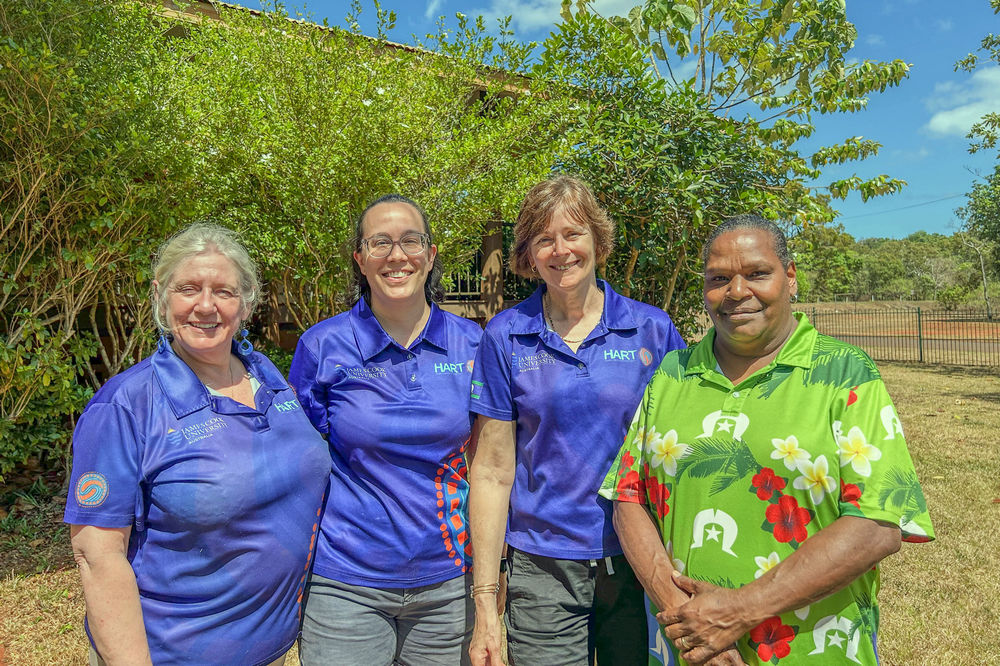
The AITHM’s Associate Professor Sarah Russell, Dr Rachel Quigley, and their colleagues from the Healthy Ageing Research Team (HART) know that healthy ageing is important everywhere, but how to age well may be different in different parts of Australia.
“In 2020, we received a $1.1 million grant from the National Health and Medical Research Council (NHMRC), which allowed us to develop a Framework for Healthy Ageing in the Torres Strait,” Associate Professor Russell said.
“As part of the five-year project, we yarned with local people from four island and five Northern Peninsula Area communities to hear what healthy ageing means to them,” Dr Quigley said. The researchers found that healthy ageing in the community took a holistic, whole community approach.
“Maintaining a strong Torres Strait identity, practicing culture and traditions, and passing on knowledge and wisdom were seen as very important. But so was balancing physical, mental, cultural, and spiritual domains, and having strong community leadership,” Dr Quigley said.
After finalising the healthy ageing project earlier this year, HART is now embarking on their next big project, which goes one step further — from healthy ageing in general, to active dementia prevention. The $950,000 two-year Medical Research Future Fund (MRFF) Indigenous Health Research Fund project aims to develop a community-led model of care for mild cognitive impairment (MCI) in the Torres Strait.
“Mild cognitive impairment is often the transitional stage between healthy ageing and dementia. Of those with MCI, around 15-20 per cent will develop dementia each year,” Associate Professor Russell said. Around 45 per cent of the risk of dementia is potentially modifiable and lifestyle-related. HART is trying to leverage this knowledge by co-designing a program to address these risk factors in people who are starting to show symptoms.
“International research has shown that multi-domain programs show promising results for people with mild cognitive impairment. These programs typically incorporate a healthy diet, exercise, cognitive stimulation, social engagement and health education,” Associate Professor Russell said.
The team is planning to tailor a similar multi-domain program to the needs of people living in the Torres Strait and Northern Peninsula Area. “It might be that the activity part, instead of going to the gym three times a week, is replaced by some island dancing. As to the social component, there might be intergenerational activities where the older people are talking to younger people,” Associate Professor Russell said. “It’s what I've been wanting to do since we started HART almost 15 or so years ago.”
Ms Chenoa Wapau will coordinate the program on Thursday Island, Ms Moira Mau will coordinate the Bamaga program, and PhD candidate Dr Rhiann Sue See, who is a descendant of the Waanyi people from the Gulf of Carpentaria region and a qualified geriatrician, will lead the program.
“We have completed phase one of the project, which is to yarn with the communities about their priorities to address the risk factors for MCI and dementia,” Associate Professor Russell said. “We are now co-designing the program informed by these findings and the broader evidence base.”
Once finalised the program will run over 12 months followed by an evaluation. “If this is successful, we would like to see this program embedded into healthcare, so it can be rolled out to all communities across the region,” she said.
“Our goal is to delay the onset of dementia, and through close collaboration with the community, we aim to give everyone the tools to live independent and fulfilling lives for as long as possible.”