
Australian Institute of Tropical Health and Medicine Our impact AITHM Stories Beyond gut instinct: Uncovering what fuels bowel cancer
Beyond gut instinct: Uncovering what fuels bowel cancer
- MRCMHR
- Future Students
- JCU Global Experience
- International Students
- Student experience
- Open Day
- How to apply
- Pathways to university
- Living on Campus
- Courses
- Publications
- Mature students
- Scholarships
- Entry options
- JCU Families
- JCU Heroes Programs
- Aboriginal and Torres Strait Islander in Marine Science
- Elite Athletes
- Defence
- Capability.Co
- AI@JCU
- AALL
- Current Students
- Student Ambassador Program
- New students
- JCU Orientation
- LearnJCU
- Placements
- EDQS
- Unicare Centre and Unicampus Kids
- Graduation
- Off-Campus Students
- JCU Job Ready
- Safety and Wellbeing
- JCU Prizes
- Professional Experience Placement
- Employability Edge
- Art of Academic Writing
- Art of Academic Editing
- Careers and Employability
- Health, Wellbeing and Belonging
- Career Ready Plan
- Careers at JCU
- Partners and Community
- School Outreach and Widening Participation
- Alumni
- International partnerships
- About JCU
- Reputation and Experience
- Chancellery
- Governance
- Celebrating 50 Years
- Academy
- Indigenous Engagement
- Education Division
- Research Festival
- Graduate Research School
- Research Division
- Research and Innovation Services
- CASE
- College of Business, Law and Governance
- College of Healthcare Sciences
- College of Medicine and Dentistry
- College of Science and Engineering
- MPE
- Anthropological Laboratory for Tropical Audiovisual Research (ALTAR)
- Rural Remote and Tropical Health Systems
- Agriculture Technology and Adoption Centre (AgTAC)
- Advanced Analytical Centre
- Australian Institute of Tropical Health and Medicine
- AMHHEC
- Aquaculture Solutions
- AMHRA
- JCU Digital Wellbeing Group
- ARCSTA
- Lions Marine Research Trust
- Australian Tropical Herbarium
- Australian Quantum & Classical Transport Physics Group
- Boating and Diving
- Clinical Psychedelic Research Lab
- Centre for Tropical Biosecurity
- Centre for Tropical Bioinformatics and Molecular Biology
- CITBA
- CMT
- Centre for Disaster Solutions
- CSTFA
- Cyclone Testing Station
- The Centre for Disaster Studies
- Daintree Rainforest Observatory
- Fletcherview
- JCU Eduquarium
- JCU Turtle Health Research
- MARFU
- Orpheus
- TESS
- JCU Ideas Lab
- CADSI
- CNL
- TARL
- eResearch
- Indigenous Education and Research Centre
- Past Course and Subject Handbooks
- Estate
- Work Health and Safety
- Staff
- Discover Nature at JCU
- Cyber Security Hub
- Association of Australian University Secretaries
- Services Division
- Environmental Research Complex [ERC]
- Foundation for Australian Literary Studies
- Gender Equity at JCU
- Give to JCU
- Indigenous Legal Needs Project
- Inherent Requirements
- IsoTropics Lab
- IT Services
- JCU Webinars
- JCU Events
- JCU Motorsports
- JCU Sport
- Library
- Mabo Decision: 30 years on
- Marine Geophysics Laboratory
- Office of the Vice Chancellor and President
- Outstanding Alumni
- Policy
- PAHL
- Queensland Research Centre for Peripheral Vascular Disease
- Rapid Assessment Unit
- RDIM
- Researcher Development Portal
- Roderick Centre for Australian Literature and Creative Writing
- Contextual Science for Tropical Coastal Ecosystems
- State of the Tropics
- Strategic Procurement
- Student profiles
- SWIRLnet
- TREAD
- TropEco for Staff and Students
- TropCOVID: Mapping COVID-19 Immunity in Far North Queensland
- TUDLab
- VAVS Home
- WHOCC for Vector-borne & NTDs
- Media
- Copyright and Terms of Use
- Australian Institute of Tropical Health & Medicine
- JCU Respect
- Pay review
- Research
15 January 2026
People living with long-term inflammation of the bowel, such as Crohn’s disease or ulcerative colitis, face a higher risk of developing bowel cancer. Researchers at AITHM are investigating the influence of age on gut health and whether specialised immune cells in the gut can help protect against cancer. Understanding these relationships could ultimately lead to treatments that delay, or even prevent, bowel cancer.
Bowel cancer (also known as colorectal cancer) was the fourth most commonly diagnosed cancer in Australia in 2024. While most cases occur in people over 50, rates among people in their 30s and 40s are steadily rising.
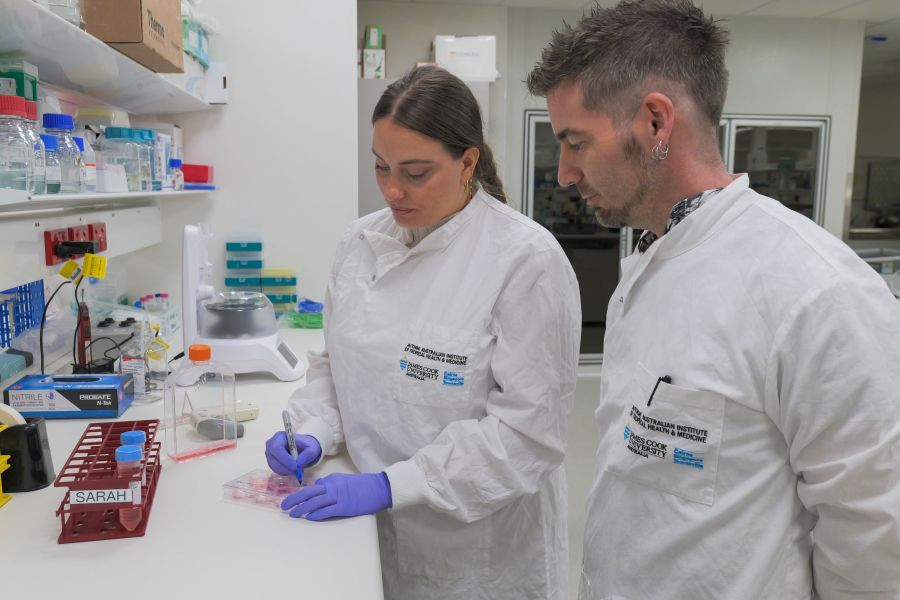
AITHM’s immunology group leader Dr Roland Ruscher and PhD candidate Sarah Gillert are exploring how the early life environment of the gut shapes protective immunity against bowel cancer in adults. “Our research focuses on beneficial immune cells in the gut, how they are established in early life and how they respond to changes in the intestinal microbiome,” Dr Ruscher said.
Everyone’s gut microbiome, which is a collection of microbes such as bacteria, viruses and fungi that live in and on many parts of the body, is unique. “A diverse and abundant community of beneficial microbes may help reduce the risk of developing colorectal cancer,” Ms Gillert explained. “In contrast, a dysbiosis — when important beneficial microorganisms are reduced and replaced by harmful microbes — can have lasting negative consequences.”
There are many factors that can contribute to a dysbiosis in the gut. “Nutrition, alcohol intake, medication such as antibiotics, ageing and a lack of exercise can all play a role,” Ms Gillert said. “There is research suggesting that people who receive antibiotics early in life may be more likely to develop bowel cancer years later, likely due to long-term effects of an altered microbiome.”
Ms Gillert’s research focuses on intraepithelial lymphocytes (IELs) –– specialised immune cells that subdivide into multiple subsets and reside within the epithelial gut lining and act as a rapid front-line defence. “Although IELs have been known for decades, the roles of specific IEL subsets in colorectal cancer remain understudied,” she said.
Using advanced preclinical experimental systems, Ms Gillert is examining how IEL subsets interact with colorectal cancer cells and whether they can limit tumour growth. Early findings by Ms Gillert show that IELs can directly reduce cancer cell survival in cell culture conditions, offering new clues about how these cells may protect the gut.
“We are also using so-called ‘fate mapping’ approaches to track IELs over time, revealing how they move into or around colorectal cancer tumours, and whether IELs formed in early life behave differently from those generated in adulthood,” Ms Gillert said.
The next stage of Ms Gillert’s and Dr Ruscher’s research will examine whether IELs derived from microbiologically diverse early-life environments are more effective at controlling tumour growth than IELs from microbially more restricted conditions.
Ultimately, the team aims to understand whether early-life immune development influences bowel cancer risk decades later. “By understanding how the protective IEL cells develop and function, we hope to identify ways to strengthen gut immunity and potentially even prevent bowel cancer in people in Australia and worldwide,” Dr Ruscher said.