
Australian Institute of Tropical Health and Medicine Our impact AITHM Stories Boosting the power of the tuberculosis vaccine
Boosting the power of the tuberculosis vaccine
- MRCMHR
- Future Students
- JCU Global Experience
- International Students
- Student experience
- Open Day
- How to apply
- Pathways to university
- Living on Campus
- Courses
- Publications
- Mature students
- Scholarships
- Entry options
- JCU Families
- JCU Heroes Programs
- Aboriginal and Torres Strait Islander in Marine Science
- Elite Athletes
- Defence
- Capability.Co
- AI@JCU
- AALL
- Current Students
- Student Ambassador Program
- New students
- JCU Orientation
- LearnJCU
- Placements
- EDQS
- Unicare Centre and Unicampus Kids
- Graduation
- Off-Campus Students
- JCU Job Ready
- Safety and Wellbeing
- JCU Prizes
- Professional Experience Placement
- Employability Edge
- Art of Academic Writing
- Art of Academic Editing
- Careers and Employability
- Health, Wellbeing and Belonging
- Career Ready Plan
- Careers at JCU
- Partners and Community
- School Outreach and Widening Participation
- Alumni
- International partnerships
- About JCU
- Reputation and Experience
- Chancellery
- Governance
- Celebrating 50 Years
- Academy
- Indigenous Engagement
- Education Division
- Research Festival
- Graduate Research School
- Research Division
- Research and Innovation Services
- CASE
- College of Business, Law and Governance
- College of Healthcare Sciences
- College of Medicine and Dentistry
- College of Science and Engineering
- MPE
- Anthropological Laboratory for Tropical Audiovisual Research (ALTAR)
- Rural Remote and Tropical Health Systems
- Agriculture Technology and Adoption Centre (AgTAC)
- Advanced Analytical Centre
- Australian Institute of Tropical Health and Medicine
- AMHHEC
- Aquaculture Solutions
- AMHRA
- JCU Digital Wellbeing Group
- ARCSTA
- Lions Marine Research Trust
- Australian Tropical Herbarium
- Australian Quantum & Classical Transport Physics Group
- Boating and Diving
- Clinical Psychedelic Research Lab
- Centre for Tropical Biosecurity
- Centre for Tropical Bioinformatics and Molecular Biology
- CITBA
- CMT
- Centre for Disaster Solutions
- CSTFA
- Cyclone Testing Station
- The Centre for Disaster Studies
- Daintree Rainforest Observatory
- Fletcherview
- JCU Eduquarium
- JCU Turtle Health Research
- MARFU
- Orpheus
- TESS
- JCU Ideas Lab
- CADSI
- CNL
- TARL
- eResearch
- Indigenous Education and Research Centre
- Past Course and Subject Handbooks
- Estate
- Work Health and Safety
- Staff
- Discover Nature at JCU
- Cyber Security Hub
- Association of Australian University Secretaries
- Services Division
- Environmental Research Complex [ERC]
- Foundation for Australian Literary Studies
- Gender Equity at JCU
- Give to JCU
- Indigenous Legal Needs Project
- Inherent Requirements
- IsoTropics Lab
- IT Services
- JCU Webinars
- JCU Events
- JCU Motorsports
- JCU Sport
- Library
- Mabo Decision: 30 years on
- Marine Geophysics Laboratory
- Office of the Vice Chancellor and President
- Outstanding Alumni
- Policy
- PAHL
- Queensland Research Centre for Peripheral Vascular Disease
- Rapid Assessment Unit
- RDIM
- Researcher Development Portal
- Roderick Centre for Australian Literature and Creative Writing
- Contextual Science for Tropical Coastal Ecosystems
- State of the Tropics
- Strategic Procurement
- Student profiles
- SWIRLnet
- TREAD
- TropEco for Staff and Students
- TropCOVID: Mapping COVID-19 Immunity in Far North Queensland
- TUDLab
- VAVS Home
- WHOCC for Vector-borne & NTDs
- Media
- Copyright and Terms of Use
- Australian Institute of Tropical Health & Medicine
- JCU Respect
- Pay review
- Research
22 January 2025
The BCG vaccine (Bacillus Calmette-Guerin) has been the only available tuberculosis vaccine for more than a hundred years. AITHM’s Dr Guangzu Zhao and Associate Professor Andreas Kupz are now working on a new type of vaccine that aims to boost the power of BCG, as BCG currently only protects children, but has limited efficacy against tuberculosis in adults.
“Australia has limited tuberculosis cases. Predominantly, because of our high living standards, good nutrition and small household sizes,” Associate Professor Andreas Kupz said. “But the situation is quite different when it comes to Australia’s nearest neighbours, Papua New Guinea (PNG) and Indonesia. These countries have some of the highest numbers of tuberculosis cases in the world.”
Vaccinating children in less developed areas of these countries can be a difficult task, as the BCG vaccine has to be constantly refrigerated between 2°C and 8°C and needs to be kept away from sunlight. This can be difficult when no permanent power supply is available. However, for now, there are no alternatives to BCG.
“Tuberculosis is a complex disease, and we don't seem to be able to find a vaccine that is better than BCG,” Associate Professor Kupz said. “Researchers have looked into the three possible vaccine types: the first one would be a preventative vaccine, that is, a replacement for BCG. The second type is a therapeutic vaccine, something that you would give to someone who already has tuberculosis.
“Our team is now working on the third type, on what we call a booster vaccine. For now, we think the best strategy is to make BCG even better by boosting the immune response BCG already elicits.”
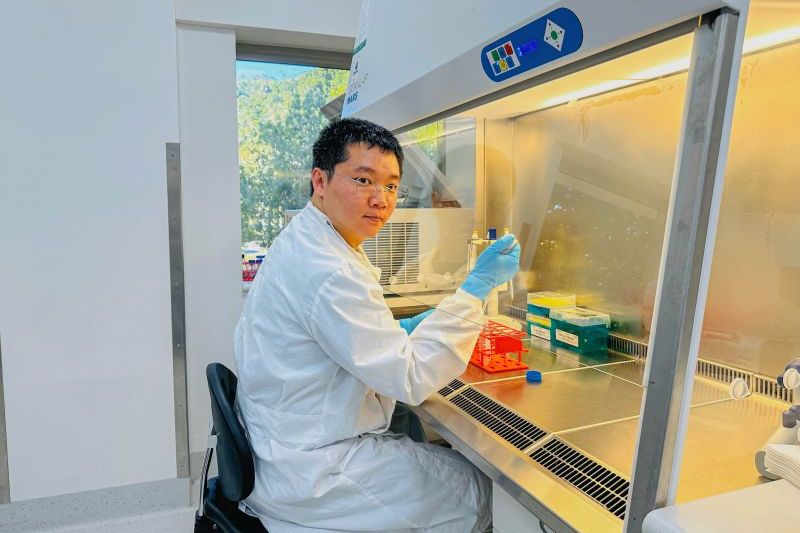
The booster project team is led by Associate Professor Kupz and Dr Guangzu Zhao. “I was brought on board for my specific expertise; Associate Professor Kupz, for example, is an immunologist, and I am a biochemist,” Dr Zhao said.
“Before I started working on this project three years ago, I had worked on a peptide-based vaccine against Group A streptococcus (GAS),” Dr Zhao said. “GAS is responsible for a variety of mild infections as well as for life-threatening autoimmune diseases, such as rheumatic fever and rheumatic heart disease.”
Now Dr Zhao is using the same technique in the fight against tuberculosis. “Peptides and peptide epitopes are the basis of our booster. Peptides are small pieces of proteins, whereas peptide epitopes are a certain fragment of protein that are recognized by the immune system,” Dr Zhao said.
“Peptides alone are not able to induce a strong enough immune response. This is why our strategy is to prepare a vaccine using peptide epitopes and other peptide moieties (fragments),” Dr Zhao said. “When mixed into water, for example, our peptide vaccine can self-assemble spontaneously into nanoparticles. Nanoparticles are so small, they can only be seen in an electron microscope. This is why we are also calling our booster a ‘nanovaccine’,” Dr Zhao said.
“The strength of our booster nanovaccine is its simplicity,” Dr Zhao said. “Another advantage is that it is cold-chain independent. It doesn't have to be stored in a fridge or a freezer, it can be stored at room temperature.”
“At the same time, it’s flexible, it's a bit like a Lego system. Our nanovaccine is composed of six peptides, and each of the six peptides is one building block,” Associate Professor Kupz said. “Depending on the population you are treating, the six peptides might be enough, or we may need a modified selection, or potentially include other peptides.”
The AITHM’s nanovaccine was recently selected for a global head-to-head comparison by the Tuberculosis Vaccine Initiative (TBVI). TBVI supports the development of new, safe and effective tuberculosis vaccines that are accessible and affordable for all people.
“Our booster is one of six candidates that were accepted in late 2024. TBVI will use an independent lab to compare all six vaccine candidates,” Associate Professor Kupz said. “In our own trials, we have seen a good immune response, and we are confident that our nanovaccine will do very well in the TBVI trials as well.”
If successful, the AITHM team’s booster could become a game changer in the global fight against tuberculosis, offering new hope to millions of people worldwide.