
Australian Institute of Tropical Health and Medicine Our impact AITHM Stories Creepy crawly cuisine
Creepy crawly cuisine
- MRCMHR
- Future Students
- JCU Global Experience
- International Students
- Student experience
- Open Day
- How to apply
- Pathways to university
- Living on Campus
- Courses
- Publications
- Mature students
- Scholarships
- Entry options
- JCU Families
- JCU Heroes Programs
- Aboriginal and Torres Strait Islander in Marine Science
- Elite Athletes
- Defence
- Capability.Co
- AI@JCU
- AALL
- Current Students
- Student Ambassador Program
- New students
- JCU Orientation
- LearnJCU
- Placements
- EDQS
- Unicare Centre and Unicampus Kids
- Graduation
- Off-Campus Students
- JCU Job Ready
- Safety and Wellbeing
- JCU Prizes
- Professional Experience Placement
- Employability Edge
- Art of Academic Writing
- Art of Academic Editing
- Careers and Employability
- Health, Wellbeing and Belonging
- Career Ready Plan
- Careers at JCU
- Partners and Community
- School Outreach and Widening Participation
- Alumni
- International partnerships
- About JCU
- Reputation and Experience
- Chancellery
- Governance
- Celebrating 50 Years
- Academy
- Indigenous Engagement
- Education Division
- Research Festival
- Graduate Research School
- Research Division
- Research and Innovation Services
- CASE
- College of Business, Law and Governance
- College of Healthcare Sciences
- College of Medicine and Dentistry
- College of Science and Engineering
- MPE
- Anthropological Laboratory for Tropical Audiovisual Research (ALTAR)
- Rural Remote and Tropical Health Systems
- Agriculture Technology and Adoption Centre (AgTAC)
- Advanced Analytical Centre
- Australian Institute of Tropical Health and Medicine
- AMHHEC
- Aquaculture Solutions
- AMHRA
- JCU Digital Wellbeing Group
- ARCSTA
- Lions Marine Research Trust
- Australian Tropical Herbarium
- Australian Quantum & Classical Transport Physics Group
- Boating and Diving
- Clinical Psychedelic Research Lab
- Centre for Tropical Biosecurity
- Centre for Tropical Bioinformatics and Molecular Biology
- CITBA
- CMT
- Centre for Disaster Solutions
- CSTFA
- Cyclone Testing Station
- The Centre for Disaster Studies
- Daintree Rainforest Observatory
- Fletcherview
- JCU Eduquarium
- JCU Turtle Health Research
- MARFU
- Orpheus
- TESS
- JCU Ideas Lab
- CADSI
- CNL
- TARL
- eResearch
- Indigenous Education and Research Centre
- Past Course and Subject Handbooks
- Estate
- Work Health and Safety
- Staff
- Discover Nature at JCU
- Cyber Security Hub
- Association of Australian University Secretaries
- Services Division
- Environmental Research Complex [ERC]
- Foundation for Australian Literary Studies
- Gender Equity at JCU
- Give to JCU
- Indigenous Legal Needs Project
- Inherent Requirements
- IsoTropics Lab
- IT Services
- JCU Webinars
- JCU Events
- JCU Motorsports
- JCU Sport
- Library
- Mabo Decision: 30 years on
- Marine Geophysics Laboratory
- Office of the Vice Chancellor and President
- Outstanding Alumni
- Policy
- PAHL
- Queensland Research Centre for Peripheral Vascular Disease
- Rapid Assessment Unit
- RDIM
- Researcher Development Portal
- Roderick Centre for Australian Literature and Creative Writing
- Contextual Science for Tropical Coastal Ecosystems
- State of the Tropics
- Strategic Procurement
- Student profiles
- SWIRLnet
- TREAD
- TropEco for Staff and Students
- TropCOVID: Mapping COVID-19 Immunity in Far North Queensland
- TUDLab
- VAVS Home
- WHOCC for Vector-borne & NTDs
- Media
- Copyright and Terms of Use
- Australian Institute of Tropical Health & Medicine
- JCU Respect
- Pay review
- Research
23 July 2025
From gardens to grocery aisles, edible insects are gaining popularity as a sustainable food source in the face of rising global demand. But could these protein-packed critters trigger unexpected allergic reactions?
Researchers from the Australian Institute of Tropical Health and Medicine (AITHM) and James Cook University’s Tropical Futures Institute (TFI) investigated the allergenic potential of two approved edible insects: the house cricket (Acheta domesticus) and black soldier fly larvae (Hermetia illucens).
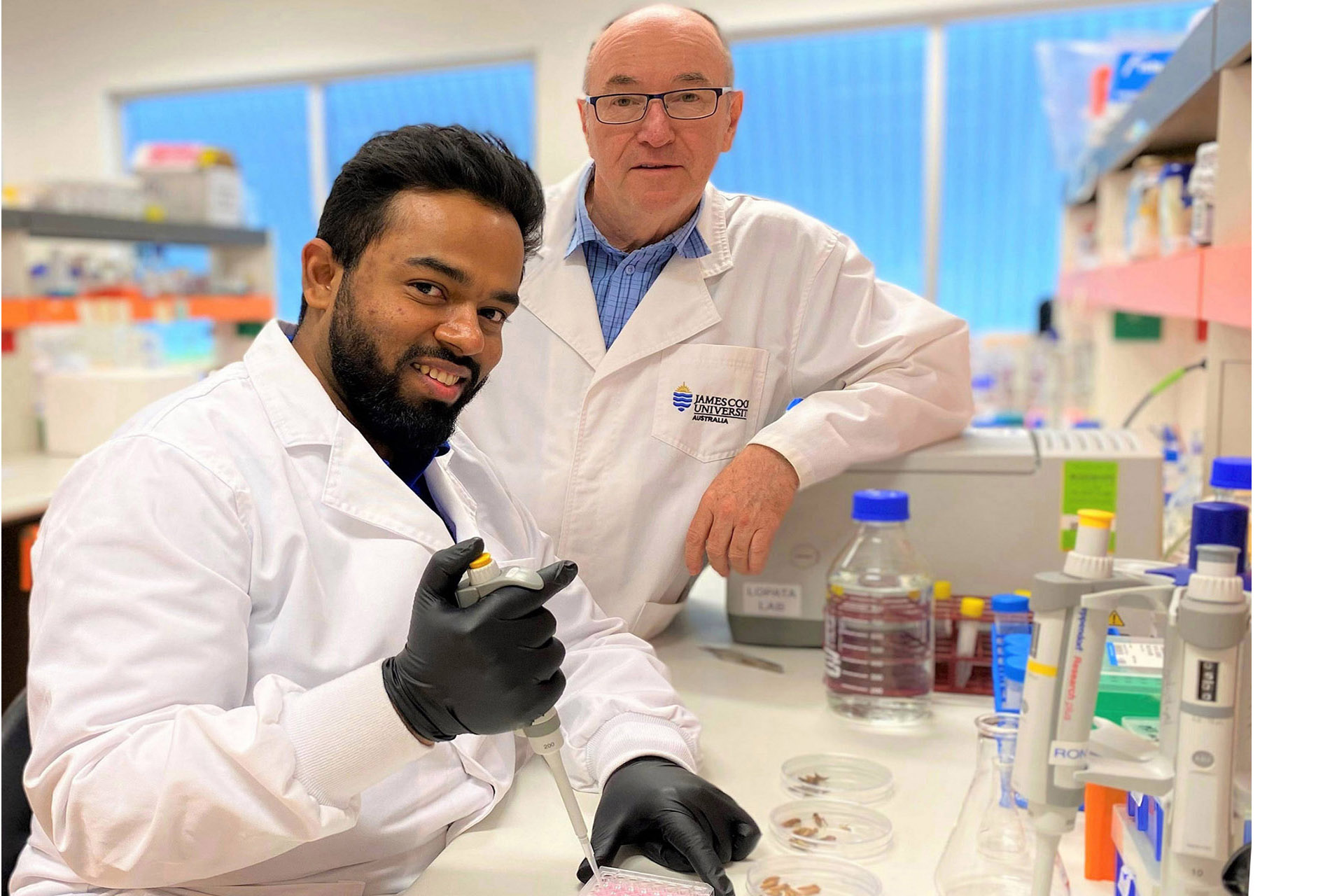
To do this, Dr Shay Karnaneedi and Professor Andreas Lopata extracted proteins from commercial insect-based food products.
“Edible insects have been consumed for centuries in parts of Asia, Africa and South America. Now they’re being introduced into mainstream markets in Western countries, but there is still a lot of stigma — and limited understanding of how they affect people with existing food allergies,” Professor Lopata said.
“Insects are biologically related to crustaceans such as prawns and crabs, and crustacean allergy affects up to 4% of the population. This means people with shellfish allergies could be at risk of reacting to insect-based foods as well.”
Currently, there are no food allergen detection methods for edible insects. Thus, existing testing relies on kits developed to detect crustacean allergens.
“We found that tropomyosin, the primary allergen in shellfish, was one of the most abundant proteins in cricket samples,” Dr Karnaneedi said. “Interestingly, it wasn’t as abundant in the black soldier fly larvae, which may be due to differences in life stage, with one being larvae and the other a fully developed insect.”
However, the research did discover another shellfish allergen, hemocyanin, at high levels in the black soldier fly larvae. Both proteins were shown to react with antibodies from people allergic to shellfish, confirming their potential to cause cross-reactive allergic responses.
“We also found unique allergens in the insects, such as proteins that aren’t known crustacean allergens. These proteins triggered a response from the immune system in people with crustacean allergy,” Dr Karnaneedi said. “This suggests there may be other insect proteins that could pose a risk to those individuals. Current testing and labelling, which focuses only on known shellfish allergens, might miss these proteins.”
The researchers also analysed two commercial crustacean allergen test kits to assess their effectiveness in detecting allergens in insect-based food products.
“Some of the test kits we looked at identified the allergens in moderate to high numbers, while others picked up no allergens at all,” Dr Karnaneedi said. “This is a problem. If these food allergen test kits are not reliably identifying allergenic proteins, then food allergen labelling may not provide the necessary information for people with allergies.”
In Australia, crustaceans are the number one cause of fatal anaphylaxis from food. There is no treatment or cure, so the only way to prevent a reaction is to avoid the allergenic foods.
“As insect-based foods become more common, we need better diagnostic tools to assess their safety for consumers,” Professor Lopata said. “Insects are a nutritious and sustainable food source, and we want to ensure people can make informed decisions and stay safe.”