
Australian Institute of Tropical Health and Medicine Our impact AITHM Stories Hookworms: Unlikely heroes in the fight against autoimmune diseases
Hookworms: Unlikely heroes in the fight against autoimmune diseases
- MRCMHR
- Future Students
- JCU Global Experience
- International Students
- Student experience
- Open Day
- How to apply
- Pathways to university
- Living on Campus
- Courses
- Publications
- Mature students
- Scholarships
- Entry options
- JCU Families
- JCU Heroes Programs
- Aboriginal and Torres Strait Islander in Marine Science
- Elite Athletes
- Defence
- Capability.Co
- AI@JCU
- AALL
- Current Students
- Student Ambassador Program
- New students
- JCU Orientation
- LearnJCU
- Placements
- EDQS
- Unicare Centre and Unicampus Kids
- Graduation
- Off-Campus Students
- JCU Job Ready
- Safety and Wellbeing
- JCU Prizes
- Professional Experience Placement
- Employability Edge
- Art of Academic Writing
- Art of Academic Editing
- Careers and Employability
- Health, Wellbeing and Belonging
- Career Ready Plan
- Careers at JCU
- Partners and Community
- School Outreach and Widening Participation
- Alumni
- International partnerships
- About JCU
- Reputation and Experience
- Chancellery
- Governance
- Celebrating 50 Years
- Academy
- Indigenous Engagement
- Education Division
- Research Festival
- Graduate Research School
- Research Division
- Research and Innovation Services
- CASE
- College of Business, Law and Governance
- College of Healthcare Sciences
- College of Medicine and Dentistry
- College of Science and Engineering
- MPE
- Anthropological Laboratory for Tropical Audiovisual Research (ALTAR)
- Rural Remote and Tropical Health Systems
- Agriculture Technology and Adoption Centre (AgTAC)
- Advanced Analytical Centre
- Australian Institute of Tropical Health and Medicine
- AMHHEC
- Aquaculture Solutions
- AMHRA
- JCU Digital Wellbeing Group
- ARCSTA
- Lions Marine Research Trust
- Australian Tropical Herbarium
- Australian Quantum & Classical Transport Physics Group
- Boating and Diving
- Clinical Psychedelic Research Lab
- Centre for Tropical Biosecurity
- Centre for Tropical Bioinformatics and Molecular Biology
- CITBA
- CMT
- Centre for Disaster Solutions
- CSTFA
- Cyclone Testing Station
- The Centre for Disaster Studies
- Daintree Rainforest Observatory
- Fletcherview
- JCU Eduquarium
- JCU Turtle Health Research
- MARFU
- Orpheus
- TESS
- JCU Ideas Lab
- CADSI
- CNL
- TARL
- eResearch
- Indigenous Education and Research Centre
- Past Course and Subject Handbooks
- Estate
- Work Health and Safety
- Staff
- Discover Nature at JCU
- Cyber Security Hub
- Association of Australian University Secretaries
- Services Division
- Environmental Research Complex [ERC]
- Foundation for Australian Literary Studies
- Gender Equity at JCU
- Give to JCU
- Indigenous Legal Needs Project
- Inherent Requirements
- IsoTropics Lab
- IT Services
- JCU Webinars
- JCU Events
- JCU Motorsports
- JCU Sport
- Library
- Mabo Decision: 30 years on
- Marine Geophysics Laboratory
- Office of the Vice Chancellor and President
- Outstanding Alumni
- Policy
- PAHL
- Queensland Research Centre for Peripheral Vascular Disease
- Rapid Assessment Unit
- RDIM
- Researcher Development Portal
- Roderick Centre for Australian Literature and Creative Writing
- Contextual Science for Tropical Coastal Ecosystems
- State of the Tropics
- Strategic Procurement
- Student profiles
- SWIRLnet
- TREAD
- TropEco for Staff and Students
- TropCOVID: Mapping COVID-19 Immunity in Far North Queensland
- TUDLab
- VAVS Home
- WHOCC for Vector-borne & NTDs
- Media
- Copyright and Terms of Use
- Australian Institute of Tropical Health & Medicine
- JCU Respect
- Pay review
- Research
19 February 2025
For years, Distinguished Professor Alex Loukas from the Australian Institute of Tropical Health and Medicine (AITHM) has been hunting for a vaccine against hookworms, a parasitic infection that affects more than 740 million people worldwide. However, more recently, his research has found that these parasites might actually offer a benefit: certain proteins found in hookworm saliva could be used to treat inflammatory bowel disease (IBD) and other autoimmune diseases.
Hookworms are small parasitic worms that live in the soil in countries with a warm and humid climate. Hookworm larvae can break through human skin, and, attached to the walls of the small intestine of dogs, cats and humans, they can survive for years.
Many people who have been infected are feeding millions of hookworms, which leaves them permanently fatigued due to the constant blood loss. “The disease can be treated, but people can be quickly reinfected, sometimes within four to six months,” Professor Loukas said. “This is why it’s important that we find a vaccine.”
However, there is also a positive side to the human-hookworm connection. “Hookworms are really potent at regulating and suppressing inflammation. They are doing this to protect their own existence and hide from our immune system,” Professor Loukas said. “We are now trying to harness that phenomenon and develop an entirely novel approach inspired by nature to treating autoimmune diseases such as IBD.”
Professor Loukas’ colleague at James Cook University (JCU), Dr Paul Giacomin, led a clinical trial where people with metabolic syndrome (precursor to type 2 diabetes) were infected with up to 40 hookworms. Trial volunteers reported a better quality of life and improved insulin sensitivity compared to placebos who did not receive a worm infection.
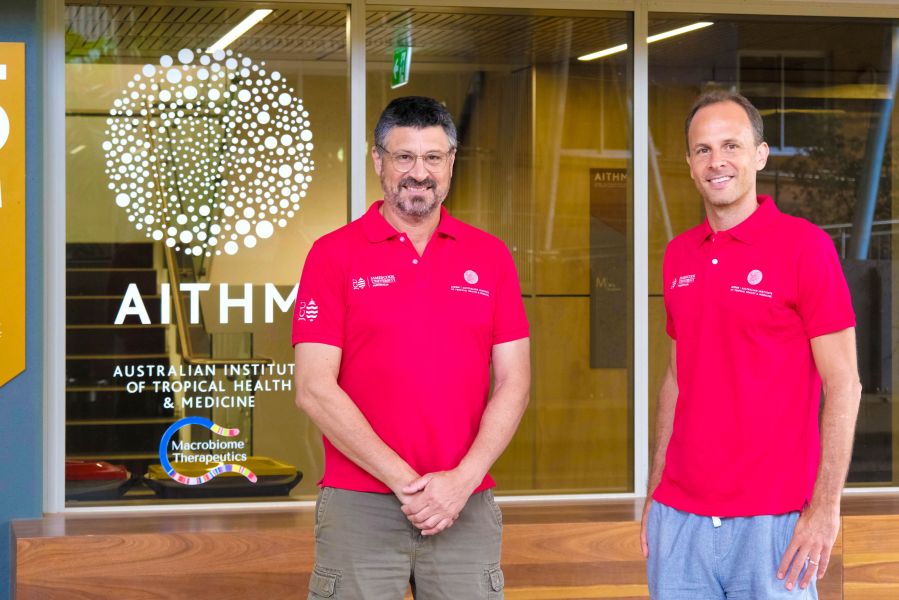
Some volunteers have been living in partnership with their small band of hookworms for years. But Professor Loukas knows that not everyone enjoys the thought of permanently hosting hookworms in their gut. This is why he and Dr Giacomin are using their knowledge about hookworm proteins to develop novel medications via their startup biotech company, Macrobiome Therapeutics Pty Ltd.
“Our research has found that a single protein from our hookworms can prevent the onset of IBD and other inflammatory conditions such as rheumatoid arthritis,” Professor Loukas said.
“We've got a handful of hookworm molecules that we engineer in the laboratory. They have all the right drug-like properties, and that is the reason we formed our company. We have selected two lead candidate molecules, and we're in the phase now that we would refer to as pre-clinical development.
“We have to create a version of our molecules to make them stay in the blood stream for longer,” Professor Loukas said. “We're currently trying to raise funding for this program. If that's successful, we go into clinical development to turn the molecules into a finished product. This is probably going to be a weekly or monthly injection, similar to the diabetes drug Ozempic.”
A vaccine against hookworms is also still on Professor Loukas’ agenda. “We are part of an EU-funded program that is developing vaccines for hookworm and blood fluke, with collaborators in the Netherlands, United Kingdom, Switzerland, Italy and Spain. By working in collaboration with researchers from around the world, we have a better chance of finally developing a vaccine that stops people from getting reinfected.”