
Australian Institute of Tropical Health and Medicine Our impact AITHM Stories Making home a safer place
Making home a safer place
- MRCMHR
- Future Students
- JCU Global Experience
- International Students
- Student experience
- Open Day
- How to apply
- Pathways to university
- Living on Campus
- Courses
- Publications
- Mature students
- Scholarships
- Entry options
- JCU Families
- JCU Heroes Programs
- Aboriginal and Torres Strait Islander in Marine Science
- Elite Athletes
- Defence
- Capability.Co
- AI@JCU
- AALL
- Current Students
- Student Ambassador Program
- New students
- JCU Orientation
- LearnJCU
- Placements
- EDQS
- Unicare Centre and Unicampus Kids
- Graduation
- Off-Campus Students
- JCU Job Ready
- Safety and Wellbeing
- JCU Prizes
- Professional Experience Placement
- Employability Edge
- Art of Academic Writing
- Art of Academic Editing
- Careers and Employability
- Health, Wellbeing and Belonging
- Career Ready Plan
- Careers at JCU
- Partners and Community
- School Outreach and Widening Participation
- Alumni
- International partnerships
- About JCU
- Reputation and Experience
- Chancellery
- Governance
- Celebrating 50 Years
- Academy
- Indigenous Engagement
- Education Division
- Research Festival
- Graduate Research School
- Research Division
- Research and Innovation Services
- CASE
- College of Business, Law and Governance
- College of Healthcare Sciences
- College of Medicine and Dentistry
- College of Science and Engineering
- MPE
- Anthropological Laboratory for Tropical Audiovisual Research (ALTAR)
- Rural Remote and Tropical Health Systems
- Agriculture Technology and Adoption Centre (AgTAC)
- Advanced Analytical Centre
- Australian Institute of Tropical Health and Medicine
- AMHHEC
- Aquaculture Solutions
- AMHRA
- JCU Digital Wellbeing Group
- ARCSTA
- Lions Marine Research Trust
- Australian Tropical Herbarium
- Australian Quantum & Classical Transport Physics Group
- Boating and Diving
- Clinical Psychedelic Research Lab
- Centre for Tropical Biosecurity
- Centre for Tropical Bioinformatics and Molecular Biology
- CITBA
- CMT
- Centre for Disaster Solutions
- CSTFA
- Cyclone Testing Station
- The Centre for Disaster Studies
- Daintree Rainforest Observatory
- Fletcherview
- JCU Eduquarium
- JCU Turtle Health Research
- MARFU
- Orpheus
- TESS
- JCU Ideas Lab
- CADSI
- CNL
- TARL
- eResearch
- Indigenous Education and Research Centre
- Past Course and Subject Handbooks
- Estate
- Work Health and Safety
- Staff
- Discover Nature at JCU
- Cyber Security Hub
- Association of Australian University Secretaries
- Services Division
- Environmental Research Complex [ERC]
- Foundation for Australian Literary Studies
- Gender Equity at JCU
- Give to JCU
- Indigenous Legal Needs Project
- Inherent Requirements
- IsoTropics Lab
- IT Services
- JCU Webinars
- JCU Events
- JCU Motorsports
- JCU Sport
- Library
- Mabo Decision: 30 years on
- Marine Geophysics Laboratory
- Office of the Vice Chancellor and President
- Outstanding Alumni
- Policy
- PAHL
- Queensland Research Centre for Peripheral Vascular Disease
- Rapid Assessment Unit
- RDIM
- Researcher Development Portal
- Roderick Centre for Australian Literature and Creative Writing
- Contextual Science for Tropical Coastal Ecosystems
- State of the Tropics
- Strategic Procurement
- Student profiles
- SWIRLnet
- TREAD
- TropEco for Staff and Students
- TropCOVID: Mapping COVID-19 Immunity in Far North Queensland
- TUDLab
- VAVS Home
- WHOCC for Vector-borne & NTDs
- Media
- Copyright and Terms of Use
- Australian Institute of Tropical Health & Medicine
- JCU Respect
- Pay review
- Research
04 December 2024
Malaria is a life-threatening disease that is spread to humans through the bite of infected mosquitoes. In 2022, it affected more than 249 million people around the globe — including Australia’s closest neighbour, Papua New Guinea (PNG). New research from the Australian Institute of Tropical Health and Medicine (AITHM) indicates that people could be better protected from mosquito bites by using a method that dates back to World War II, but with a 21st century twist.
Malaria is primarily found in countries with a tropical climate, where people generally rely on the protection of mosquito nets that are treated with an insecticide. However, this leaves people vulnerable to bites when outside the nets.
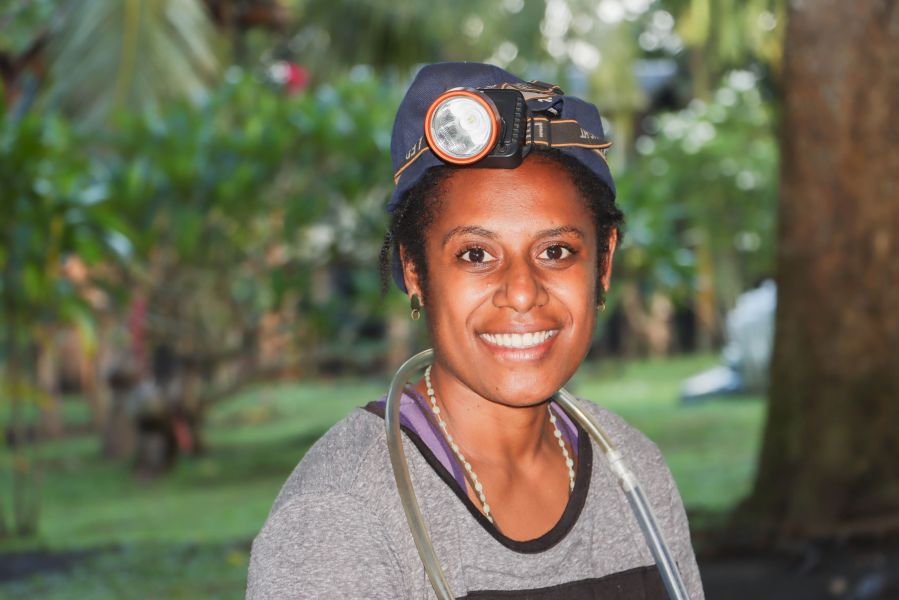
PhD candidate Ms Rebecca Vinit from the PNG Institute of Medical Research, with her advisor Associate Professor Stephan Karl from the Australian Institute of Tropical Health and Medicine (AITHM), is examining if indoor residual spraying (IRS) significantly reduces the number of malaria cases in PNG.
IRS involves spraying walls and other surfaces of the house with an insecticide. The insecticide will kill mosquitos that land on these treated surfaces, and typically lasts for several months.
“IRS is not new to PNG; it was first used back in the 1930s and during World War II,” Ms Vinit said. “After it became known that Australian soldiers were killed faster by malaria than in combat, indoor residual spraying proved to be very efficient in reducing the number of infections during the 1960s. But after PNG became independent in 1975, the program was abandoned.”
Some insecticides that were used then were harmful to not just mosquitoes but also other animals. This is why in her research, Ms Vinit is using products that only affect mosquitos. “We call it ‘residual spraying’ because it involves a small but potent quantity,” she said. “It's enough to knock out a mosquito without having a negative effect on other animals or humans.”
There are several mosquito species that can transmit malaria in PNG, and they may respond differently to insecticides, but the actual mosquito population in a place depends on a variety of biological factors, such as how close to the coast a village is located.
Four villages along the North Coast of Madang Province in PNG participated in Ms Vinit’s study: two located on the coast and two about five kilometres inland.
“In 2021, we initially sprayed two villages to assess the impact of indoor residual spraying. This was followed by monthly surveys before and after, as we wanted to find out how long the insecticide was effective,” Ms Vinit said.
“In phase two, we sprayed all four villages and conducted two assessments to measure the effectiveness of the insecticide at three months and six months,” she said. All in all, Ms Vinit’s team sprayed around 330 homes in phase one.
“We have a hypothesis that indoor residual spraying is having a positive impact in our two inland villages, but in the coastal areas, where mosquitoes are more of a nuisance, it may be less effective,” Ms Vinit said. However, the analysis is still in progress, and Ms Vinit says it’s too early to provide any recommendations.
After Ms Vinit’s research project is finished in 2026, indoor residual spraying may become a part of PNG’s national malaria control program to complement the current program of insecticide treated bednets. “Indoor residual spraying is an expensive intervention for the government,” Ms Vinit said. “This is why I’m looking for an effective and efficient way to implement this only in places where indoor spraying can actually make a difference.”