
Australian Institute of Tropical Health and Medicine Our impact AITHM Stories Mapping care across North Queensland
Mapping care across North Queensland
- MRCMHR
- Future Students
- JCU Global Experience
- International Students
- Student experience
- Open Day
- How to apply
- Pathways to university
- Living on Campus
- Courses
- Publications
- Mature students
- Scholarships
- Entry options
- JCU Families
- JCU Heroes Programs
- Aboriginal and Torres Strait Islander in Marine Science
- Elite Athletes
- Defence
- Capability.Co
- AI@JCU
- AALL
- Current Students
- Student Ambassador Program
- New students
- JCU Orientation
- LearnJCU
- Placements
- EDQS
- Unicare Centre and Unicampus Kids
- Graduation
- Off-Campus Students
- JCU Job Ready
- Safety and Wellbeing
- JCU Prizes
- Professional Experience Placement
- Employability Edge
- Art of Academic Writing
- Art of Academic Editing
- Careers and Employability
- Health, Wellbeing and Belonging
- Career Ready Plan
- Careers at JCU
- Partners and Community
- School Outreach and Widening Participation
- Alumni
- International partnerships
- About JCU
- Reputation and Experience
- Chancellery
- Governance
- Celebrating 50 Years
- Academy
- Indigenous Engagement
- Education Division
- Research Festival
- Graduate Research School
- Research Division
- Research and Innovation Services
- CASE
- College of Business, Law and Governance
- College of Healthcare Sciences
- College of Medicine and Dentistry
- College of Science and Engineering
- MPE
- Anthropological Laboratory for Tropical Audiovisual Research (ALTAR)
- Rural Remote and Tropical Health Systems
- Agriculture Technology and Adoption Centre (AgTAC)
- Advanced Analytical Centre
- Australian Institute of Tropical Health and Medicine
- AMHHEC
- Aquaculture Solutions
- AMHRA
- JCU Digital Wellbeing Group
- ARCSTA
- Lions Marine Research Trust
- Australian Tropical Herbarium
- Australian Quantum & Classical Transport Physics Group
- Boating and Diving
- Clinical Psychedelic Research Lab
- Centre for Tropical Biosecurity
- Centre for Tropical Bioinformatics and Molecular Biology
- CITBA
- CMT
- Centre for Disaster Solutions
- CSTFA
- Cyclone Testing Station
- The Centre for Disaster Studies
- Daintree Rainforest Observatory
- Fletcherview
- JCU Eduquarium
- JCU Turtle Health Research
- MARFU
- Orpheus
- TESS
- JCU Ideas Lab
- CADSI
- CNL
- TARL
- eResearch
- Indigenous Education and Research Centre
- Past Course and Subject Handbooks
- Estate
- Work Health and Safety
- Staff
- Discover Nature at JCU
- Cyber Security Hub
- Association of Australian University Secretaries
- Services Division
- Environmental Research Complex [ERC]
- Foundation for Australian Literary Studies
- Gender Equity at JCU
- Give to JCU
- Indigenous Legal Needs Project
- Inherent Requirements
- IsoTropics Lab
- IT Services
- JCU Webinars
- JCU Events
- JCU Motorsports
- JCU Sport
- Library
- Mabo Decision: 30 years on
- Marine Geophysics Laboratory
- Office of the Vice Chancellor and President
- Outstanding Alumni
- Policy
- PAHL
- Queensland Research Centre for Peripheral Vascular Disease
- Rapid Assessment Unit
- RDIM
- Researcher Development Portal
- Roderick Centre for Australian Literature and Creative Writing
- Contextual Science for Tropical Coastal Ecosystems
- State of the Tropics
- Strategic Procurement
- Student profiles
- SWIRLnet
- TREAD
- TropEco for Staff and Students
- TropCOVID: Mapping COVID-19 Immunity in Far North Queensland
- TUDLab
- VAVS Home
- WHOCC for Vector-borne & NTDs
- Media
- Copyright and Terms of Use
- Australian Institute of Tropical Health & Medicine
- JCU Respect
- Pay review
- Research
05 October 2023
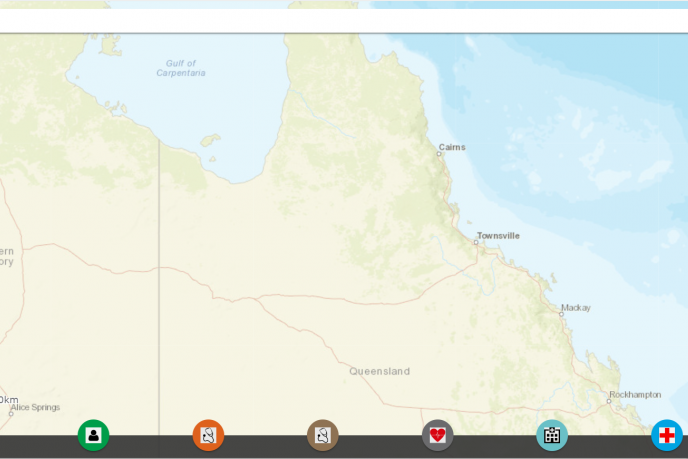
A JCU-led project has created a unique, interactive health map of North Queensland. The open-access resource provides a clearer picture of unmet community health needs, which have been exacerbated by crucial gaps in information sharing between multiple health systems in the region.
Launched in July 2022, the Northern Queensland Health Atlas is phase one of a million-dollar project, Integrating Health Care Planning for Health and Prosperity in North Queensland. The project aims to help healthcare providers, community advocates and health planners meet the varying needs of regional, rural and remote communities across five regions between Mackay and the Torres Strait.
According to the project’s lead investigator, Professor Sarah Larkins, a lack of coordination and targeted investment in planning and delivery of health services is leading to gaps and inefficiencies that are hampering health outcomes.
“Service providers and communities lack access to accurate information about community health and health service data, including the numbers and types of visiting health services,” Professor Larkins said.
"There are multiple sources of health and health workforce data available. But these are not always publicly available for rural communities, and organisations count information differently. For example, some staffing figures consist of a head count, while others report numbers of actual full-time workers. In addition, the defined geographic boundaries within which data are reported varies.”
Funded by the Cooperative Research Centre for Developing Northern Australia and the Tropical Australian Academic Health Centre, the project brings together partners from across the health industry; in addition to hospital and health services, these include the North Queensland and Western Queensland Primary Health Networks, Queensland Aboriginal and Islander Health Council and Apunipima Cape York Health Council.
Despite this support, compiling the Atlas was no easy feat. Alongside co-researchers, Project Senior Research Officer and Data Manager, Dr Karen Johnston, trawled through more than 50 publicly available data collections, as well as numerous data sets within those collections, to map both healthcare needs and health service provision throughout the region.
The end result is a highly detailed online health map which can be utilised by both healthcare providers and the communities they serve for health service planning and advocacy. It includes data on population, health status and behaviours (such as smoking habits, obesity and chronic conditions), hospital utilisation, health workforce, health care provision and service locations.
The Atlas is interactive, enabling users to overlay the different types of data to bring individual community needs into sharper focus, and also compare them with other communities.
“It can provide evidence of demand for healthcare services within communities, which is important for health industry planners trying to ensure effective use of resources and also for communities lobbying for changes in services,” Dr Johnston said.
The Atlas, combined with a gap analysis of unmet health needs in the region, was pivotal to prioritising which communities to invite to take part in phase two of the project. Following further consultation, local health and community stakeholders in Clermont, Hughenden and Kowanyama agreed to participate in place-based health planning to co-design, implement and evaluate new models of care.
“These three communities were prioritised because they represent diversity in this region — agricultural, mining and an Aboriginal and Torres Strait Islander community — and were experiencing unmet health needs. Communities are all unique. We can maximise our project learnings by exploring the different ways they function. They were also keen to participate,” said project manager, Dr Deb Smith.
Phase two is already well advanced. Following a series of workshops for local health stakeholders and community members, the place-based planning process has been completed in Clermont and Hughenden, and implementation of prioritised action plans are now underway. The same process is due to begin soon in Kowanyama.
The Integrated Health Care Planning project will conclude in June 2024. However, the team has already compiled a Gap Analysis of Health Needs and Services Report and drafted guidelines: Process guidelines for participatory place-based health service co-design for health planning in north Queensland, to share their learnings to date.
They have also documented their research experiences in Democratising data to address health system inequities in Australia, which was published in BMJ Global Health on 17 May 2023.