
Australian Institute of Tropical Health and Medicine Our impact AITHM Stories Mapping the risk of Japanese encephalitis in Australia
Mapping the risk of Japanese encephalitis in Australia
- MRCMHR
- Future Students
- JCU Global Experience
- International Students
- Student experience
- Open Day
- How to apply
- Pathways to university
- Living on Campus
- Courses
- Publications
- Mature students
- Scholarships
- Entry options
- JCU Families
- JCU Heroes Programs
- Aboriginal and Torres Strait Islander in Marine Science
- Elite Athletes
- Defence
- Capability.Co
- AI@JCU
- AALL
- Current Students
- Student Ambassador Program
- New students
- JCU Orientation
- LearnJCU
- Placements
- EDQS
- Unicare Centre and Unicampus Kids
- Graduation
- Off-Campus Students
- JCU Job Ready
- Safety and Wellbeing
- JCU Prizes
- Professional Experience Placement
- Employability Edge
- Art of Academic Writing
- Art of Academic Editing
- Careers and Employability
- Health, Wellbeing and Belonging
- Career Ready Plan
- Careers at JCU
- Partners and Community
- School Outreach and Widening Participation
- Alumni
- International partnerships
- About JCU
- Reputation and Experience
- Chancellery
- Governance
- Celebrating 50 Years
- Academy
- Indigenous Engagement
- Education Division
- Research Festival
- Graduate Research School
- Research Division
- Research and Innovation Services
- CASE
- College of Business, Law and Governance
- College of Healthcare Sciences
- College of Medicine and Dentistry
- College of Science and Engineering
- MPE
- Anthropological Laboratory for Tropical Audiovisual Research (ALTAR)
- Rural Remote and Tropical Health Systems
- Agriculture Technology and Adoption Centre (AgTAC)
- Advanced Analytical Centre
- Australian Institute of Tropical Health and Medicine
- AMHHEC
- Aquaculture Solutions
- AMHRA
- JCU Digital Wellbeing Group
- ARCSTA
- Lions Marine Research Trust
- Australian Tropical Herbarium
- Australian Quantum & Classical Transport Physics Group
- Boating and Diving
- Clinical Psychedelic Research Lab
- Centre for Tropical Biosecurity
- Centre for Tropical Bioinformatics and Molecular Biology
- CITBA
- CMT
- Centre for Disaster Solutions
- CSTFA
- Cyclone Testing Station
- The Centre for Disaster Studies
- Daintree Rainforest Observatory
- Fletcherview
- JCU Eduquarium
- JCU Turtle Health Research
- MARFU
- Orpheus
- TESS
- JCU Ideas Lab
- CADSI
- CNL
- TARL
- eResearch
- Indigenous Education and Research Centre
- Past Course and Subject Handbooks
- Estate
- Work Health and Safety
- Staff
- Discover Nature at JCU
- Cyber Security Hub
- Association of Australian University Secretaries
- Services Division
- Environmental Research Complex [ERC]
- Foundation for Australian Literary Studies
- Gender Equity at JCU
- Give to JCU
- Indigenous Legal Needs Project
- Inherent Requirements
- IsoTropics Lab
- IT Services
- JCU Webinars
- JCU Events
- JCU Motorsports
- JCU Sport
- Library
- Mabo Decision: 30 years on
- Marine Geophysics Laboratory
- Office of the Vice Chancellor and President
- Outstanding Alumni
- Policy
- PAHL
- Queensland Research Centre for Peripheral Vascular Disease
- Rapid Assessment Unit
- RDIM
- Researcher Development Portal
- Roderick Centre for Australian Literature and Creative Writing
- Contextual Science for Tropical Coastal Ecosystems
- State of the Tropics
- Strategic Procurement
- Student profiles
- SWIRLnet
- TREAD
- TropEco for Staff and Students
- TropCOVID: Mapping COVID-19 Immunity in Far North Queensland
- TUDLab
- VAVS Home
- WHOCC for Vector-borne & NTDs
- Media
- Copyright and Terms of Use
- Australian Institute of Tropical Health & Medicine
- JCU Respect
- Pay review
- Research
13 August 2024
In 2022, mainland Australia experienced its first outbreak of Japanese encephalitis virus (JEV). As a result, 45 people were infected and six lost their lives. Researchers at the Australian Institute of Tropical Health and Medicine (AITHM) have identified areas at risk of future outbreaks to inform public health planning.
Japanese encephalitis is a disease caused by JEV. It is spread to humans through mosquito bites, which become infected by biting pigs and waterbirds that are carrying the virus. While most people show no symptoms when infected, some will experience fever and headaches, and severe cases can lead to permanent neurological complications or death.
The research, led by AITHM mathematical modeller Associate Professor Roslyn Hickson and virologist Associate Professor Paul Horwood, focused on understanding the distribution of three mosquito species suspected of transmitting the disease, as well as waterbirds and domestic and feral pig populations in Australia.
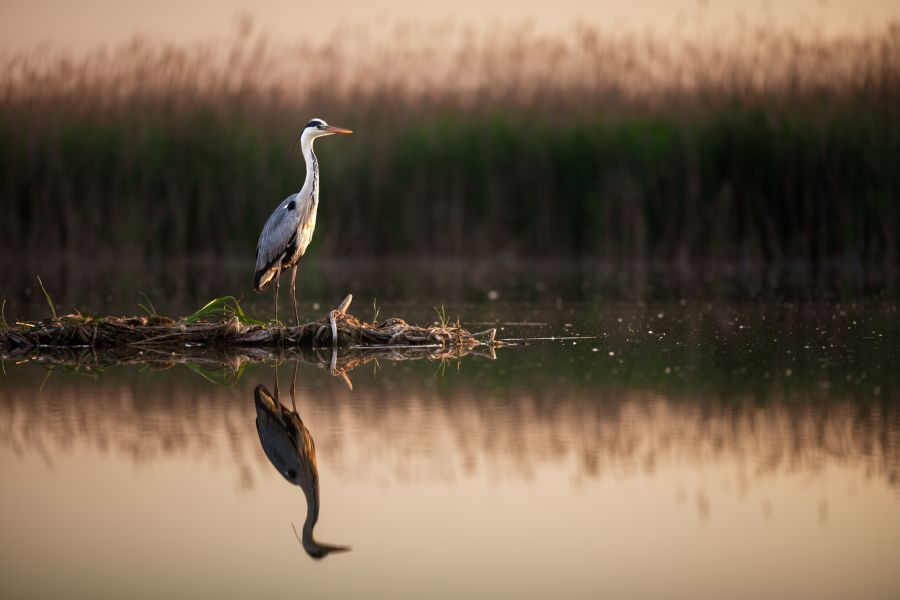
“Wild waterbirds, like egrets and herons, are the main reservoirs of JEV. Culex mosquitos bite these birds and then spread the virus among them,” Associate Professor Horwood said. “The mosquitos also bite and infect pigs, who can transmit the virus to each other. So, once JEV gets into piggeries and pig populations, it circulates and amplifies quickly. However, JEV cannot be transmitted from person to person; it’s only spread to humans via mosquito bites.”
To identify areas at highest risk of JEV transmission in Australia, the team — comprised of a veterinary epidemiologist, a wildlife ecologist, an entomologist, a machine learning expert, a veterinary pathologist, a virologist and an infectious diseases modeller — used maths and modelling to create an ecological niche model: a scientific tool used to predict where certain species might live based on environmental conditions.
“Basically, we fed the model environmental parameters that we know these species need to survive. Things like water availability, humidity, temperature and so on, and it shows us where they are likely to be present,” Associate Professor Hickson said.
The findings indicate that the relative risk of transmission of JEV is widespread across Australia. However, areas with high densities of piggeries and feral pigs, particularly along the northern and eastern coastlines of the continent, are at greater risk.
“These regions have wet, humid conditions that support year-round mosquito populations, abundant wetlands, and significant feral pig numbers, creating the perfect environment for JEV to circulate,” Associate Professor Horwood said.
According to Associate Professor Hickson, combating the virus will require ongoing surveillance of the key animals involved in its circulation and transmission.
“Our findings highlight the need for mosquito control and biosecurity measures to prevent contact between feral pigs, domestic pigs, and water birds,” she said. “There is still a lot more research that needs to be done and much to learn about JEV in Australia.”
For a disease as complex as JEV, a holistic approach that considers the different animal species, the environment, and the social situations that can lead to outbreaks is crucial for developing effective strategies to manage and mitigate its impact. This research represents a significant step forward in understanding JEV's behaviour in a unique environment like Australia and underscores the importance of a multifaceted approach.
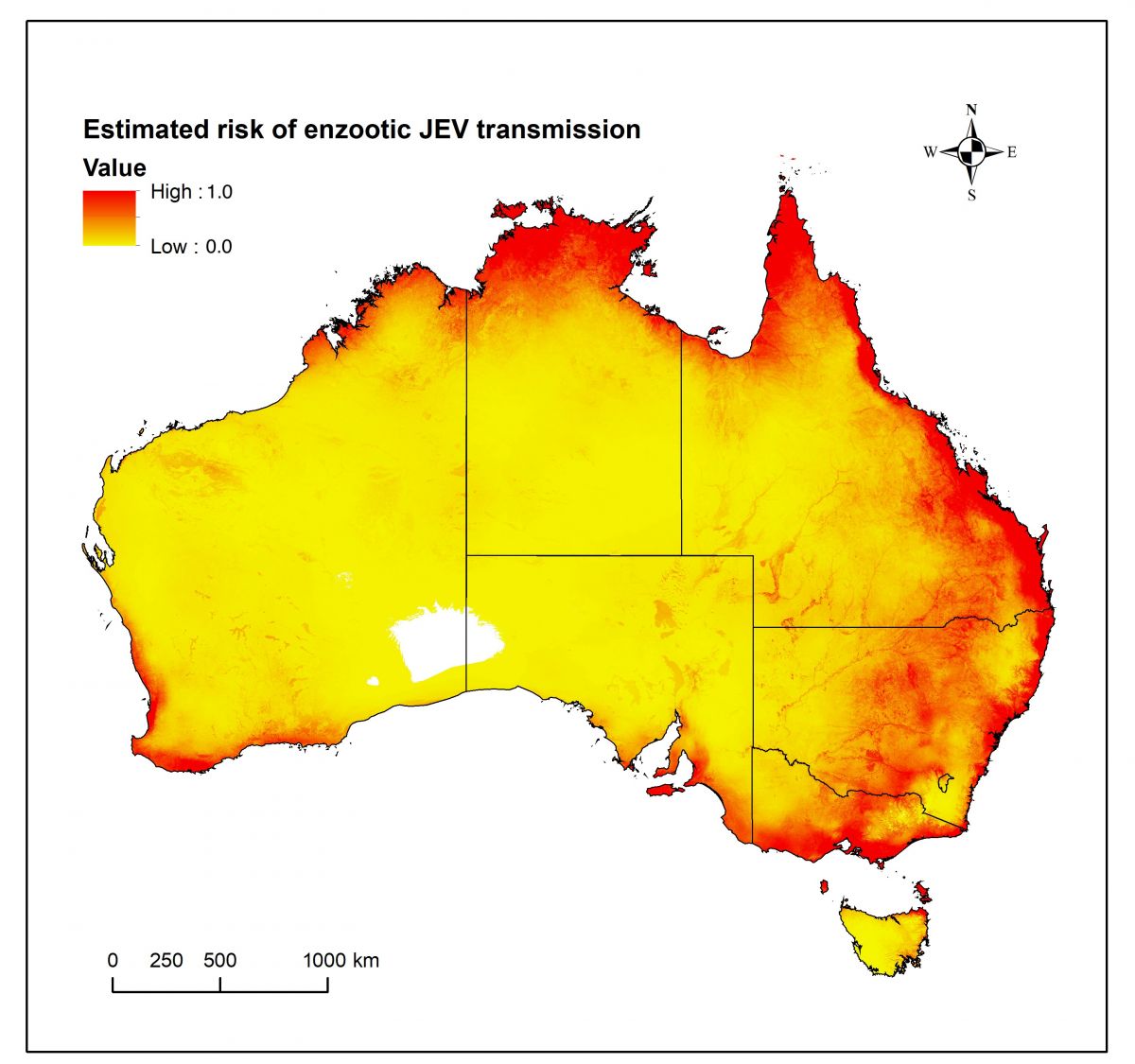
The estimated risk of JEV transmission in animals in Australia where the estimated risk ranges from zero (white) and low (yellow) to high (red). Source: Furlong et al. Japanese Encephalitis Enzootic and Epidemic Risks across Australia. Viruses. 2023; 15(2):450. Note: colour bar difference from source.