
Australian Institute of Tropical Health and Medicine Our impact AITHM Stories More than a gut feeling
More than a gut feeling
- MRCMHR
- Future Students
- JCU Global Experience
- International Students
- Student experience
- Open Day
- How to apply
- Pathways to university
- Living on Campus
- Courses
- Publications
- Mature students
- Scholarships
- Entry options
- JCU Families
- JCU Heroes Programs
- Aboriginal and Torres Strait Islander in Marine Science
- Elite Athletes
- Defence
- Capability.Co
- AI@JCU
- AALL
- Current Students
- Student Ambassador Program
- New students
- JCU Orientation
- LearnJCU
- Placements
- EDQS
- Unicare Centre and Unicampus Kids
- Graduation
- Off-Campus Students
- JCU Job Ready
- Safety and Wellbeing
- JCU Prizes
- Professional Experience Placement
- Employability Edge
- Art of Academic Writing
- Art of Academic Editing
- Careers and Employability
- Health, Wellbeing and Belonging
- Career Ready Plan
- Careers at JCU
- Partners and Community
- School Outreach and Widening Participation
- Alumni
- International partnerships
- About JCU
- Reputation and Experience
- Chancellery
- Governance
- Celebrating 50 Years
- Academy
- Indigenous Engagement
- Education Division
- Research Festival
- Graduate Research School
- Research Division
- Research and Innovation Services
- CASE
- College of Business, Law and Governance
- College of Healthcare Sciences
- College of Medicine and Dentistry
- College of Science and Engineering
- MPE
- Anthropological Laboratory for Tropical Audiovisual Research (ALTAR)
- Rural Remote and Tropical Health Systems
- Agriculture Technology and Adoption Centre (AgTAC)
- Advanced Analytical Centre
- Australian Institute of Tropical Health and Medicine
- AMHHEC
- Aquaculture Solutions
- AMHRA
- JCU Digital Wellbeing Group
- ARCSTA
- Lions Marine Research Trust
- Australian Tropical Herbarium
- Australian Quantum & Classical Transport Physics Group
- Boating and Diving
- Clinical Psychedelic Research Lab
- Centre for Tropical Biosecurity
- Centre for Tropical Bioinformatics and Molecular Biology
- CITBA
- CMT
- Centre for Disaster Solutions
- CSTFA
- Cyclone Testing Station
- The Centre for Disaster Studies
- Daintree Rainforest Observatory
- Fletcherview
- JCU Eduquarium
- JCU Turtle Health Research
- MARFU
- Orpheus
- TESS
- JCU Ideas Lab
- CADSI
- CNL
- TARL
- eResearch
- Indigenous Education and Research Centre
- Past Course and Subject Handbooks
- Estate
- Work Health and Safety
- Staff
- Discover Nature at JCU
- Cyber Security Hub
- Association of Australian University Secretaries
- Services Division
- Environmental Research Complex [ERC]
- Foundation for Australian Literary Studies
- Gender Equity at JCU
- Give to JCU
- Indigenous Legal Needs Project
- Inherent Requirements
- IsoTropics Lab
- IT Services
- JCU Webinars
- JCU Events
- JCU Motorsports
- JCU Sport
- Library
- Mabo Decision: 30 years on
- Marine Geophysics Laboratory
- Office of the Vice Chancellor and President
- Outstanding Alumni
- Policy
- PAHL
- Queensland Research Centre for Peripheral Vascular Disease
- Rapid Assessment Unit
- RDIM
- Researcher Development Portal
- Roderick Centre for Australian Literature and Creative Writing
- Contextual Science for Tropical Coastal Ecosystems
- State of the Tropics
- Strategic Procurement
- Student profiles
- SWIRLnet
- TREAD
- TropEco for Staff and Students
- TropCOVID: Mapping COVID-19 Immunity in Far North Queensland
- TUDLab
- VAVS Home
- WHOCC for Vector-borne & NTDs
- Media
- Copyright and Terms of Use
- Australian Institute of Tropical Health & Medicine
- JCU Respect
- Pay review
- Research
05 March 2025
Around 100,000 people in Australia suffer from Crohn’s disease or ulcerative colitis; both conditions are more commonly known as inflammatory bowel disease (IBD). Aside from having a lower quality of life, people affected by IBD are also at an increased risk of developing colorectal cancer. Researchers at the Australian Institute of Tropical Health and Medicine (AITHM) are examining how gut immunity fails as people grow older, which is a first step to better treatments for people suffering from IBD and colorectal cancer.
So far, our knowledge about how the immune system in our gut changes over time remains limited. But AITHM’s Dr Roland Ruscher aims to fill in the gaps with a 5-year project supported by a $600,000 National Health and Medical Research Council (NHMRC) Investigator Grant.
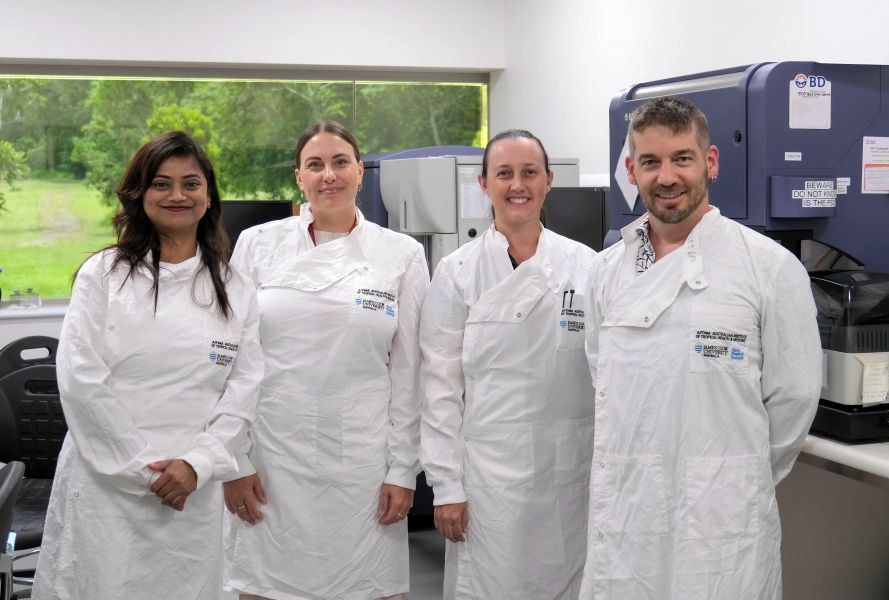
Dr Ruscher, Group Leader of the Mucosal Immunity Team and Head of Microbial Diversification and Translational Research Program, along with his PhD candidates Ms Maxine Smith and Ms Sarah Gillert, are working on this project.
“What we do know is that if you have colorectal cancer in your family, there's a bit of a genetic association with it,” Dr Ruscher said. “But environmental factors throughout life and ageing processes also shape the intestinal immune system. We are wondering if there is something that you can do in earlier life to reduce your risk of developing colorectal cancer later on.
“Once we understand how early life events shape immune cells in the gut in the long run, it opens the door to developing specific medication or a vaccine to target those cells before IBD or cancer even occur.”
In this context, Dr Ruscher is especially interested in intraepithelial lymphocytes (IELs). Lymphocytes are immune cells that identify threats and respond to them. IELs are specialised lymphocytes that live within the outer layer (epithelium) of the small and large intestine of mammals, where they help reduce inflammation and eliminate cancerous cells. “We now know that IELs develop in early life, and they are thought to persist as we age,” Dr Ruscher said. “Events during infancy and childhood may therefore impact IEL functionality long-term.”
Thanks to a collaboration with Yale University’s Medical School, which provides access to donated gut cell samples from people of various ages, Dr Ruscher and the team have been given the opportunity to learn more about these elusive cells.
Often, immune cells can be maintained outside the body under cell culture conditions for some time. However, Dr Ruscher said a major challenge in this research project is that IEL cells die quickly once they are outside their usual environment, making experiments in culture conditions difficult.
“Other researchers have tried to keep these cells alive with limited success,” he said. “But PhD candidate Maxine Smith has established a good protocol for maintaining IELs in culture for several weeks. This sets the stage for a lot of new studies.”
However, gut cells are only one part of the equation. “Recently, we have also received a colorectal cancer cell line, and we can now culture these cancer cells in the petri dish along with IELs to study their cancer fighting capacity in-depth,” Dr Ruscher said.
The research project finishes in 2026, and given the successes so far, the team is confident that they will continue to gain deeper insights into the connection between IELs, IBD and colorectal cancer by then. Their findings will pave the way for better treatments for patients suffering from IBD and colorectal cancer.