
Australian Institute of Tropical Health and Medicine Our impact AITHM Stories PacMOSSI: Empowering the Pacific to swat mosquito threats
PacMOSSI: Empowering the Pacific to swat mosquito threats
- MRCMHR
- Future Students
- JCU Global Experience
- International Students
- Student experience
- Open Day
- How to apply
- Pathways to university
- Living on Campus
- Courses
- Publications
- Mature students
- Scholarships
- Entry options
- JCU Families
- JCU Heroes Programs
- Aboriginal and Torres Strait Islander in Marine Science
- Elite Athletes
- Defence
- Capability.Co
- AI@JCU
- AALL
- Current Students
- Student Ambassador Program
- New students
- JCU Orientation
- LearnJCU
- Placements
- EDQS
- Unicare Centre and Unicampus Kids
- Graduation
- Off-Campus Students
- JCU Job Ready
- Safety and Wellbeing
- JCU Prizes
- Professional Experience Placement
- Employability Edge
- Art of Academic Writing
- Art of Academic Editing
- Careers and Employability
- Health, Wellbeing and Belonging
- Career Ready Plan
- Careers at JCU
- Partners and Community
- School Outreach and Widening Participation
- Alumni
- International partnerships
- About JCU
- Reputation and Experience
- Chancellery
- Governance
- Celebrating 50 Years
- Academy
- Indigenous Engagement
- Education Division
- Research Festival
- Graduate Research School
- Research Division
- Research and Innovation Services
- CASE
- College of Business, Law and Governance
- College of Healthcare Sciences
- College of Medicine and Dentistry
- College of Science and Engineering
- MPE
- Anthropological Laboratory for Tropical Audiovisual Research (ALTAR)
- Rural Remote and Tropical Health Systems
- Agriculture Technology and Adoption Centre (AgTAC)
- Advanced Analytical Centre
- Australian Institute of Tropical Health and Medicine
- AMHHEC
- Aquaculture Solutions
- AMHRA
- JCU Digital Wellbeing Group
- ARCSTA
- Lions Marine Research Trust
- Australian Tropical Herbarium
- Australian Quantum & Classical Transport Physics Group
- Boating and Diving
- Clinical Psychedelic Research Lab
- Centre for Tropical Biosecurity
- Centre for Tropical Bioinformatics and Molecular Biology
- CITBA
- CMT
- Centre for Disaster Solutions
- CSTFA
- Cyclone Testing Station
- The Centre for Disaster Studies
- Daintree Rainforest Observatory
- Fletcherview
- JCU Eduquarium
- JCU Turtle Health Research
- MARFU
- Orpheus
- TESS
- JCU Ideas Lab
- CADSI
- CNL
- TARL
- eResearch
- Indigenous Education and Research Centre
- Past Course and Subject Handbooks
- Estate
- Work Health and Safety
- Staff
- Discover Nature at JCU
- Cyber Security Hub
- Association of Australian University Secretaries
- Services Division
- Environmental Research Complex [ERC]
- Foundation for Australian Literary Studies
- Gender Equity at JCU
- Give to JCU
- Indigenous Legal Needs Project
- Inherent Requirements
- IsoTropics Lab
- IT Services
- JCU Webinars
- JCU Events
- JCU Motorsports
- JCU Sport
- Library
- Mabo Decision: 30 years on
- Marine Geophysics Laboratory
- Office of the Vice Chancellor and President
- Outstanding Alumni
- Policy
- PAHL
- Queensland Research Centre for Peripheral Vascular Disease
- Rapid Assessment Unit
- RDIM
- Researcher Development Portal
- Roderick Centre for Australian Literature and Creative Writing
- Contextual Science for Tropical Coastal Ecosystems
- State of the Tropics
- Strategic Procurement
- Student profiles
- SWIRLnet
- TREAD
- TropEco for Staff and Students
- TropCOVID: Mapping COVID-19 Immunity in Far North Queensland
- TUDLab
- VAVS Home
- WHOCC for Vector-borne & NTDs
- Media
- Copyright and Terms of Use
- Australian Institute of Tropical Health & Medicine
- JCU Respect
- Pay review
- Research
30 October 2024
In the fight against mosquito-borne diseases, countries in the Pacific Island region face unique challenges. These small, isolated nations are vulnerable to outbreaks that can overwhelm communities and health systems relying on limited resources. For this reason, the Pacific Mosquito Surveillance Strengthening for Impact (PacMOSSI) program was launched to support Pacific Island countries as they work to combat these devastating diseases.
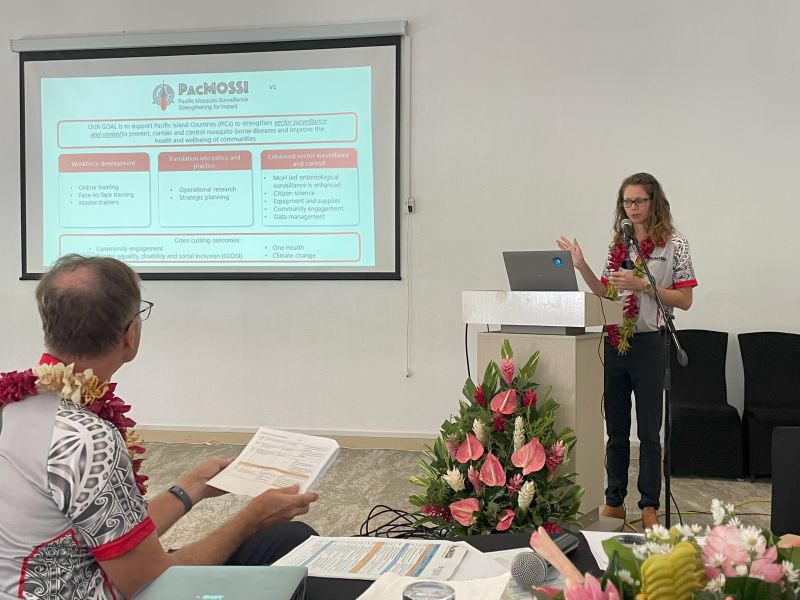
Led by Australian Institute of Tropical Health and Medicine (AITHM) researcher Associate Professor Tanya Russell, PacMOSSI is a collaborative initiative managed by James Cook University (JCU) in partnership with the World Health Organization (WHO) and The Pacific Community (also known as SPC). The program is a network of international institutions and Pacific Island countries working together to monitor and control outbreaks of mosquito-borne diseases throughout the region.
“In small Pacific Island countries, health systems are fragile, and capacity is very low,” Associate Professor Russell said. “This means that when there are outbreaks of diseases like malaria, dengue, Zika or Chikungunya, they can completely overwhelm the community and their resources. Our focus is on effective vector control to prevent transmission and save lives.”
PacMOSSI was established in 2020 and has been focused on capacity building in 21 Pacific Island countries ever since. The program offers online training and hands-on workshops that are tailored to each nation’s needs, as well as equipment, supplies and operational research.
“The real strength of the PacMOSSI is in its development of networks and relationships, not only between the technical partners but also between the countries,” Associate Professor Russell said. “Environmental health officers in this region are often juggling a large range of responsibilities and having that peer network allows them to share advice and support to make their operations more efficient.”
PacMOSSI’s work has been so impactful that it recently received an additional round of funding from the Australian Government Department of Foreign Affairs and Trade (DFAT), which will allow it to build on the successes of its first phase.
“It’s really exciting to receive another round of support. This additional funding not only recognises the strength of PacMOSSI, but also highlights the ongoing need for the program from the country perspective,” Associate Professor Russell said.
PacMOSSI plans to use the funds to expand its digital data management systems, engage communities in mosquito control efforts, and continue strengthening strategic plans for vector control.
“Moving forward, one area we want to focus on is supporting in-country vector control teams to encourage citizen science and develop interactive tools that encourage communities to participate in vector surveillance,” she said.
“For example, a new module has been integrated into the high school curriculum in the Solomon Islands where students are learning about mosquito-borne disease transmission cycles. They’re also learning how to build mosquito traps and collect data to submit to local health authorities.
“Building up that purpose of community by giving people a role and the ability to contribute to the greater good is hugely important.”
Associate Professor Russell is confident that the PacMOSSI program is well-positioned to significantly enhance the capacity of countries in the Pacific Island region to monitor and control the persistent threat of mosquito-borne diseases.
“I really believe in PacMOSSI’s ability to empower countries by developing tailored resources and programs to address their unique needs,” she said. “Together, we can strengthen these initiatives and create a lasting impact on public health and quality of life in the Pacific.”