
Australian Institute of Tropical Health and Medicine Our impact AITHM Stories Peptide predictions with a high-tech twist
Peptide predictions with a high-tech twist
- MRCMHR
- Future Students
- JCU Global Experience
- International Students
- Student experience
- Open Day
- How to apply
- Pathways to university
- Living on Campus
- Courses
- Publications
- Mature students
- Scholarships
- Entry options
- JCU Families
- JCU Heroes Programs
- Aboriginal and Torres Strait Islander in Marine Science
- Elite Athletes
- Defence
- Capability.Co
- AI@JCU
- AALL
- Current Students
- Student Ambassador Program
- New students
- JCU Orientation
- LearnJCU
- Placements
- EDQS
- Unicare Centre and Unicampus Kids
- Graduation
- Off-Campus Students
- JCU Job Ready
- Safety and Wellbeing
- JCU Prizes
- Professional Experience Placement
- Employability Edge
- Art of Academic Writing
- Art of Academic Editing
- Careers and Employability
- Health, Wellbeing and Belonging
- Career Ready Plan
- Careers at JCU
- Partners and Community
- School Outreach and Widening Participation
- Alumni
- International partnerships
- About JCU
- Reputation and Experience
- Chancellery
- Governance
- Celebrating 50 Years
- Academy
- Indigenous Engagement
- Education Division
- Research Festival
- Graduate Research School
- Research Division
- Research and Innovation Services
- CASE
- College of Business, Law and Governance
- College of Healthcare Sciences
- College of Medicine and Dentistry
- College of Science and Engineering
- MPE
- Anthropological Laboratory for Tropical Audiovisual Research (ALTAR)
- Rural Remote and Tropical Health Systems
- Agriculture Technology and Adoption Centre (AgTAC)
- Advanced Analytical Centre
- Australian Institute of Tropical Health and Medicine
- AMHHEC
- Aquaculture Solutions
- AMHRA
- JCU Digital Wellbeing Group
- ARCSTA
- Lions Marine Research Trust
- Australian Tropical Herbarium
- Australian Quantum & Classical Transport Physics Group
- Boating and Diving
- Clinical Psychedelic Research Lab
- Centre for Tropical Biosecurity
- Centre for Tropical Bioinformatics and Molecular Biology
- CITBA
- CMT
- Centre for Disaster Solutions
- CSTFA
- Cyclone Testing Station
- The Centre for Disaster Studies
- Daintree Rainforest Observatory
- Fletcherview
- JCU Eduquarium
- JCU Turtle Health Research
- MARFU
- Orpheus
- TESS
- JCU Ideas Lab
- CADSI
- CNL
- TARL
- eResearch
- Indigenous Education and Research Centre
- Past Course and Subject Handbooks
- Estate
- Work Health and Safety
- Staff
- Discover Nature at JCU
- Cyber Security Hub
- Association of Australian University Secretaries
- Services Division
- Environmental Research Complex [ERC]
- Foundation for Australian Literary Studies
- Gender Equity at JCU
- Give to JCU
- Indigenous Legal Needs Project
- Inherent Requirements
- IsoTropics Lab
- IT Services
- JCU Webinars
- JCU Events
- JCU Motorsports
- JCU Sport
- Library
- Mabo Decision: 30 years on
- Marine Geophysics Laboratory
- Office of the Vice Chancellor and President
- Outstanding Alumni
- Policy
- PAHL
- Queensland Research Centre for Peripheral Vascular Disease
- Rapid Assessment Unit
- RDIM
- Researcher Development Portal
- Roderick Centre for Australian Literature and Creative Writing
- Contextual Science for Tropical Coastal Ecosystems
- State of the Tropics
- Strategic Procurement
- Student profiles
- SWIRLnet
- TREAD
- TropEco for Staff and Students
- TropCOVID: Mapping COVID-19 Immunity in Far North Queensland
- TUDLab
- VAVS Home
- WHOCC for Vector-borne & NTDs
- Media
- Copyright and Terms of Use
- Australian Institute of Tropical Health & Medicine
- JCU Respect
- Pay review
- Research
20 November 2024
From agriculture and healthcare to business and education, artificial intelligence (AI) is transforming the future across almost every industry. But how might it be harnessed to shape scientific discovery? A new study from the Australian Institute of Tropical Health and Medicine (AITHM) explores AI’s ability to predict the structure of peptides — a breakthrough that could accelerate the development of life-saving drugs.
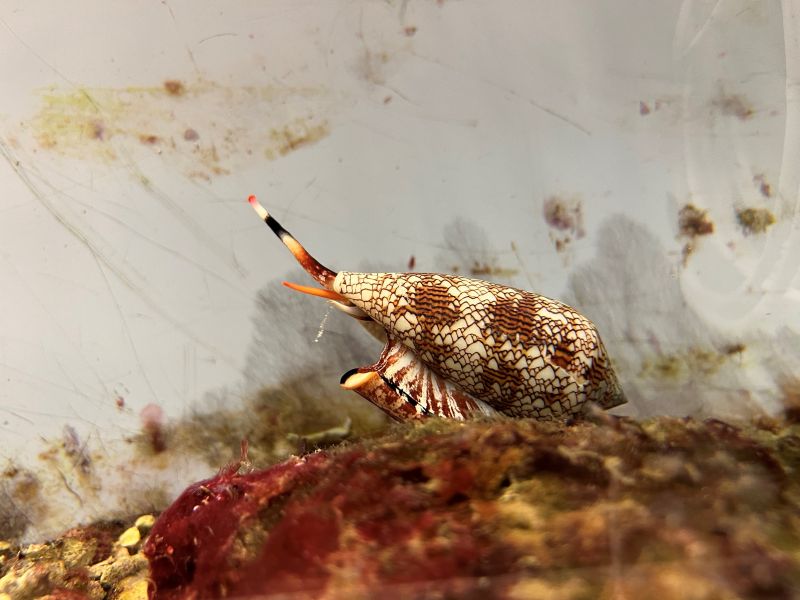
The research focuses on cystine-rich peptides found in cone snail venom. These peptides have several disulfide bonds, which act as ‘glue’ to hold the peptide in a specific shape and stabilise their structure.
The way a peptide is structured is critical to its biological function, as it influences how the peptide interacts with its environment. For example, the structural constraints imposed by disulfide bonds in cone snail venom peptides can play a crucial role in the ability of the peptides to immobilise prey. Modifications in peptide structure can result in loss of function or unintended effects, so accurate structural prediction is vital.
In this study, AITHM Professor Norelle Daly, along with her PhD student and lead author Mr Tiziano Raffaelli, tested how accurately the AI tool AlphaFold could predict the structure of a specific cone snail venom peptide called TxVIIB.
“The AI successfully predicted the overall structure of the peptide but made errors in predicting the disulfide connectivity, leading to incorrect predictions about how these stabilising bonds are formed,” Professor Daly said. “While models like AlphaFold have made significant strides in predicting larger protein structures, smaller peptides still present challenges.”
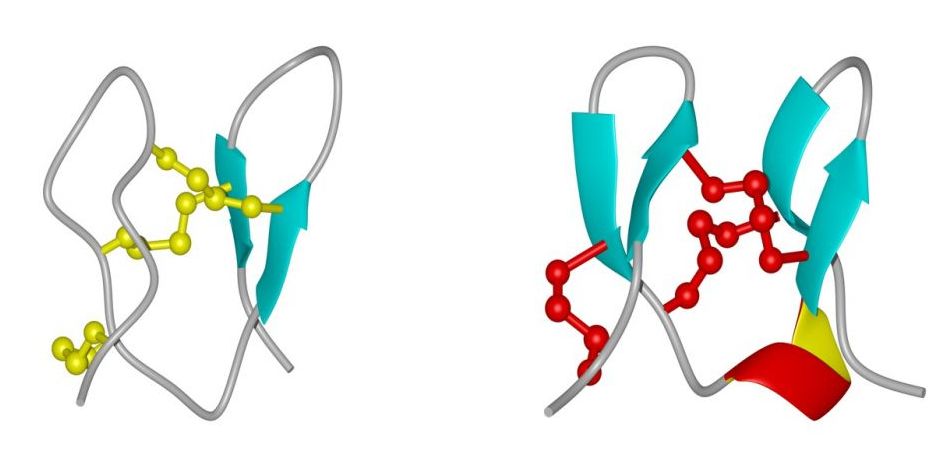
Left: NMR experimental calculation. Right: AlphaFold prediction
According to Professor Daly, determining the structure of peptides is particularly challenging due to their small size and complex nature.
“At present, getting structures of peptides is extremely time consuming, costly, and requires specialised equipment and techniques such as crystallography and NMR spectroscopy,” she said.
“If we can use AI to accurately predict these structures, it would accelerate the identification and development of novel therapeutics. Peptides, especially those with disulfide bonds, are key candidates for drug development because of their enhanced stability and ability to target particular receptors.”
Despite current limitations, Professor Daly believes AI has enormous potential in structural biology, highlighted by the 2024 Nobel Prize in Chemistry awarded to Demis Hassabis and John Jumper for developing AlphaFold.
“AI for structure prediction is incredibly exciting and very promising,” she said. “I believe it will continue to improve and play a significant role in the field. Although we’re not yet at a stage where experimental structural biology can be fully replaced by predictions, studies like this one are crucial for shaping the future of AI predictions.”
Indeed, as AI technology continues to evolve, it has the potential to revolutionise scientific discovery and transform the way we approach drug development. Professor Daly’s team will continue to build on these initial studies to further explore the impact of AI on predicting the structures of disulfide-rich peptides.