
Australian Institute of Tropical Health and Medicine Our impact AITHM Stories Protecting livestock and livelihoods with a dual-action vaccine
Protecting livestock and livelihoods with a dual-action vaccine
- MRCMHR
- Future Students
- JCU Global Experience
- International Students
- Student experience
- Open Day
- How to apply
- Pathways to university
- Living on Campus
- Courses
- Publications
- Mature students
- Scholarships
- Entry options
- JCU Families
- JCU Heroes Programs
- Aboriginal and Torres Strait Islander in Marine Science
- Elite Athletes
- Defence
- Capability.Co
- AI@JCU
- AALL
- Current Students
- Student Ambassador Program
- New students
- JCU Orientation
- LearnJCU
- Placements
- EDQS
- Unicare Centre and Unicampus Kids
- Graduation
- Off-Campus Students
- JCU Job Ready
- Safety and Wellbeing
- JCU Prizes
- Professional Experience Placement
- Employability Edge
- Art of Academic Writing
- Art of Academic Editing
- Careers and Employability
- Health, Wellbeing and Belonging
- Career Ready Plan
- Careers at JCU
- Partners and Community
- School Outreach and Widening Participation
- Alumni
- International partnerships
- About JCU
- Reputation and Experience
- Chancellery
- Governance
- Celebrating 50 Years
- Academy
- Indigenous Engagement
- Education Division
- Research Festival
- Graduate Research School
- Research Division
- Research and Innovation Services
- CASE
- College of Business, Law and Governance
- College of Healthcare Sciences
- College of Medicine and Dentistry
- College of Science and Engineering
- MPE
- Anthropological Laboratory for Tropical Audiovisual Research (ALTAR)
- Rural Remote and Tropical Health Systems
- Agriculture Technology and Adoption Centre (AgTAC)
- Advanced Analytical Centre
- Australian Institute of Tropical Health and Medicine
- AMHHEC
- Aquaculture Solutions
- AMHRA
- JCU Digital Wellbeing Group
- ARCSTA
- Lions Marine Research Trust
- Australian Tropical Herbarium
- Australian Quantum & Classical Transport Physics Group
- Boating and Diving
- Clinical Psychedelic Research Lab
- Centre for Tropical Biosecurity
- Centre for Tropical Bioinformatics and Molecular Biology
- CITBA
- CMT
- Centre for Disaster Solutions
- CSTFA
- Cyclone Testing Station
- The Centre for Disaster Studies
- Daintree Rainforest Observatory
- Fletcherview
- JCU Eduquarium
- JCU Turtle Health Research
- MARFU
- Orpheus
- TESS
- JCU Ideas Lab
- CADSI
- CNL
- TARL
- eResearch
- Indigenous Education and Research Centre
- Past Course and Subject Handbooks
- Estate
- Work Health and Safety
- Staff
- Discover Nature at JCU
- Cyber Security Hub
- Association of Australian University Secretaries
- Services Division
- Environmental Research Complex [ERC]
- Foundation for Australian Literary Studies
- Gender Equity at JCU
- Give to JCU
- Indigenous Legal Needs Project
- Inherent Requirements
- IsoTropics Lab
- IT Services
- JCU Webinars
- JCU Events
- JCU Motorsports
- JCU Sport
- Library
- Mabo Decision: 30 years on
- Marine Geophysics Laboratory
- Office of the Vice Chancellor and President
- Outstanding Alumni
- Policy
- PAHL
- Queensland Research Centre for Peripheral Vascular Disease
- Rapid Assessment Unit
- RDIM
- Researcher Development Portal
- Roderick Centre for Australian Literature and Creative Writing
- Contextual Science for Tropical Coastal Ecosystems
- State of the Tropics
- Strategic Procurement
- Student profiles
- SWIRLnet
- TREAD
- TropEco for Staff and Students
- TropCOVID: Mapping COVID-19 Immunity in Far North Queensland
- TUDLab
- VAVS Home
- WHOCC for Vector-borne & NTDs
- Media
- Copyright and Terms of Use
- Australian Institute of Tropical Health & Medicine
- JCU Respect
- Pay review
- Research
09 July 2025
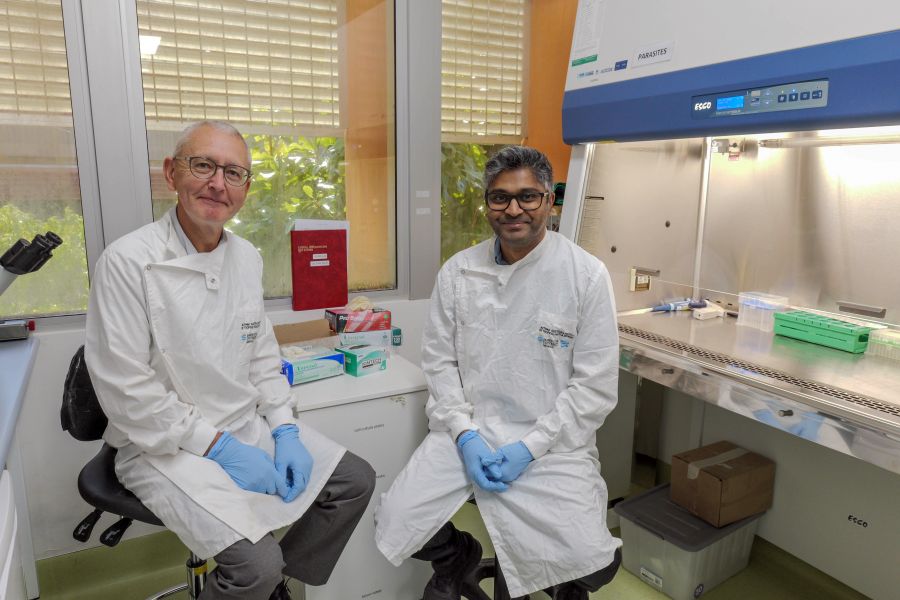
Cattle ticks are notorious for spreading tick fever, a potentially fatal disease that threatens the health of beef and dairy cows in Australia and around the world. The only currently available vaccine is expensive to produce, hard to deploy, and does not prevent the infected tick from transmitting the disease to other animals. Dr Vignesh Ambothi Rathinasamy and Adjunct Professor Brian Cooke from the Australian Institute of Tropical Health and Medicine (AITHM) are developing an alternative vaccine that aims to be more affordable, more effective and easier to deploy.
Cattle ticks transmit tick fever, also known as bovine babesiosis, in tropical and subtropical regions with high humidity, such as South and South East Asia, Sub-Saharan Africa, Central and South America, and most of Northern Australia.
“Tick fever can result in high mortality in cattle, but we don't actually know what the true economic impact is on the beef and dairy industry — it’s potentially a lot worse than commonly known,” Professor Cooke said. “It's very hard to get this data. We are now working with collaborators in the United States, Egypt and Türkiye to assess the global economic impact of cattle tick fever.”
In Australia, a vaccine is available from the Tick Fever Centre in Brisbane for about six dollars per dose. The vaccines need to be stored and transported at 2–8°C and must be used within four days of manufacture. “If you are a beef farmer in the Northern Territory and you're running twenty or thirty thousand head of cattle, the cost adds up and will have an impact on the bottom line of the business,” Professor Cooke said.
Additionally, in some regions in Asia and Sub-Saharan Africa, subsistence farmers might only own one or two cows and often cannot afford the vaccine. Dr Rathinasamy, who grew up in South India, understands the challenges firsthand. “A family’s livelihood may rely on that one animal,” he said. “They might not be able to afford the vaccine, nor do they own a fridge to store it.”
This is why Dr Rathinasamy and Professor Cooke are approaching the development of their tick vaccine from two key perspectives. “Our goal is to have not only a vaccine that protects the animals against disease, but that also cures the tick so it cannot transmit bovine babesiosis to other cattle,” Professor Cooke said. “This is something that has never been done before.”
The team have already conducted two successful large-animal trials with potential vaccine candidates in Queensland and in the United States. “One of the vaccines that we have co-developed with Dr Carlos Suarez from the United States Department of Agriculture has completely blocked the parasite circulation in the ticks,” Dr Rathinasamy said.
“We are very excited about that, as it provides 100% protection. This could be turned into an effective vaccine as soon as we can find some investors to fund the venture.”
The researchers are also seeing promising results in blocking the parasites in the cattle itself, but further work is needed before the vaccine candidate is market-ready. “It's showing strong signs towards protection, but we still need to fine-tune it to make it more effective,” Dr Rathinasamy said.
Professor Cooke and Dr Rathinasamy are currently being supported by the Australian Research Council (ARC), which is funding their research into loopholes in the parasite’s lifecycle that might be used as potential targets for new vaccines.
Additionally, funding from the Bill and Melinda Gates Foundation and the Canadian International Development Research Centre (IDRC) expired in late 2024, leaving the researchers seeking new donors and investors.
Their current research also includes a spin-off project that aims to reduce methane emissions produced by cattle — a promising extension of their current research.