
Australian Institute of Tropical Health and Medicine Our impact AITHM Stories Spraying away Pacific Island mozzies
Spraying away Pacific Island mozzies
- MRCMHR
- Future Students
- JCU Global Experience
- International Students
- Student experience
- Open Day
- How to apply
- Pathways to university
- Living on Campus
- Courses
- Publications
- Mature students
- Scholarships
- Entry options
- JCU Families
- JCU Heroes Programs
- Aboriginal and Torres Strait Islander in Marine Science
- Elite Athletes
- Defence
- Capability.Co
- AI@JCU
- AALL
- Current Students
- Student Ambassador Program
- New students
- JCU Orientation
- LearnJCU
- Placements
- EDQS
- Unicare Centre and Unicampus Kids
- Graduation
- Off-Campus Students
- JCU Job Ready
- Safety and Wellbeing
- JCU Prizes
- Professional Experience Placement
- Employability Edge
- Art of Academic Writing
- Art of Academic Editing
- Careers and Employability
- Health, Wellbeing and Belonging
- Career Ready Plan
- Careers at JCU
- Partners and Community
- School Outreach and Widening Participation
- Alumni
- International partnerships
- About JCU
- Reputation and Experience
- Chancellery
- Governance
- Celebrating 50 Years
- Academy
- Indigenous Engagement
- Education Division
- Research Festival
- Graduate Research School
- Research Division
- Research and Innovation Services
- CASE
- College of Business, Law and Governance
- College of Healthcare Sciences
- College of Medicine and Dentistry
- College of Science and Engineering
- MPE
- Anthropological Laboratory for Tropical Audiovisual Research (ALTAR)
- Rural Remote and Tropical Health Systems
- Agriculture Technology and Adoption Centre (AgTAC)
- Advanced Analytical Centre
- Australian Institute of Tropical Health and Medicine
- AMHHEC
- Aquaculture Solutions
- AMHRA
- JCU Digital Wellbeing Group
- ARCSTA
- Lions Marine Research Trust
- Australian Tropical Herbarium
- Australian Quantum & Classical Transport Physics Group
- Boating and Diving
- Clinical Psychedelic Research Lab
- Centre for Tropical Biosecurity
- Centre for Tropical Bioinformatics and Molecular Biology
- CITBA
- CMT
- Centre for Disaster Solutions
- CSTFA
- Cyclone Testing Station
- The Centre for Disaster Studies
- Daintree Rainforest Observatory
- Fletcherview
- JCU Eduquarium
- JCU Turtle Health Research
- MARFU
- Orpheus
- TESS
- JCU Ideas Lab
- CADSI
- CNL
- TARL
- eResearch
- Indigenous Education and Research Centre
- Past Course and Subject Handbooks
- Estate
- Work Health and Safety
- Staff
- Discover Nature at JCU
- Cyber Security Hub
- Association of Australian University Secretaries
- Services Division
- Environmental Research Complex [ERC]
- Foundation for Australian Literary Studies
- Gender Equity at JCU
- Give to JCU
- Indigenous Legal Needs Project
- Inherent Requirements
- IsoTropics Lab
- IT Services
- JCU Webinars
- JCU Events
- JCU Motorsports
- JCU Sport
- Library
- Mabo Decision: 30 years on
- Marine Geophysics Laboratory
- Office of the Vice Chancellor and President
- Outstanding Alumni
- Policy
- PAHL
- Queensland Research Centre for Peripheral Vascular Disease
- Rapid Assessment Unit
- RDIM
- Researcher Development Portal
- Roderick Centre for Australian Literature and Creative Writing
- Contextual Science for Tropical Coastal Ecosystems
- State of the Tropics
- Strategic Procurement
- Student profiles
- SWIRLnet
- TREAD
- TropEco for Staff and Students
- TropCOVID: Mapping COVID-19 Immunity in Far North Queensland
- TUDLab
- VAVS Home
- WHOCC for Vector-borne & NTDs
- Media
- Copyright and Terms of Use
- Australian Institute of Tropical Health & Medicine
- JCU Respect
- Pay review
- Research
12 October 2023
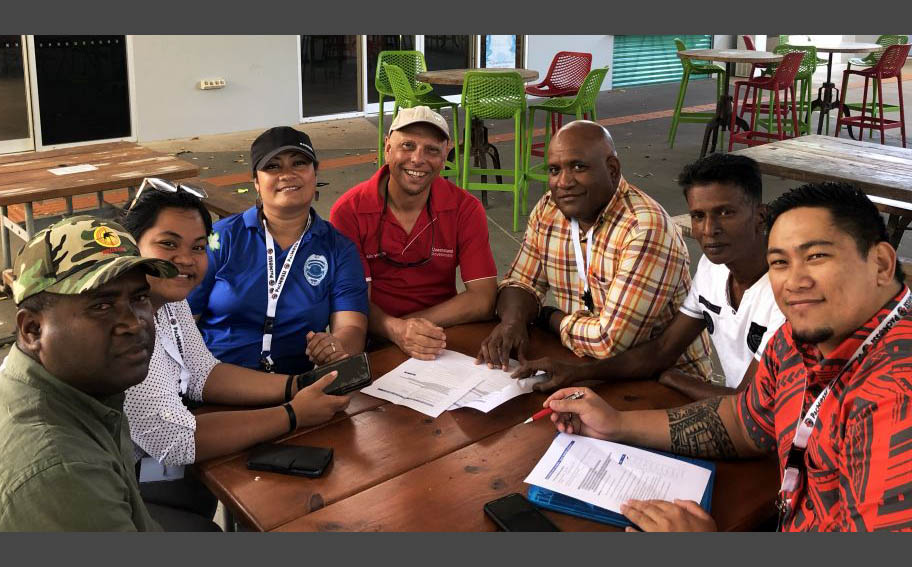
Public health officials from 12 Pacific Island countries are visiting the James Cook University (JCU) Cairns campus this week for training that will help protect their communities from mosquito-borne diseases.
“The five-day workshop is focused on best practices for applying long-lasting insecticides to targeted areas where dangerous mosquitos are likely to land,” Professor Tom Burkot said. “Mosquitos that can transmit dengue and bite indoors are targeted by insecticides applied to walls and under furniture.”
The 18 workshop participants, all managerial or operational staff from their countries’ Ministries of Health, will be sharing their experience in preventing diseases such as chikungunya, dengue, malaria, and Zika virus.
“They are from countries where the risk of mosquito-borne diseases is increasing, but the resources to respond are not,” Professor Burkot said.
“Country participants are learning about evidence-based mosquito control strategies suitable for Pacific settings — and how to pass this knowledge on to their colleagues once they return home.”
The workshop participants represent the first level of a train-the-trainer model which will see them pass on the skills learned in Cairns to their colleagues, to increase the pool of skilled mosquito control specialists in the Pacific.
“We focus on hands-on learning, with participants watching demonstrations before completing practical exercises,” Professor Burkot said. “Their training skills are honed by teaching what they’ve learnt to others in the group.”
Topics covered over the week will include safe use of spray equipment and insecticides, maintaining equipment, spraying techniques, and troubleshooting in challenging situations.
The workshop is run by PacMOSSI, a regional partnership supported by the Department of Foreign Affairs and Trade (DFAT) and managed by JCU. With 12 international institutions (including the World Health Organisation and The Pacific Community) PacMOSSI works with Pacific Island countries to combat mosquito-borne diseases. Workshop facilitators include experts from Queensland Health and Goizper Group.
Through PacMOSSI, JCU will be equipping the workshop participants to put their training into practice when they return home. Spray machines, spare parts, personal protective equipment and training resources will be shipped to each participating country.
“Mosquito-borne diseases pose a serious health threat and place great strain on communities and health services in Pacific Island countries,” JCU technical advisor Dr Tessa Knox said. “We want to make sure our Pacific neighbours are equipped to reduce and manage those risks, in ways that work for their diverse settings.”
Workshop participants are from American Samoa, Cook Islands, Fiji, Kiribati, Nauru, Palau, Papua New Guinea, Samoa, Solomon Islands, Tonga, Tuvalu and Vanuatu.
The workshop is funded by DFAT’s Indo-Pacific Centre for Health Security, with support from Queensland Health and Goizper Group.