
Australian Institute of Tropical Health and Medicine Our impact AITHM Stories Stonefish skin toxins for parasite prevention
Stonefish skin toxins for parasite prevention
- MRCMHR
- Future Students
- JCU Global Experience
- International Students
- Student experience
- Open Day
- How to apply
- Pathways to university
- Living on Campus
- Courses
- Publications
- Mature students
- Scholarships
- Entry options
- JCU Families
- JCU Heroes Programs
- Aboriginal and Torres Strait Islander in Marine Science
- Elite Athletes
- Defence
- Capability.Co
- AI@JCU
- AALL
- Current Students
- Student Ambassador Program
- New students
- JCU Orientation
- LearnJCU
- Placements
- EDQS
- Unicare Centre and Unicampus Kids
- Graduation
- Off-Campus Students
- JCU Job Ready
- Safety and Wellbeing
- JCU Prizes
- Professional Experience Placement
- Employability Edge
- Art of Academic Writing
- Art of Academic Editing
- Careers and Employability
- Health, Wellbeing and Belonging
- Career Ready Plan
- Careers at JCU
- Partners and Community
- School Outreach and Widening Participation
- Alumni
- International partnerships
- About JCU
- Reputation and Experience
- Chancellery
- Governance
- Celebrating 50 Years
- Academy
- Indigenous Engagement
- Education Division
- Research Festival
- Graduate Research School
- Research Division
- Research and Innovation Services
- CASE
- College of Business, Law and Governance
- College of Healthcare Sciences
- College of Medicine and Dentistry
- College of Science and Engineering
- MPE
- Anthropological Laboratory for Tropical Audiovisual Research (ALTAR)
- Rural Remote and Tropical Health Systems
- Agriculture Technology and Adoption Centre (AgTAC)
- Advanced Analytical Centre
- Australian Institute of Tropical Health and Medicine
- AMHHEC
- Aquaculture Solutions
- AMHRA
- JCU Digital Wellbeing Group
- ARCSTA
- Lions Marine Research Trust
- Australian Tropical Herbarium
- Australian Quantum & Classical Transport Physics Group
- Boating and Diving
- Clinical Psychedelic Research Lab
- Centre for Tropical Biosecurity
- Centre for Tropical Bioinformatics and Molecular Biology
- CITBA
- CMT
- Centre for Disaster Solutions
- CSTFA
- Cyclone Testing Station
- The Centre for Disaster Studies
- Daintree Rainforest Observatory
- Fletcherview
- JCU Eduquarium
- JCU Turtle Health Research
- MARFU
- Orpheus
- TESS
- JCU Ideas Lab
- CADSI
- CNL
- TARL
- eResearch
- Indigenous Education and Research Centre
- Past Course and Subject Handbooks
- Estate
- Work Health and Safety
- Staff
- Discover Nature at JCU
- Cyber Security Hub
- Association of Australian University Secretaries
- Services Division
- Environmental Research Complex [ERC]
- Foundation for Australian Literary Studies
- Gender Equity at JCU
- Give to JCU
- Indigenous Legal Needs Project
- Inherent Requirements
- IsoTropics Lab
- IT Services
- JCU Webinars
- JCU Events
- JCU Motorsports
- JCU Sport
- Library
- Mabo Decision: 30 years on
- Marine Geophysics Laboratory
- Office of the Vice Chancellor and President
- Outstanding Alumni
- Policy
- PAHL
- Queensland Research Centre for Peripheral Vascular Disease
- Rapid Assessment Unit
- RDIM
- Researcher Development Portal
- Roderick Centre for Australian Literature and Creative Writing
- Contextual Science for Tropical Coastal Ecosystems
- State of the Tropics
- Strategic Procurement
- Student profiles
- SWIRLnet
- TREAD
- TropEco for Staff and Students
- TropCOVID: Mapping COVID-19 Immunity in Far North Queensland
- TUDLab
- VAVS Home
- WHOCC for Vector-borne & NTDs
- Media
- Copyright and Terms of Use
- Australian Institute of Tropical Health & Medicine
- JCU Respect
- Pay review
- Research
25 June 2025
Parasitic worms infect about 1.5 billion people and millions of livestock around the world, causing a range of health problems and significant economic losses. With limited treatment options and growing drug resistance, tackling these infections has become increasingly challenging. But researchers at the Australian Institute of Tropical Health and Medicine (AITHM) may have discovered a solution in an unlikely source — the estuarine stonefish.
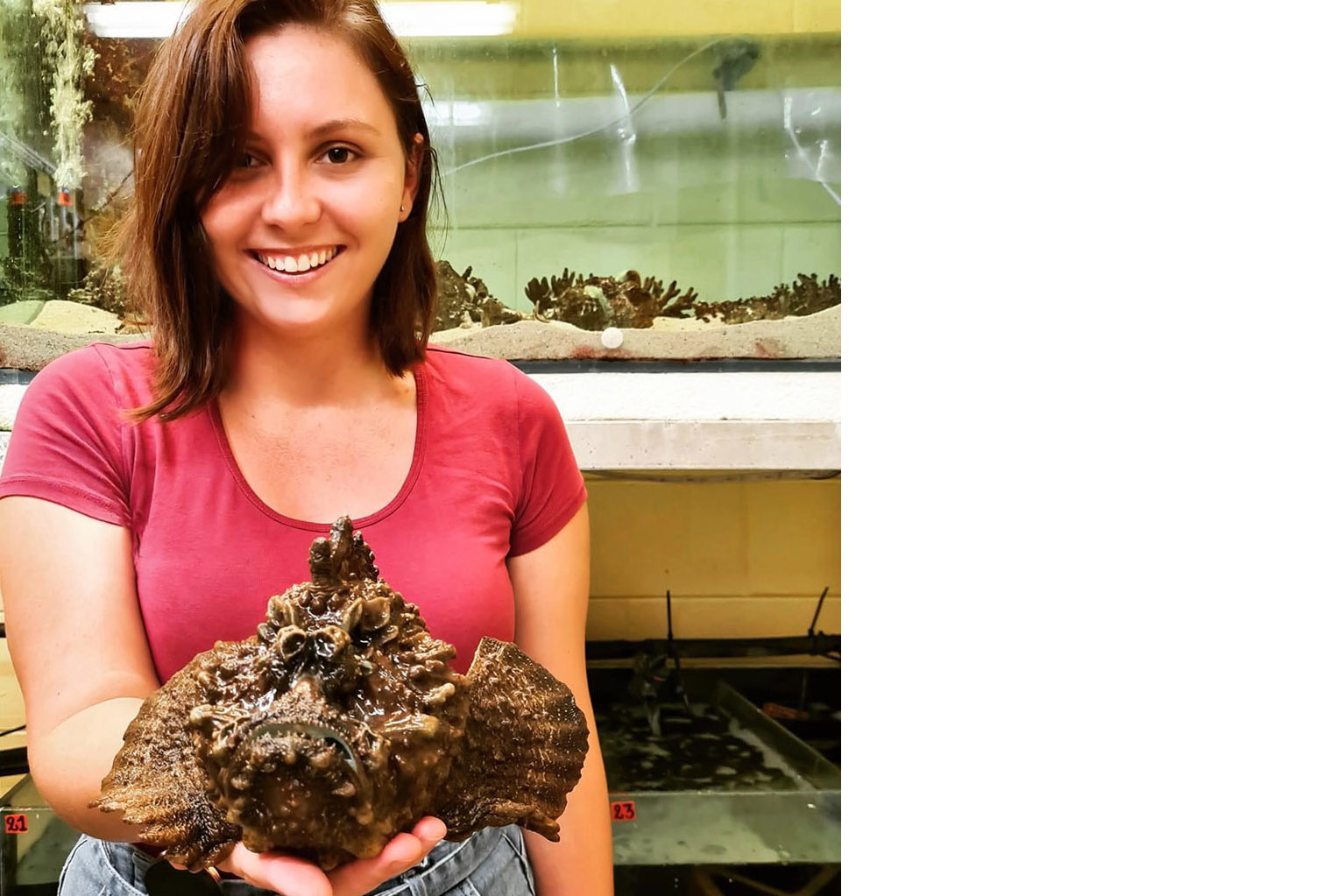
Stonefish (Synanceia spp.) are bottom-dwelling fish that camouflage themselves on the ocean floor to avoid predators and ambush prey. As the name suggests, they look and act like a stone. They are known as the world’s most venomous fish due to the potency of their venom, which can cause a range of symptoms from severe pain to cardiac arrest, and in rare cases, death.
In addition to their venom, stonefish also release a toxin from their skin known as ichthyocrinotoxin, which, until recently, was largely unexplored. PhD candidate Danica Lennox-Bulow, under the guidance of AITHM’s Professor Jamie Seymour, Dr Robert Courtney, Dr Michael Smout and Distinguished Professor Alex Loukas, set out to investigate whether the skin toxin from two different species of stonefish could treat parasite infections in humans and animals.
“While other species of fish that produce ichthyocrinotoxin, such as soap fish, use it to protect themselves against predators, we found that stonefish don’t use it that way. Instead, when a stonefish feels threatened, they will raise the spines on their back to inject venom,” Ms Lennox-Bulow said. “This suggests that the skin toxin might serve another purpose, which raised the question: if not to protect themselves from predators, what are stonefish using this toxin for?”
Based on their tendency to bury themselves in the mud and sand of the ocean floor, it’s suspected that stonefish are highly vulnerable to skin-burrowing parasitic worms. However, despite this vulnerability, they appear to harbour a surprisingly low abundance and diversity of internal parasites. Ms Lennox-Bulow’s research proposed that the stonefish’s skin toxin may act as a defence mechanism against these organisms, a possibility that had not previously been explored.
“Understanding how this skin toxin works could reveal how stonefish protect themselves from parasites and offer new insights into potential treatments for worm infections in domestic animals, livestock and people,” she said. So, Ms Lennox-Bulow tested if and how the skin toxin from reef (Synanceia verrucosa) and estuarine (S. horrida) stonefish affected skin-burrowing parasites.
“Our findings revealed that the toxin from the estuarine species of stonefish was slightly more harmful to parasites than the toxin from the reef species,” she said. “But toxins are complex concoctions, and their composition can vary between species. So, our ultimate goal was to figure out what part of the toxin from each species was responsible for affecting the parasites.
“To do this, I separated the toxins into two component groups (large components and small components) and tested each one. The large and small components from the reef stonefish, as well as the large components from the estuarine stonefish skin, had no effect. However, the small components from the estuarine stonefish skin toxin were found to be just as toxic to the parasites as the whole toxin.”
This shows that small components are responsible for the toxicity in estuarine stonefish ichthyocrinotoxin, while both small and large components work together in reef stonefish ichthyocrinotoxin.
From a drug development standpoint, this makes the skin toxin from the estuarine stonefish more appealing than that from the reef stonefish. “Small components are generally easier to manufacture, more stable, and can be taken orally; that is, as a pill, for example,” Ms Lennox-Bulow said.
The next stage of Ms Lennox-Bulow’s research focused solely on the toxin from the estuarine stonefish. “After determining the effectiveness of the estuarine stonefish’s ichthyocrinotoxin against parasites, we began to test if these components would be safe for humans by measuring their effect on cells in the lab,” she said. “At concentrations that killed the parasites, these components were non-toxic to the majority of cell lines we tested. This suggests that some of the smaller components within the skin toxin of the estuarine stonefish may be promising candidates for anti-parasitic therapeutics.”
Ms Lennox-Bulow, in collaboration with Professor Seymour and the AITHM team, plans to continue exploring the therapeutic potential of stonefish toxin for parasitic worm infections.
“While there is still a lot that needs to be done, this discovery holds promise for the future development of novel, nature-inspired therapies. It offers new hope in the fight against parasitic worm infections in livestock, domestic pets and humans, as well as the growing challenge of anti-parasitic drug resistance.”