
Australian Institute of Tropical Health and Medicine Our impact AITHM Stories World-first research into the ebb and flow of the deadly Irukandji jellyfish
World-first research into the ebb and flow of the deadly Irukandji jellyfish
- MRCMHR
- Future Students
- JCU Global Experience
- International Students
- Student experience
- Open Day
- How to apply
- Pathways to university
- Living on Campus
- Courses
- Publications
- Mature students
- Scholarships
- Entry options
- JCU Families
- JCU Heroes Programs
- Aboriginal and Torres Strait Islander in Marine Science
- Elite Athletes
- Defence
- Capability.Co
- AI@JCU
- AALL
- Current Students
- Student Ambassador Program
- New students
- JCU Orientation
- LearnJCU
- Placements
- EDQS
- Unicare Centre and Unicampus Kids
- Graduation
- Off-Campus Students
- JCU Job Ready
- Safety and Wellbeing
- JCU Prizes
- Professional Experience Placement
- Employability Edge
- Art of Academic Writing
- Art of Academic Editing
- Careers and Employability
- Health, Wellbeing and Belonging
- Career Ready Plan
- Careers at JCU
- Partners and Community
- School Outreach and Widening Participation
- Alumni
- International partnerships
- About JCU
- Reputation and Experience
- Chancellery
- Governance
- Celebrating 50 Years
- Academy
- Indigenous Engagement
- Education Division
- Research Festival
- Graduate Research School
- Research Division
- Research and Innovation Services
- CASE
- College of Business, Law and Governance
- College of Healthcare Sciences
- College of Medicine and Dentistry
- College of Science and Engineering
- MPE
- Anthropological Laboratory for Tropical Audiovisual Research (ALTAR)
- Rural Remote and Tropical Health Systems
- Agriculture Technology and Adoption Centre (AgTAC)
- Advanced Analytical Centre
- Australian Institute of Tropical Health and Medicine
- AMHHEC
- Aquaculture Solutions
- AMHRA
- JCU Digital Wellbeing Group
- ARCSTA
- Lions Marine Research Trust
- Australian Tropical Herbarium
- Australian Quantum & Classical Transport Physics Group
- Boating and Diving
- Clinical Psychedelic Research Lab
- Centre for Tropical Biosecurity
- Centre for Tropical Bioinformatics and Molecular Biology
- CITBA
- CMT
- Centre for Disaster Solutions
- CSTFA
- Cyclone Testing Station
- The Centre for Disaster Studies
- Daintree Rainforest Observatory
- Fletcherview
- JCU Eduquarium
- JCU Turtle Health Research
- MARFU
- Orpheus
- TESS
- JCU Ideas Lab
- CADSI
- CNL
- TARL
- eResearch
- Indigenous Education and Research Centre
- Past Course and Subject Handbooks
- Estate
- Work Health and Safety
- Staff
- Discover Nature at JCU
- Cyber Security Hub
- Association of Australian University Secretaries
- Services Division
- Environmental Research Complex [ERC]
- Foundation for Australian Literary Studies
- Gender Equity at JCU
- Give to JCU
- Indigenous Legal Needs Project
- Inherent Requirements
- IsoTropics Lab
- IT Services
- JCU Webinars
- JCU Events
- JCU Motorsports
- JCU Sport
- Library
- Mabo Decision: 30 years on
- Marine Geophysics Laboratory
- Office of the Vice Chancellor and President
- Outstanding Alumni
- Policy
- PAHL
- Queensland Research Centre for Peripheral Vascular Disease
- Rapid Assessment Unit
- RDIM
- Researcher Development Portal
- Roderick Centre for Australian Literature and Creative Writing
- Contextual Science for Tropical Coastal Ecosystems
- State of the Tropics
- Strategic Procurement
- Student profiles
- SWIRLnet
- TREAD
- TropEco for Staff and Students
- TropCOVID: Mapping COVID-19 Immunity in Far North Queensland
- TUDLab
- VAVS Home
- WHOCC for Vector-borne & NTDs
- Media
- Copyright and Terms of Use
- Australian Institute of Tropical Health & Medicine
- JCU Respect
- Pay review
- Research
17 August 2023
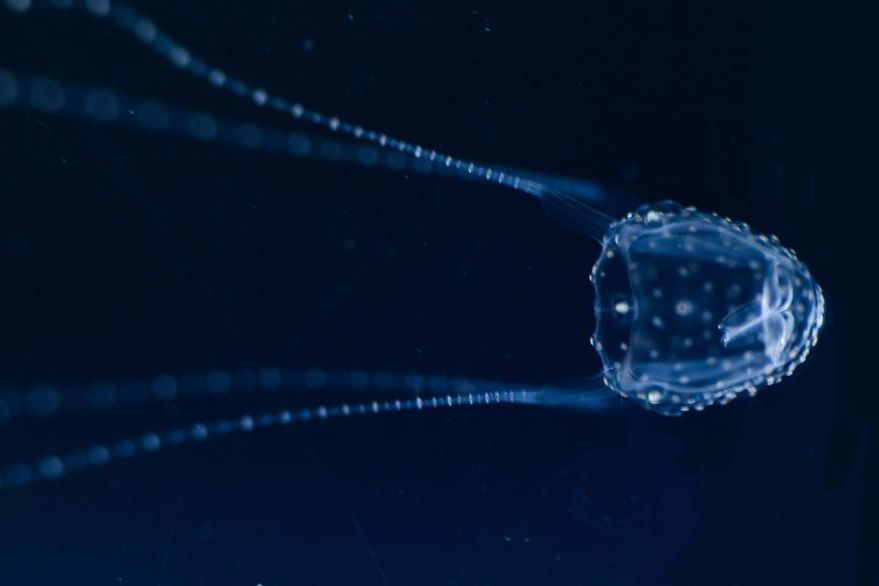
The highly venomous Irukandji jellyfish (Carukia barnesi) is believed to cost Australia an estimated $15-20 million annually in sting-related medical care and over $1 billion in lost tourism dollars when a death occurs. The sting is excruciating and can kill. Despite this, virtually nothing is known about the jellyfish, which is extremely hard to survey in its natural environment.
A JCU PhD researcher who took to the sea to pursue a world-first study into the environmental triggers that guide the elusive Irukandji jellyfish has dispelled one theory – that wind patterns nudge them closer to beaches – and generated other new data which could aid future strategies to help keep swimmers safe.
Prior to marine biologist Olivia Rowley’s study, most information on the presence and abundance of the tiny (max. 30 mm) transparent jellyfish in Far North Queensland waters was based on hospital sting records – which did not include direct identification of the culprit stinger.
“They are virtually invisible in the water and low in number compared to other jellyfish. So, they are termed a ‘logistically difficult species’, which means they're hard to find and hard to study. Therefore, few people do, even though they have a huge impact on communities, especially in terms of tourism,” said Dr Rowley, a member of JCU’s Tropical Australian Stinger Research Unit (TASRU).
Undeterred and aided by her TASRU colleagues, Olivia embarked on a scientific voyage of discovery to capture Irukandji in the wild and explore environmental factors – particularly wind and rainfall – that could influence their presence and numbers during stinger seasons.
“This whole study was simply trying to understand what caused the jellyfish to turn up when they did. And if we could see anything that would predict how many of them would turn up,” she said.
Over six consecutive stinger seasons (November 2013 to January 2019), aided by funding from the Lions Foundation, Dr Rowley and the TASRU team undertook 153 expeditions to the offshore waters of Double and Haycock Islands, where they netted a total of 960 specimens – the result of 460 hours of work.
“There are some jellyfish where you pick up that many specimens in one day’s work,” said Dr Rowley ruefully.
“We had to put in a lot of hours to gain sufficient data to start drawing conclusions on natural variability in the presence and absence of these jellyfish – not just based on the numbers we netted, but also the environmental/weather conditions at the time.
“The more variability we had in the environment and in the number of jellyfish we saw, the better, in terms of exploring environmental patterns.”
Catching the ghostly Irukandji was no mean feat. Rather fittingly, it happened at night. The jellyfish are attracted to light. The 5.8 metre research vessel lowered high-powered LED lights into the sea on either side of the craft for three hours (between 7 and 10 pm), then waited. Boat-based observers identified the approaching jellyfish, which were then captured with fine mesh scoop nets and transferred to individual containers.
The operation was not without risk. Safety precautions were religiously followed to avoid direct contact with the jellyfish.
The data collected by Dr Rowley was what scientists’ term “quite interesting” in shape.
Essentially, 50 per cent of the time, Irukandji were there and 50 per cent of the time, they were not. Some nights, the team would catch one or two, and other nights up to about 150. So, Dr Rowley has a good data set for low numbers of the animals, but not high numbers. As no other scientists have ever gone out to tally Irukandji in their natural environment, using this method and over that time frame, it could just be that they don’t occur in higher numbers.
She did gather sufficient data to disprove a popular theory that North-easterly winds lure the Irukandji closer to shore in greater numbers.
“We believe, given the results of this study, that wind direction has no influence on the presence or abundance of these animals,” she said. “Instead, what we believe is North-easterly winds tend to coincide with when the beaches are calmest and the weather is hottest, so there are a higher number of people in the water, which increases the probability of getting stung.”
Historically, rainfall, which changes salinity levels in sea water, has been known to influence the abundance of other jellyfish species. But Dr Rowley’s data indicated that statistical relationships between Irukandji and rainfall were just too low (16 to 20 percent) to venture advice which could reliably be used as a human safety guide.
The six-year study has created a world-first database on the presence and abundance of this venomous jellyfish in Far North Queensland waters. At the same time, it has highlighted just how much we still need to learn about this species. About 80 per cent of Irukandji’s movements and numbers remain a mystery.
“Really, it’s been a bit like finding a needle in a haystack, and in that way, it's been wicked to be on the leading edge of such research,” said Dr Rowley.
“The idea is that this database will become a resource, used by other researchers in multiple different ways, to try and fill some of the knowledge gaps that still exist for this species. The data will provide a steppingstone to greater understanding of the Irukandji, which, in turn, will inform the development of more effective risk management strategies.”