
Australian Institute of Tropical Health and Medicine Our impact AITHM Stories A deeper dive into shellfish allergy diagnosis
A deeper dive into shellfish allergy diagnosis
- MRCMHR
- Future Students
- JCU Global Experience
- International Students
- Student experience
- Open Day
- How to apply
- Pathways to university
- Living on Campus
- Courses
- Publications
- Mature students
- Scholarships
- Entry options
- JCU Families
- JCU Heroes Programs
- Aboriginal and Torres Strait Islander in Marine Science
- Elite Athletes
- Defence
- Capability.Co
- AI@JCU
- AALL
- Current Students
- Student Ambassador Program
- New students
- JCU Orientation
- LearnJCU
- Placements
- EDQS
- Unicare Centre and Unicampus Kids
- Graduation
- Off-Campus Students
- JCU Job Ready
- Safety and Wellbeing
- JCU Prizes
- Professional Experience Placement
- Employability Edge
- Art of Academic Writing
- Art of Academic Editing
- Careers and Employability
- Health, Wellbeing and Belonging
- Career Ready Plan
- Careers at JCU
- Partners and Community
- School Outreach and Widening Participation
- Alumni
- International partnerships
- About JCU
- Reputation and Experience
- Chancellery
- Governance
- Celebrating 50 Years
- Academy
- Indigenous Engagement
- Education Division
- Research Festival
- Graduate Research School
- Research Division
- Research and Innovation Services
- CASE
- College of Business, Law and Governance
- College of Healthcare Sciences
- College of Medicine and Dentistry
- College of Science and Engineering
- MPE
- Anthropological Laboratory for Tropical Audiovisual Research (ALTAR)
- Rural Remote and Tropical Health Systems
- Agriculture Technology and Adoption Centre (AgTAC)
- Advanced Analytical Centre
- Australian Institute of Tropical Health and Medicine
- AMHHEC
- Aquaculture Solutions
- AMHRA
- JCU Digital Wellbeing Group
- ARCSTA
- Lions Marine Research Trust
- Australian Tropical Herbarium
- Australian Quantum & Classical Transport Physics Group
- Boating and Diving
- Clinical Psychedelic Research Lab
- Centre for Tropical Biosecurity
- Centre for Tropical Bioinformatics and Molecular Biology
- CITBA
- CMT
- Centre for Disaster Solutions
- CSTFA
- Cyclone Testing Station
- The Centre for Disaster Studies
- Daintree Rainforest Observatory
- Fletcherview
- JCU Eduquarium
- JCU Turtle Health Research
- MARFU
- Orpheus
- TESS
- JCU Ideas Lab
- CADSI
- CNL
- TARL
- eResearch
- Indigenous Education and Research Centre
- Past Course and Subject Handbooks
- Estate
- Work Health and Safety
- Staff
- Discover Nature at JCU
- Cyber Security Hub
- Association of Australian University Secretaries
- Services Division
- Environmental Research Complex [ERC]
- Foundation for Australian Literary Studies
- Gender Equity at JCU
- Give to JCU
- Indigenous Legal Needs Project
- Inherent Requirements
- IsoTropics Lab
- IT Services
- JCU Webinars
- JCU Events
- JCU Motorsports
- JCU Sport
- Library
- Mabo Decision: 30 years on
- Marine Geophysics Laboratory
- Office of the Vice Chancellor and President
- Outstanding Alumni
- Policy
- PAHL
- Queensland Research Centre for Peripheral Vascular Disease
- Rapid Assessment Unit
- RDIM
- Researcher Development Portal
- Roderick Centre for Australian Literature and Creative Writing
- Contextual Science for Tropical Coastal Ecosystems
- State of the Tropics
- Strategic Procurement
- Student profiles
- SWIRLnet
- TREAD
- TropEco for Staff and Students
- TropCOVID: Mapping COVID-19 Immunity in Far North Queensland
- TUDLab
- VAVS Home
- WHOCC for Vector-borne & NTDs
- Media
- Copyright and Terms of Use
- Australian Institute of Tropical Health & Medicine
- JCU Respect
- Pay review
- Research
01 September 2023
Shellfish are the number one food-related trigger of fatal allergic reactions in Australia. Accurate diagnosis is vital for identifying appropriate management tools and preventing adverse health effects. However, new research shows that one of the most common methods for diagnosing food allergies can yield unreliable results.
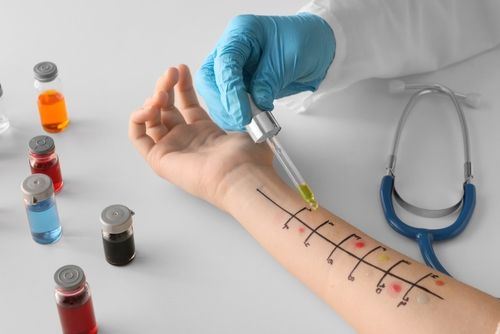
Skin prick testing (SPT) is often the first-line diagnostic approach for identifying an allergy to animals, plants, drugs and other culprits. It involves a healthcare worker placing a drop of solution made from the suspected culprit on a person’s forearm or back and seeing if the body reacts; if the skin becomes red and swollen, the test is positive. It’s considered an affordable, accessible and low risk method.
In a recent study, a team led by Dr Thimo Ruethers and Professor Andreas Lopata from the Australian Institute of Tropical Health and Medicine (AITHM) and JCU Singapore’s Tropical Futures Institute (TFI), tested a number of commercial crustacean and mollusc SPT solutions used to diagnose shellfish allergies.
“We suspected that some extracts may not even contain the specific allergenic shellfish proteins (allergens) required for triggering a skin reaction that would suggest a patient is allergic or not. So, we purchased 16 SPT preparations from 6 different manufacturers and tested them using biochemical and immunological methods,” Dr Ruethers says.
“We did find a huge diversity in the overall allergen content; some extracts did not contain a sufficient amount of shellfish allergen components. Thus, diagnosis is largely hampered, and tests could return a false negative.”
A false negative SPT result can lead to life-threatening anaphylaxis if patients are exposed to food they are allergic to. Therefore, other diagnostic tests — such as oral food challenges in clinical settings — are often still required.
The study not only found that some commercial solutions lack a sufficient amount of shellfish allergens, but they also lacked diversity of shellfish allergens.
“Every single shellfish is different. This is important because, for example, if you test only for calamari and the patient is negative, they may be highly allergic to a different type of shellfish, such as prawns,” Dr Ruethers says.
“That’s only one element. We then must consider the diversity of each kind of shellfish across regions. The prawns we eat in Australia are quite different to those you would eat in Europe or North America. Yet, Australia’s commercial SPT extracts are produced and imported from Europe and North America.
“In this study, none of the prawn SPT extracts we analysed were a true reflection of prawns eaten in Australia.”
In 2019, Dr Ruethers, Professor Lopata and a team undertook a similar study, evaluating the effectiveness of 26 SPT extracts for fish allergy, and found considerable variability. They also discovered the critical importance of species-specific allergies.
“Both of these studies provide proof that commercial SPT solutions are not reliable for diagnosing fish or shellfish allergies,” Dr Ruethers says. “Standardisation of allergen extracts is urgently needed to improve the accuracy and reliability of SPT.”
Food allergies pose major public health concerns, lower quality of life and can be fatal. Professor Lopata says developing more reliable allergy diagnostic tools, including blood tests, requires further interdisciplinary research and is necessary to safeguard allergy sufferers globally.
“We want patients to be able to make informed decisions about their diet and at least be aware of what can happen. We need to be able to identify those at risk of anaphylaxis to ensure they have an emergency medication with them at all times. At the end of the day, it saves lives,” Professor Lopata says.
This research received funding from the National Health Medical Research Council (NHMRC). Dr Ruethers will present it as a Hot Publication at the upcoming ASCIA conference in Sydney (5-8 Sep) with the support of the Centre for Food & Allergy Research (CFAR).