
Assessment & Learning Tools
Assessment and Learning Tools for MPE
This page explains which assessment and learning tools are used during midwifery practice experience (MPE), when to use each one, and how they support student learning, safety and progression.
It is intended for students, Clinical Partners and/or Clinical Assessors.
Quick actions (start here)
Which tool do I use?
Assessment during MPE uses several learning and assessment tools together. No single tool, on its own, is sufficient to meet registration requirements; these are achieved through a combination of MPE hours, continuity of care experiences (CoCE), documented experiences, and satisfactory performance in learning tools and summative assessments.
- MCATs – Midwifery Clinical Assessment Tools: skills-based learning tools.
- AMSAT – Australian Midwifery Standards Assessment Tool: overall practice assessment.
- Other tools and documentation – e.g. timesheets, reflection, episodes of care and ongoing reflection
Please note, students enrolled from 2025 onward are using the midwifery clinical assessment tools detailed here. Students enrolled prior to 2025 will complete the clinical assessment tools included in their cohort hardcopy portfolio "Midwifery Clinical Workbook". If you have any questions about this, please contact JCU midwifery academics at mpe@jcu.edu .
MCAT – Midwifery Clinical Assessment Tools
MCATs are learning tools designed to support:
- skill acquisition and consolidation
- supervised practice within scope
- formative feedback during MPE.
They:
- focus on specific clinical skills or skill groups
- are assessed progressively across the course according to subject requirements
- support learning and readiness for broader assessment
- provide evidence of clinical experience but do not determine overall competence for practice on their own.
Acknowledgement of MIDAC
MCATs are adapted from the Victorian Standardised Clinical Assessment Tool for Midwifery Students, developed by Midwifery Academics Victoria (MIDAC). This work reflects substantial collaboration between midwifery academics, clinicians, students, and key stakeholders and is used with acknowledgement of MIDAC’s contribution to midwifery clinical assessment.
- A total of 23 clinical skills (drawn from the MIDAC framework) are included and aligned with NMBA Midwife Standards for Practice (2018).
- Each MCAT references the relevant standard(s).
- All sections of each tool must be completed for the assessment to be valid.
Note: Woman-centred care recognises the woman’s baby/babies, partner, family and community.
MCATs must be assessed by:
- the supervising registered midwife, or
- a registered nurse when the tool is undertaken in the Special Care Nursery, where permitted by local policy.
Some health services restrict MCAT assessments to senior midwives only; local policy must always be followed.
If part of a learning tool cannot be directly observed:
- the student may explain the underlying knowledge, or
- demonstrate components via simulation or discussion, if appropriate.
Examples:
- Working with pain in labour – if TENS is not available, the student may explain pad placement and underlying physiology.
- Care of the woman progressing in labour – students demonstrate principles of care with the woman they are caring for; not all variations must be observed in one assessment.
The Modified Bondy Scale is used to assess clinical skills progressively across the course.
Performance levels (summary)
- Independent (I) – safe, accurate, efficient performance without cues for the student’s level.
- Proficient (P) – safe, accurate performance with occasional supportive cues.
- Assisted (A) – safe, accurate performance with frequent verbal and occasional physical directive cues.
- Supported (S) – safe only with continuous verbal and frequent physical cues; not safe alone.
- Dependent (D) – unsafe; unable to perform behaviour without continuous support. The scale reflects performance at the student’s stage of learning, not the standard expected of a registered midwife.
MBSClinicalAssessorGuide_Video
MBS Clinical Assessor PPT.
| Scale level | Professional standards and procedures | Quality of performance | Assistance required |
|---|---|---|---|
Independent (I) |
|
|
|
Proficient (P) |
|
|
|
| Assisted (A) |
|
|
|
Supported (S) |
|
|
|
Dependent (D) |
|
|
|
- MCATs are the formal name for the midwifery clinical learning tools.
The MCAT forms are structured tools that guide and document how students perform specific midwifery skills (e.g. abdominal assessment, care in labour, newborn care) during MPE. - They function as learning tools because they are designed for teaching as well as assessment.
Each MCAT sets out the steps or elements of the skill, prompts the student to self‑assess, and then records the assessor’s rating using the Modified Bondy Scale, which supports feedback and reflection rather than just a “pass/fail” outcome. - They are used progressively across the course.
Different MCATs are linked to particular subjects and levels (e.g. early skills in NS2277, more complex skills in NS3991/NS4993), so students revisit and build on skills over time, which is exactly what a learning tool is intended to do. - They sit underneath, and feed into, broader assessment.
MCATs provide evidence that a student has practised and been observed performing particular skills, which then supports higher‑level judgements about overall practice made via AMSAT and other assessments.
Learning tools support the development and assessment of clinical skills in practice.
JCU has chosen 23 of the original 26 MIDAC MCAT tools to assess student competency against midwifery standards.
| Number | Learning Tool (MCAT) |
|---|---|
| 1 | Initial pregnancy assessment |
| 2 | Ongoing pregnancy care |
| 3 | Abdominal examination |
| 4 | Performing and interpreting an antenatal cardiotocograph |
| 5 | Care of the woman on admission to the birth environment |
| 6 | Performing and interpreting an intrapartum cardiotocograph |
| 7 | Care of the woman progressing in labour |
| 8 | Working with pain in labour |
| 9 | Epidural analgesia in labour |
| 10 | Insertion of a urinary catheter |
| 11 | Care of the woman and baby during an induction of labour |
| 12 | Care (reception) of the newborn at birth |
| 13 | Vaginal examination |
| 14 | Maternal and baby wellbeing assessment following birth |
| 15 | Facilitating breastfeeding for the woman and baby |
| 16 | Breastfeeding challenges for the woman and baby |
| 17 | Care of a woman after a caesarean birth |
| 18 | Blood sampling of the newborn baby |
| 19 | Full examination of the newborn baby |
| 20 | Enteral/tube feeding a baby |
| 21 | Assessment and clinical management of the unwell baby- situated learning |
| 22 | Administering an injection to the newborn |
| 23 | Neonatal resuscitation via simulation |
Attribution Statement
James Cook University Midwifery acknowledges the extensive work of the Midwifery Academics of Victoria (MIDAC) in developing the Victorian Standardised Clinical Assessment Tool for Midwifery Students, 4th Edition (2021). This tool and its accompanying guidelines were created through significant contributions from Victorian midwifery academics, clinicians, students and key stakeholders, with evidence updates completed across the 2nd, 3rd and 4th editions by numerous MIDAC members. JCU recognises and appreciates the foundational work of the authors of the earlier editions, as well as the Victorian Department of Human Services for funding the development of the original 2009 tool. Materials from the Victorian Standardised Clinical Assessment Tool may be reproduced for non-commercial, educational purposes with acknowledgement to the authors and Victorian Midwifery Academics (MIDAC), Melbourne, Australia.
AMSAT – Australian Midwifery Standards Assessment Tool
AMSAT is the primary tool used to evaluate overall midwifery practice against the NMBA (2018) Midwife standards for practice.
It is used for:
- formative assessment (e.g. to assist students to determine progress or, when learning needs are identified)
- summative assessment (end of placement or key progression points).
AMSAT:
- assesses practice at the expected level for the student’s stage
- supports decisions about progression, support strategies and readiness to complete MPE.
AMSAT assessments:
The AMSAT evaluates midwifery practice against the expected standard for the student’s level of education.
- First‑year students are assessed against first‑year expectations.
- Fourth‑year students are assessed against knowledge and skills appropriate to fourth‑year practice.
Assessment involves making a professional judgement about a student’s performance against:
- established learning objectives, and
- the NMBA (2018) Midwife standards for practice
Assessment of student performance:
- occurs during midwifery placements (MPE),
- involves the student, the clinical assessor and the university, and
- supports consistent and standards‑based evaluation of practice.
- is developed against the NMBA (2018) Midwife standards for practice, and
- has been demonstrated to be a valid, reliable and acceptable tool for assessing midwifery student workplace performance
- uses a validated scoring sheet
- uses a feedback sheet
- uses behavioural cue examples
- together, these provide performance ratings, structured feedback, and illustrative behaviours
- only the feedback components may be adapted to local needs
The AMSAT assessment
The Australian College of Midwives (ACM) provides support resources for AMSAT, including: The AMSAT Resource Manual
Videos:
AMSAT FORM
If you would like further information about the AMSAT, please reach out via mpe@jcu.edu.au to the relevant subject coordinator.
For more information visit AMSAT-FAQs.pdf
Registration and Accreditation Requirements: Other tools and documentation
Clinical learning, assessment and documentation during MPE are structured to meet:
- ANMAC (2021) Midwife accreditation standards, which set minimum clinical experience and continuity of care requirements, and
- NMBA (2018) Midwife standards for practice, which require graduates to demonstrate capability across all seven (7) standards
Midwifery practice requirements (MPR) are met through the combination of:
- completed MPE hours,
- continuity of care experiences,
- documented clinical experiences,
- successful completion of learning tools where required, and
- satisfactory performance in formal assessments, including summative AMSAT.
For detailed course-level requirements, see: Courses & Requirements and MPE.
All students complete the required theoretical learning before commencing midwifery practice experience (MPE).
Clinical learning opportunities during MPE will vary between students.
MPE occurs across a range of care settings, including:
- Hospital
- Community
- Rural and remote
- Private practice
As a result, the type and range of clinical encounters may differ across placements.
Students progress through competencies at different rates and meet elements of practice at different points in the program.
This variation is expected in real world midwifery education and aligns with Australian Nursing and Midwifery Accreditation Council standards.
Students are supported to develop capability and confidence across the continuum of care.
Assessment processes recognise progression over time and ensure all graduates meet the minimum requirements for safe, woman-centred midwifery practice.
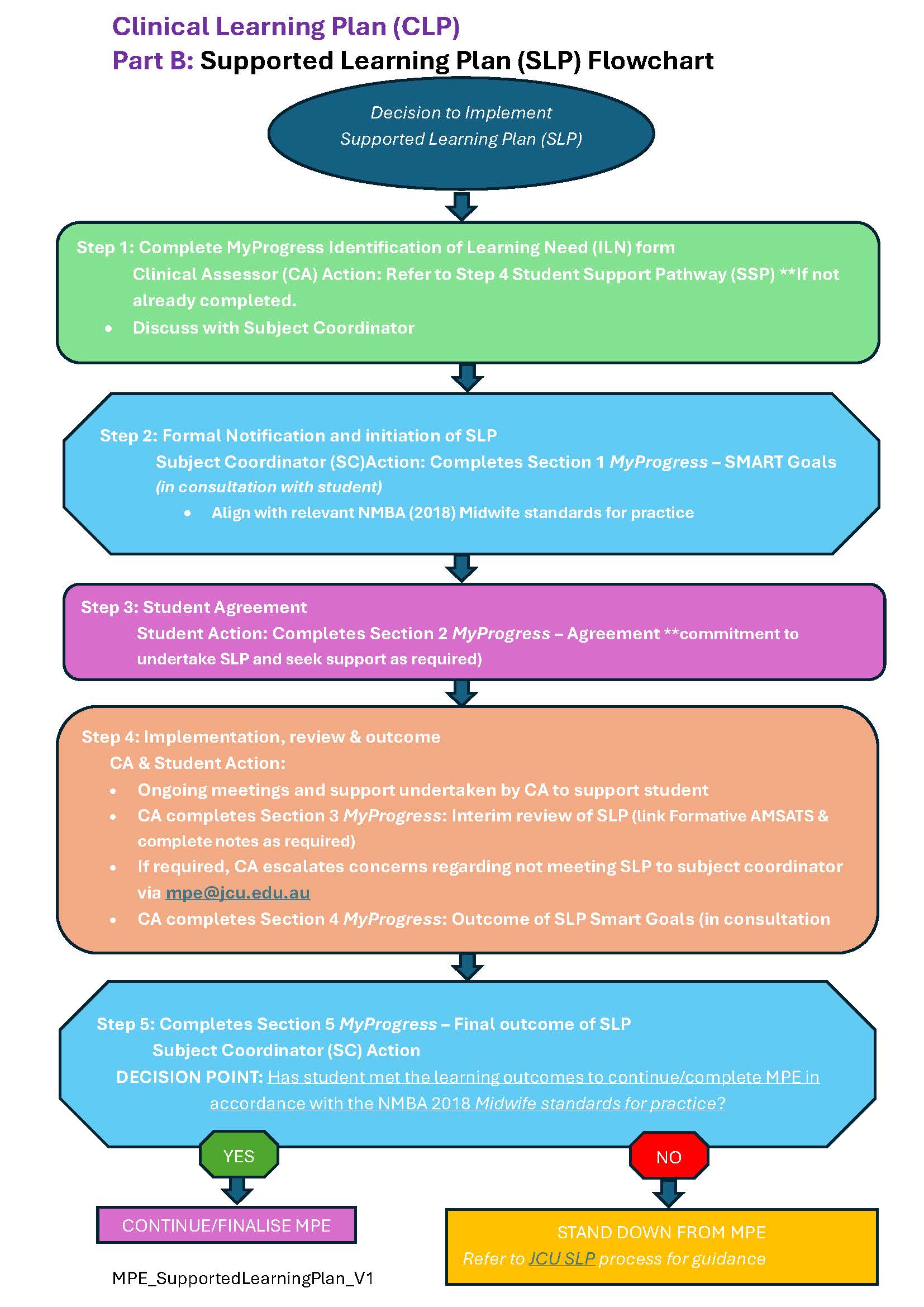
Early feedback and intervention are essential. Where required, additional support strategies, including a Supported Learning Plan (SLP), may be implemented.
- Refer to the Student Progress section for guidance on identifying and escalating concerns. You can also contact the subject coordinator via mpe@jcu.edu.au
If a student is not demonstrating the expected level of competence:
- address concerns using the Student Support Pathway (CLP Part A)
- in the event that the CLP Part A does not resolve the learning needs, consider initiating a Supported Learning Plan (SLP – CLP Part B)
- use AMSAT and other tools to document performance and progress.
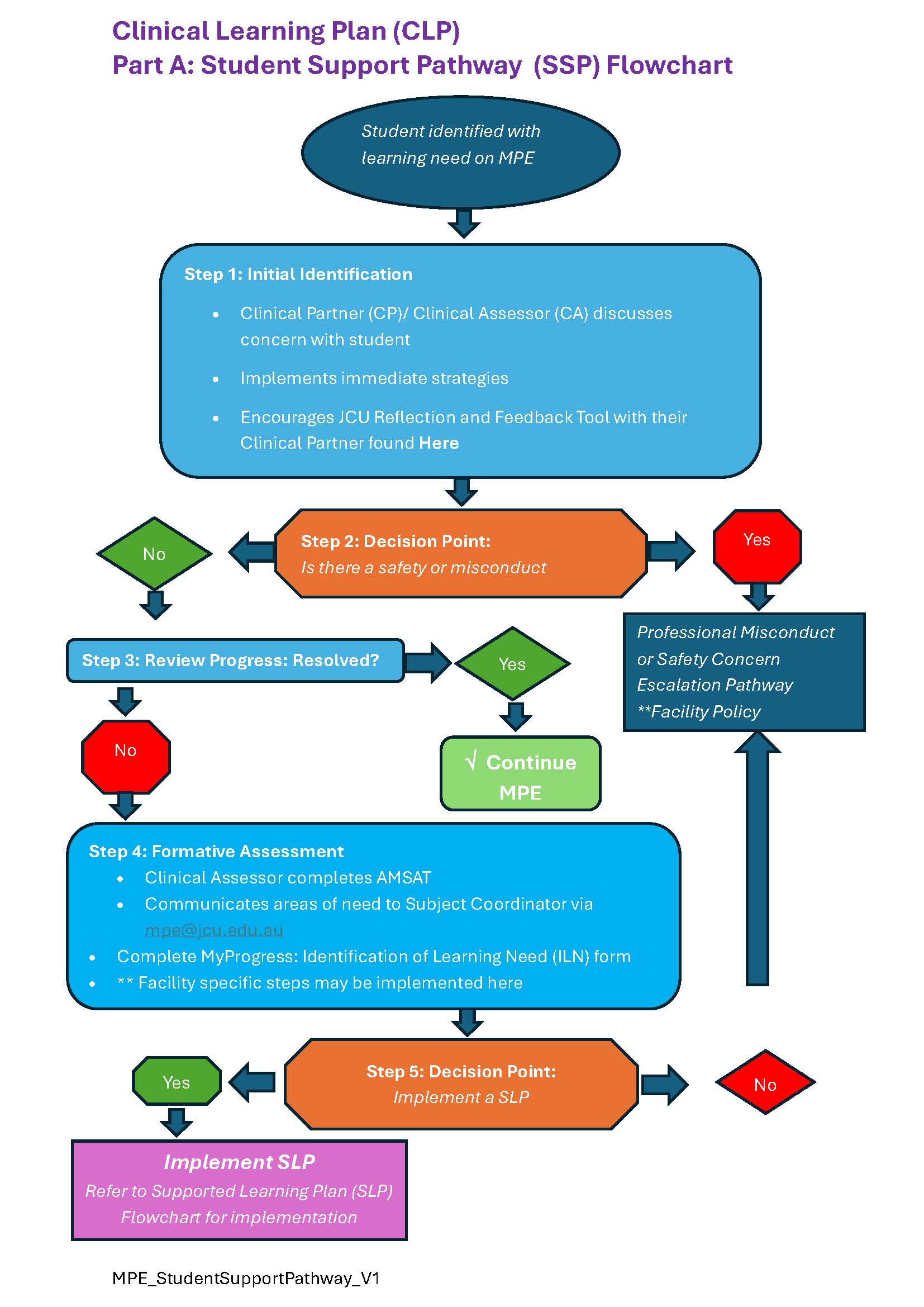
If serious safety or conduct concerns arise, follow local facility policies and escalate immediately.
See: Student Progress and Policies & Safety.
Reflecting on midwifery practice experience (MPE) is essential because it helps you link your experiences in practice to professional standards, improve the safety and quality of care, and demonstrate ongoing learning and professional development expected of midwives in Australia and internationally. Reflection supports you to recognise what went well, identify areas for growth, and show how your practice aligns with midwifery standards and codes of professional conduct.
Why reflect on MPE?
- To connect clinical experiences with midwifery standards and learning outcomes.
- To develop insight into your strengths and areas needing improvement in practice.
- To support safe, woman‑centred care through continuous learning and quality improvement.
- To provide evidence of reflective practice, which is a professional expectation for midwives and students.
How and when to use the Reflection and feedback tool
- When to use it
- After significant learning moments during MPE (e.g. new skills, complex cases, communication challenges).
- When you receive feedback from a Clinical Partner or Clinical Assessor and want to record what you learned and what you will do differently next time.
- As part of preparing for formative or summative assessment discussions, or when a learning need has been identified.
- How to use it
- Briefly describe the situation or experience.
- Reflect on what went well and what could be improved, linking your insights to relevant midwifery standards or learning outcomes.
- Identify specific actions or goals for your next MPE shift or future practice.
NOTE: Your placement facility may have their own reflection and/or feedback documentation which they may request you to utilise.
Please also refer to the resources available in the Student Support section. Reflection-and-Feedback-Tool_2020.pdf
This website brings together a range of valuable resources to support student learning, clinical supervision and assessment throughout midwifery practice experience (MPE).
You will also have access to local supervisory supports, including clinical coaches, educators and supervisory training networks within your health service.
If you cannot find the information or guidance you are looking for here or locally, you can also access resources in Help: Student Support Services guide or by contacting the JCU midwifery academic team via mpe@jcu.edu.au.