
Student Progress
Supporting Students with Identified Learning Needs During MPE
- Regular communication, timely feedback, and early recognition of concerns are central to supporting students and managing learning needs effectively during MPE
- Learning needs are identified when a student’s performance does not align with the NMBA (2018) Midwife Standards for Practice or the expected level of competence for their stage of the course.
- Indicators of learning needs may include unsafe or inconsistent practice, gaps in knowledge or skills, difficulty applying theory to practice, and reduced confidence or clinical judgement.
- Early recognition and proactive management of learning needs promote student success and support safe, high-quality maternity care.
- Prompt intervention at the local level can prevent escalation and contribute to positive learning and placement outcomes.
- All actions must comply with local facility policies, particularly where safety or professional misconduct concerns are identified.
- Subject Coordinators must be informed of any concerns promptly by emailing mpe@jcu.edu.au.
Quick actions (start here)
Well done, you have made a step in the right direction by identify that you are struggling
Step 1: Talk to your Clinical Partner and/or Clinical Assessor
Step 2: Review the information and resources on this page & your subject requirements found in LearnJCU
Step 3: Contact your Subject Coordinator via mpe@jcu.edu.au
Step 1: Talk to your student about these concerns
Step 2: Review the information and resources on this page including the Clinical Learning Plan (CLP) & the student's scope of practice for the relevant subject
Step 3: Follow local escalation procedures & contact the subject coordinator via mpe@jcu.edu.au.
Students: when to seek support
Students have an active responsibility to seek support early when they experience challenges during MPE. Recognising and communicating learning needs is an essential part of professional practice and safe care.
Students are expected to:
- reflect on their own performance and identify when they are struggling to meet expected standards
- seek feedback and guidance from their Clinical Partner or Clinical Assessor
- raise concerns promptly when they feel unsure, overwhelmed, fatigued or outside their scope or capability
- engage constructively with feedback and agreed support strategies.
Seeking support is viewed as professional behaviour and will not disadvantage a student. Failure to seek support when safety, learning or wellbeing are affected may place the student, women, babies or others at risk and may result in escalation.
Where concerns persist or the student feels unable to raise issues locally, students are encouraged to contact their Subject Coordinator via mpe@jcu.edu.au.
For more information visit HELP_StudentSupportServices.pdf
Potential Concerns and Required Actions
These are managed through supervision, feedback and assessment processes, including AMSAT and learning plans.
See: Student Progress → Clinical Learning Plans for guidance.
These require immediate escalation in line with local facility policies and may involve formal reporting or removal from practice settings.
See: Policies & Safety for mandatory notification and incident reporting guidance.
Responsibilities
Supporting student progress is a shared responsibility involving:
- the student
- the Clinical Partner (CP)
- the Clinical Assessor (CA)
- the Subject Coordinator (SC) and wider JCU Midwifery Academic team.
Everyone involved must:
- recognise concerns early
- communicate clearly
- document actions
- support safe, woman-centred care.
Early identification and timely intervention:
- improves student outcomes
- supports safe practice
- reduces the need for escalation
JCU Clinical Learning Plan
Learning needs are identified when a student’s performance during MPE does not align with:
- the NMBA (2018) Midwife standards for practice , or
- the expected level of competence for their stage in the course.
Indicators of identified learning needs may include:
- unsafe or inconsistent clinical practice
- gaps in required knowledge or clinical skills
- difficulty applying theoretical knowledge to clinical practice
- reduced confidence
- developing or impaired clinical judgement
Identification of learning needs supports safe midwifery practice and progression toward professional competence in accordance with regulatory requirements (NMBA, 2018). The JCU Clinical Learning Plan supports the student and clinical assessor to identify and implement clearly defined learning goals, appropriate support strategies, and measurable outcomes.
See: Policies & Safety → Mandatory notification.
See: Assessment & Learning Tools and MyProgress for forms and instructions.
For more information visit Guide-to-Clinical-Learning-Plans-on-MPE-including-SLPV1.pdf
The Student Support Pathway, Part A - CLP, provides a structured, staged approach for identifying, managing, and responding to student learning concerns during MPE, with an emphasis on early intervention, student support, safety, and regular feedback to develop student capabilities.
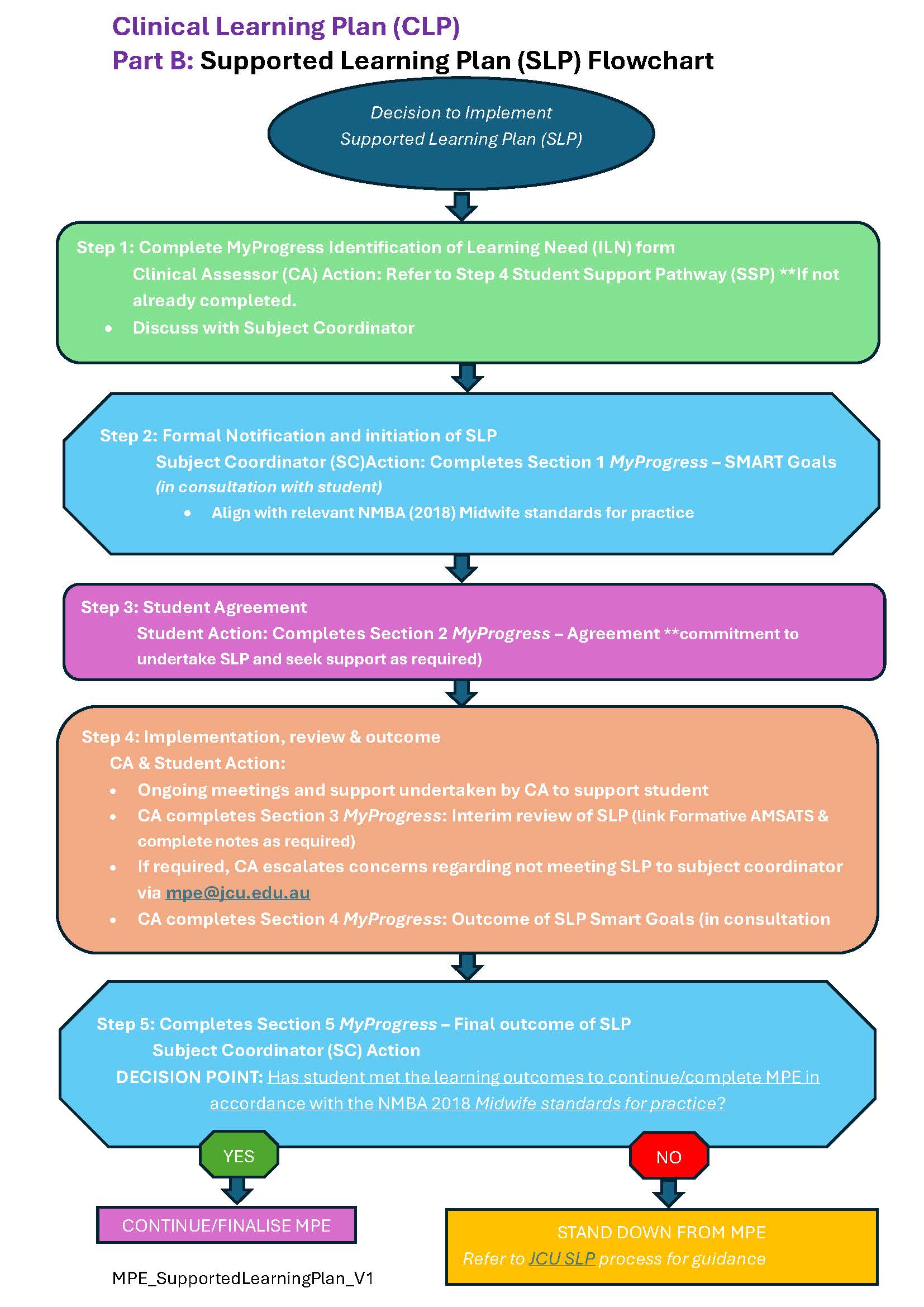
A Supported Learning Plan (SLP) is implemented when a student’s performance during MPE does not meet expected standards despite formative feedback and support through CLP Part A.
When is an SLP needed?
An SLP may be implemented when:
- learning needs persist following initial support, or
- there is a pattern of concerns across shifts or settings.
An SLP can be initiated at any time during MPE in any clinical setting. Ideally, it is developed early when indicators suggest the student is not demonstrating a satisfactory standard.
SLP process
An SLP usually includes:
- clearly described learning needs linked to NMBA Standards
- specific, measurable, achievable, relevant and time-bound (SMART) goals
- identified learning strategies and supports
- defined review points and responsibilities (student, CP, CA, SC).
The duration of an SLP depends on the learning needs and goals. Regular reviews, feedback and communication are essential throughout. Progress and outcomes are documented in MyProgress where used, or in the approved hardcopy format.
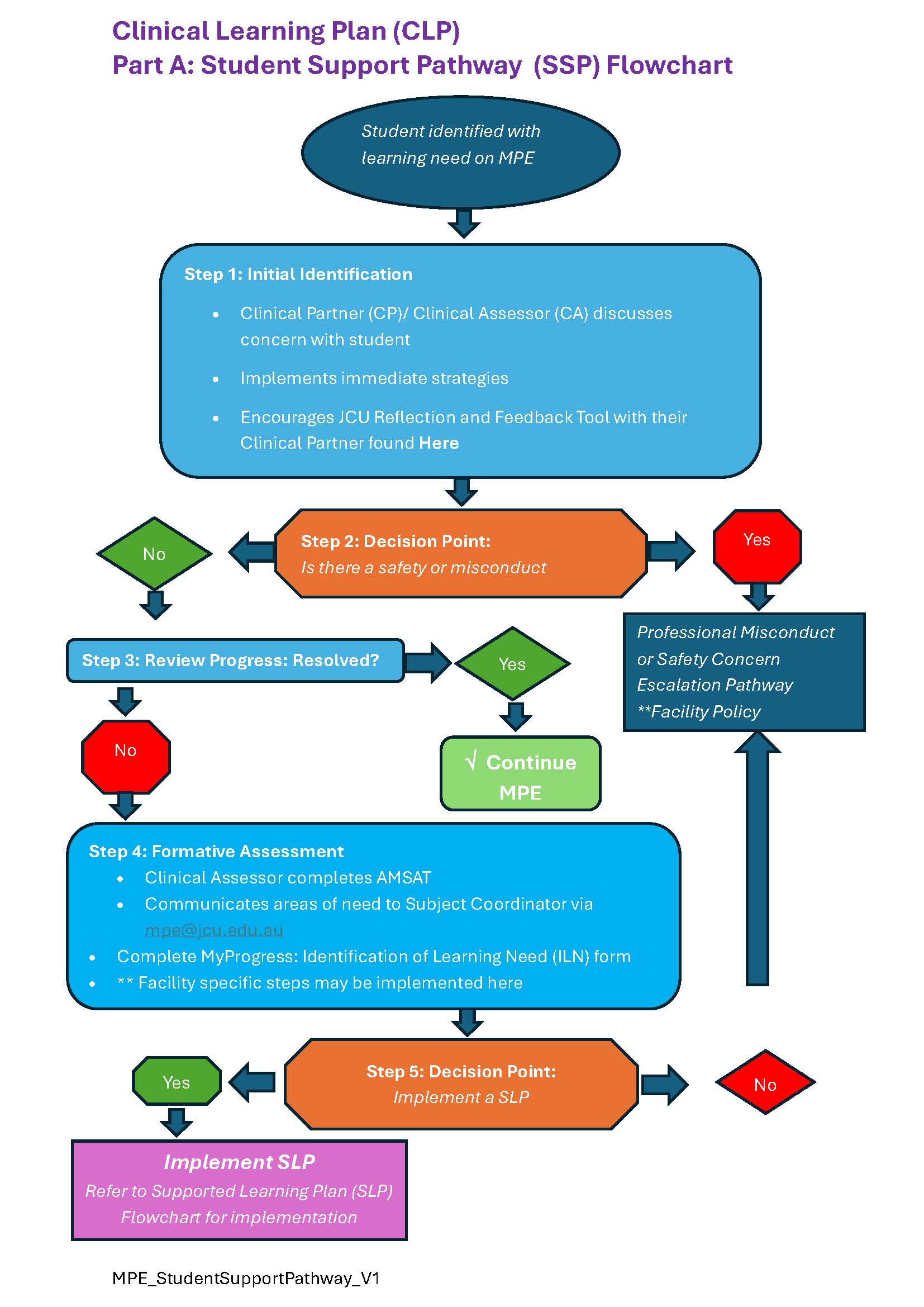
If learning or safety concerns arise:
- follow local facility policies and escalation procedures first
- notify the Subject Coordinator via mpe@jcu.edu.au
- if urgent, contact the Course Coordinator or Deputy Course Coordinator using the details on the Contact page.
Note: the student is to be involved in all stages of the implementation of the SLP
Clinical Assessor: Identifies learning needs, conducts formative assessment using AMSAT, and documents progress using the ILN form in MyProgress
Subject Coordinator: Determines the format and duration of the SLP (including timing for future formative AMSATs, completes MyProgress sections, and provides formal notification.
Student: Reviews the plan, agrees to undertake requirements within specified timeframes, and engages with support strategies.
Clinical Partner / Clinical Assessor: Provides feedback, supports strategies, and participates in reviews as appropriate.
Clinical Learning Plan – Supported Learning Plan Flowchart