
Midwifery Students
Guide to practising safely and successfully during MPE
This page explains what is expected of you on placement, how to prepare, how to ask for help early and how to meet professional, regulatory and course requirements.
Quick actions (start here)
Use this section at the beginning of each placement or shift to support you to practise safely and effectively.
- Arrive on time for every shift, allowing sufficient time to be ready to commence work at the scheduled start time
- Always wear your JCU clinical identification badge
- Ensure your year level badge is visible where required
- Ensure your uniform, grooming and professional presentation comply with the JCU Professional Attire (Uniform) Policy and local facility requirements
- If asked, provide official photo identification
- Introduce yourself clearly and professionally as a JCU midwifery student
Ensure you are oriented to the clinical environment, including:
- emergency and evacuation procedures
- documentation and electronic record systems
- medication policies and processes
- key staff members and supervision arrangements.
- Confirm who will supervise you on each shift, including your Clinical Partner and/or Clinical Assessor.
- Clarify how and when feedback will be provided, for example mid-shift and end-of-shift.
- Know how to approach your supervisor with questions, concerns or learning needs.
See MyProgress → Allocating Clinical Assessor and recording feedback.
- Ensure you understand which clinical activities are appropriate for your year level.
- Work within your scope and clarify with local facilities policies
- Seek supervision before undertaking unfamiliar or complex activities.
- Be aware of local policies that may affect your scope of practice.
See Courses & Requirements → Scope of practice by year, and Policies and Safety → Scope and delegation.
- Discuss potential learning opportunities with your supervisor at the start of the shift.
- Engage in suitable clinical activities such as assessments, procedures and communication tasks.
- Reflect on your learning needs and identify goals appropriate to your stage of learning.
- Understand how to raise concerns related to patient safety, supervision or learning.
- Clarify who to speak to first, such as your Clinical Partner, the nurse or midwife in charge, or Clinical Assessor.
- Know how safety concerns are escalated within the facility.
- Remember your subject coordinator and the midwifery academic team are here to support you contact via mpe@jcu.edu.au
What you need to do
During MPE, you are expected to:
- attend and prepare for all placement activities
- follow professional standards and policies
- work within your approved student scope of practice
- communicate clearly and respectfully
- seek support whenever you are unsure.
Important — unsure what to do? Ask early
If you are unsure, lack confidence or feel outside your scope:
- stop and seek guidance
- speak with your Clinical Partner and/or Clinical Assessor
- contact your Subject Coordinator via mpe@jcu.edu.au if you need additional support.
Asking for help early is a professional behaviour and supports safe, woman-centred care and successful progression.
Use these links if you are requiring further guidance.
- Student Progress → if you are struggling or unsure about your progress.
- Assessment & Learning Tools → to understand how you are assessed (AMSAT, MCATs and other tools).
- Policies & Safety → professional, legal and safety requirements.
Your responsibility during placement
You are responsible for:
- your behaviour in clinical environments
- your own learning and engagement
- practising safely under supervision
- meeting all course and placement requirements
Expectations in practice
Professional conduct
You must comply with all JCU policies, NMBA standards and facility requirements at all times.
This includes:
- maintaining professional behaviour
- respecting women, families and healthcare teams
- practising safely and ethically
- following workplace policies and procedures.
See: Policies & Safety → Professional conduct.
Accountability
You remain responsible for your learning and the actions you take in practice.
You must:
- practise safely under supervision
- follow guidance from your Clinical Partner or Clinical Assessor
- remain accountable for the care you are involved in
- respond constructively to feedback
- seek assistance if you are unsure or not confident.
You must only undertake clinical activities within your approved student scope of practice.
See: Student Progress and Scope of practice resources.
You are expected to:
- communicate respectfully with women, families and healthcare teams
- introduce yourself clearly as a JCU midwifery student
- work collaboratively as part of the healthcare team
- follow appropriate escalation processes if you have concerns.
See: Policies & Safety → Communication and escalation expectations.
You must:
- when not on formal MPE and attending CoCE appointments, ensure you wear the CoCE scrub top
- wear the approved JCU clinical uniform when on formal MPE
- always maintain professional presentation
- follow infection prevention and control standards
- comply with all facility-specific requirements.
See: Policies & Safety → Professional attire and presentation.
You must always maintain strict confidentiality.
- Do not share any clinical information on social media.
- Do not share “de-identified” information that could still be recognised.
- Follow JCU policies and AHPRA guidance on social media and professional behaviour.
Breaches of confidentiality may result in:
- removal from placement
- disciplinary action
- impact on course progression.
See: Policies & Safety → Confidentiality and social media.
Attendance, safety and escalation
To meet course requirements, you must:
- attend all required placement hours
- arrive on time, prepared and ready for practice
- notify absence according to facility and JCU requirements
Failure to meet attendance or preparation requirements may result in:
- placement interruption
- inability to progress in the course
- additional assessment or remediation requirements
See: Policies & Safety → Attendance and absence.
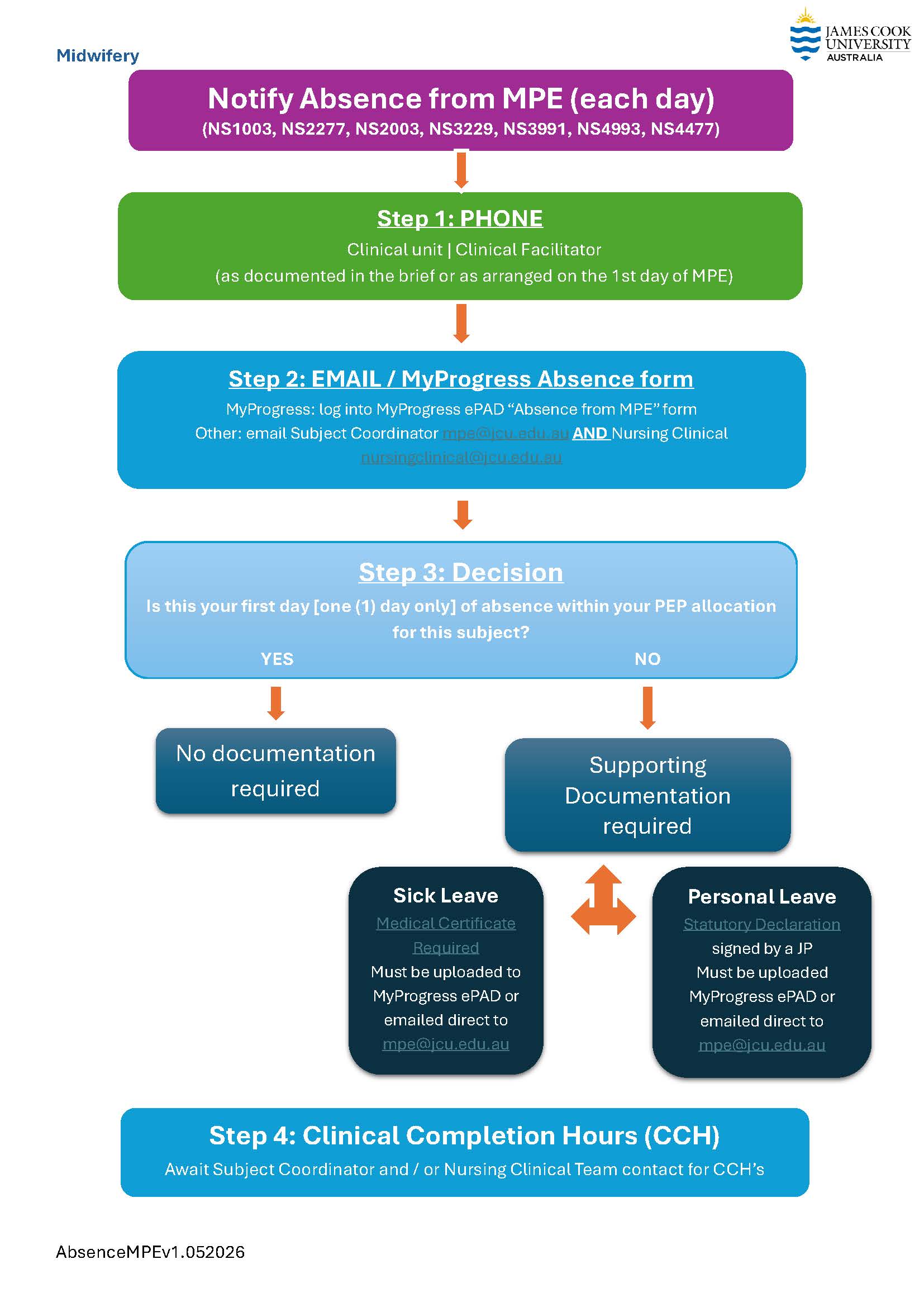
If you are unable to attend placement:
- notify both the placement facility and the university as soon as possible
- follow current health regulations related to illness and exclusion
- refer to the JCU Absence from MPE Guideline and Flowchart for detailed steps.
See: Policies & Safety and MyProgress resources.
JCU Absence from MPE Guideline and flowchart
Concerns about health professionals
You have a professional responsibility to contribute to safe, ethical and respectful clinical environments.
Students are not mandatory reporters under the Health Practitioner Regulation National Law, but you must act if you become aware of conduct that may place the safety of women, babies, families, yourself or others at risk.
- Report concerns to your Clinical Partner and/or Clinical Assessor
- Follow local facility policies for escalation
- Notify your Subject Coordinator via mpe@jcu.edu.au as soon as practicable.
Child safety concerns
Midwifery students are not mandatory reporters under the Child Safety Act, but you must always prioritise the safety and wellbeing of children and young people.
If you suspect or become aware of abuse, neglect or risk of harm:
- report immediately to your Clinical Partner or Clinical Assessor
- follow local facility child safety and escalation procedures
- notify your Subject Coordinator via mpe@jcu.edu.au as soon as practicable
- do not investigate concerns yourself.
If there is immediate danger, follow local emergency procedures.
Concerns raised in good faith are confidential, supported and will not disadvantage you.
See: Policies & Safety → Mandatory reporting and child safety.
Self-disclosure of health concerns
Midwifery students are required to self-disclose health concerns that may affect their ability to undertake MPE safely, in line with JCU policy, ANMAC accreditation standards and the National Registration and Accreditation Scheme.
You must inform JCU if you have a health condition that may impact fitness for practice or public safety during clinical learning. Disclosure relates to the impact on practice, not the diagnosis itself.
Self-disclosure allows JCU to:
- assess risk
- implement reasonable adjustments or support strategies
- meet regulatory obligations.
Information is managed confidentially and shared only on a need-to-know basis. Failure to disclose a health concern that affects safe practice may result in placement interruption or escalation under JCU fitness for practice processes.
You are encouraged to seek guidance early and discuss concerns with your subject xoordinator or the JCU Midwifery Academic team via mpe@jcu.edu.au.
See: Policies & Safety → Fitness for practice and self-disclosure.
Documentation and systems
Documentation of MPE is a requirement of AHPRA-approved midwifery programs and James Cook University.
JCU is transitioning from a hardcopy Midwifery Clinical Portfolio (MCP) to MyProgress, an online portfolio platform for documenting:
- clinical experiences
- timesheets
- episodes of care
- Continuity of Care Experiences
- AMSAT assessments
- MCAT assessments
- progression tracking.
If you use MyProgress, follow guidance in MyProgress
If you still use the hardcopy workbook, relevant information is available under Assessment & Learning Tools.
Midwifery students are responsible for ensuring all clinical documentation completed during placement meets professional, legal and safety standards.
Students must:
- Complete documentation that is accurate, timely, legible and professional.
- Practise under supervision at all times and within student scope of practice.
- Not make independent clinical record entries without appropriate supervision.
- Ensure all documentation completed by a student is reviewed and countersigned by the supervising midwife.
- Confirm local facility requirements for student access to electronic and paper-based records.
- Participate in documentation only as permitted by the health service and under direction.
- Actively seek clarification if documentation expectations are unclear.
- Escalate documentation concerns to the Clinical Partner or Clinical Assessor promptly.
Supervising registered midwives retain overall accountability for clinical records. Documentation that is not appropriately countersigned may be considered a patient safety risk and a breach of professional standards.
These responsibilities align with:
- National Safety and Quality Health Service NSQHS Standards
- Standard 1, Clinical Governance
- Standard 6, Communicating for Safety
Students are expected to confirm documentation processes at the commencement of each placement and comply with both health service policies and JCU requirements.