
Agriculture Technology and Adoption Centre (AgTAC) Our Research
Our Research Focus Areas
- MRCMHR
- Future Students
- JCU Global Experience
- International Students
- Student experience
- Open Day
- How to apply
- Pathways to university
- Living on Campus
- Courses
- Publications
- Mature students
- Scholarships
- Entry options
- JCU Families
- JCU Heroes Programs
- Aboriginal and Torres Strait Islander in Marine Science
- Elite Athletes
- Defence
- Capability.Co
- AI@JCU
- AALL
- Current Students
- Student Ambassador Program
- New students
- JCU Orientation
- LearnJCU
- Placements
- EDQS
- Unicare Centre and Unicampus Kids
- Graduation
- Off-Campus Students
- JCU Job Ready
- Safety and Wellbeing
- JCU Prizes
- Professional Experience Placement
- Employability Edge
- Art of Academic Writing
- Art of Academic Editing
- Careers and Employability
- Health, Wellbeing and Belonging
- Career Ready Plan
- Careers at JCU
- Partners and Community
- School Outreach and Widening Participation
- Alumni
- International partnerships
- About JCU
- Reputation and Experience
- Chancellery
- Governance
- Celebrating 50 Years
- Academy
- Indigenous Engagement
- Education Division
- Research Festival
- Graduate Research School
- Research Division
- Research and Innovation Services
- CASE
- College of Business, Law and Governance
- College of Healthcare Sciences
- College of Medicine and Dentistry
- College of Science and Engineering
- MPE
- Anthropological Laboratory for Tropical Audiovisual Research (ALTAR)
- Rural Remote and Tropical Health Systems
- Agriculture Technology and Adoption Centre (AgTAC)
- Advanced Analytical Centre
- Australian Institute of Tropical Health and Medicine
- AMHHEC
- Aquaculture Solutions
- AMHRA
- JCU Digital Wellbeing Group
- ARCSTA
- Lions Marine Research Trust
- Australian Tropical Herbarium
- Australian Quantum & Classical Transport Physics Group
- Boating and Diving
- Clinical Psychedelic Research Lab
- Centre for Tropical Biosecurity
- Centre for Tropical Bioinformatics and Molecular Biology
- CITBA
- CMT
- Centre for Disaster Solutions
- CSTFA
- Cyclone Testing Station
- The Centre for Disaster Studies
- Daintree Rainforest Observatory
- Fletcherview
- JCU Eduquarium
- JCU Turtle Health Research
- MARFU
- Orpheus
- TESS
- JCU Ideas Lab
- CADSI
- CNL
- TARL
- eResearch
- Indigenous Education and Research Centre
- Past Course and Subject Handbooks
- Estate
- Work Health and Safety
- Staff
- Discover Nature at JCU
- Cyber Security Hub
- Association of Australian University Secretaries
- Services Division
- Environmental Research Complex [ERC]
- Foundation for Australian Literary Studies
- Gender Equity at JCU
- Give to JCU
- Indigenous Legal Needs Project
- Inherent Requirements
- IsoTropics Lab
- IT Services
- JCU Webinars
- JCU Events
- JCU Motorsports
- JCU Sport
- Library
- Mabo Decision: 30 years on
- Marine Geophysics Laboratory
- Office of the Vice Chancellor and President
- Outstanding Alumni
- Policy
- PAHL
- Queensland Research Centre for Peripheral Vascular Disease
- Rapid Assessment Unit
- RDIM
- Researcher Development Portal
- Roderick Centre for Australian Literature and Creative Writing
- Contextual Science for Tropical Coastal Ecosystems
- State of the Tropics
- Strategic Procurement
- Student profiles
- SWIRLnet
- TREAD
- TropEco for Staff and Students
- TropCOVID: Mapping COVID-19 Immunity in Far North Queensland
- TUDLab
- VAVS Home
- WHOCC for Vector-borne & NTDs
- Media
- Copyright and Terms of Use
- Australian Institute of Tropical Health & Medicine
- JCU Respect
- Pay review
- Research
AgTAC has five core research areas and three enablers.
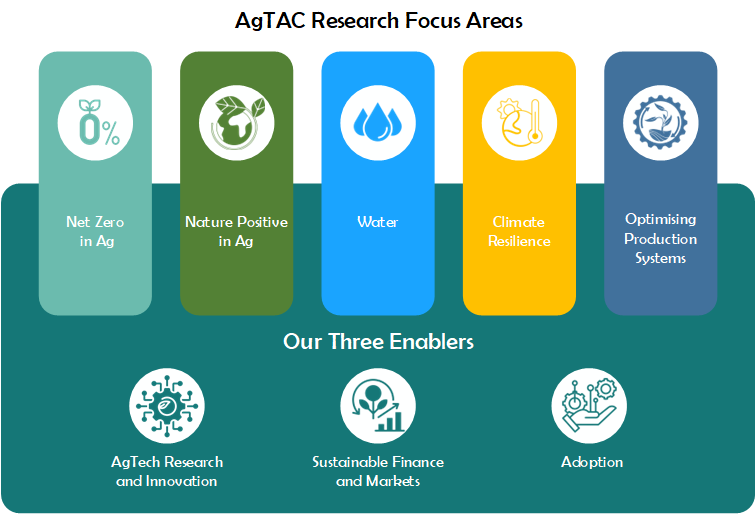
Net Zero in Ag
AgTAC collaborates with farmers and agricultural stakeholders to mitigate greenhouse gas emissions through the application of technology and innovation. This approach encompasses data collection, the development of advanced tools and novel methods, implementation of sustainable practices, and the adoption of enhanced land management strategies, all aimed at reducing environmental impact and carbon emissions.
Nature Positive in Ag
Our research expertise provides guidance to farmers on regenerating ecosystems and enhancing biodiversity, which in turn contributes to improved soil health and water quality. These improvements ultimately support increased yields and foster long-term agricultural resilience.
Water
Water Quantity: Optimizing farm productivity and protecting the Reef: AgTAC leverages advanced science and energy solutions to reduce costs and energy use, proving that sustainable water management is good for both the bottom line and the environment.
Water Quality: Our world class researchers are developing and applying novel methods for measuring, monitoring and improving water quality outcomes.
Climate Resilience
AgTAC researchers are committed to bolstering the resilience of industries, communities, and natural ecosystems in response to climate change and climate variability. Through the application of drone technology, satellite imagery, machine learning, and field studies, our teams address a range of challenges including: providing cattle with adequate shade and nutrition during extended dry periods; evaluating crop rotation strategies to improve soil health; analysing hydrological patterns to support drought and flood preparedness in rural areas; improving climate prediction accuracy and assessing innovative approaches for carbon sequestration.
Optimising Production Systems
Leveraging our broad expertise and experience, we adopt a comprehensive approach to develop innovative solutions that achieve measurable results. AgTAC members are advancing tools and methodologies that enable producers to enhance sustainability and productivity through industry best practices.
AgTech Research and Innovation
AgTAC researchers are using cutting-edge technologies and novel techniques to find solutions that are custom-made for the challenges at hand. Artificial intelligence, machine learning, drone and satellite technologies, infrared spectroscopy, ecoacoustics, sensors, monitoring, modelling, geospatial mapping, are all part of the tool kit.
Sustainable Finance and Markets
Working with farmers and industry, AgTAC is implementing strategies to address sustainability challenges, improve performance metrics, strengthen organisational resilience, mitigate risks, and identify new opportunities.
Adoption
The successful adoption of technological innovations depends on individuals' perceptions of their applicability, relevance, and value. Members of AgTAC are developing insights into the intricate relationships among social, emotional, and cognitive factors that influence motivation to embrace or reject new technologies. Enhanced understanding of these dynamics can lead to the development of targeted implementation strategies, thereby increasing adoption rates and delivering more substantial outcomes.