
EDQS Teaching@JCU Support WIL Resources for Staff Local Global Learning About the Project
About the Project
- MRCMHR
- Future Students
- JCU Global Experience
- International Students
- Student experience
- Open Day
- How to apply
- Pathways to university
- Living on Campus
- Courses
- Publications
- Mature students
- Scholarships
- Entry options
- JCU Families
- JCU Heroes Programs
- Aboriginal and Torres Strait Islander in Marine Science
- Elite Athletes
- Defence
- Capability.Co
- AI@JCU
- AALL
- Current Students
- Student Ambassador Program
- New students
- JCU Orientation
- LearnJCU
- Placements
-
EDQS
- About EDQS
- Education Strategy
- Teaching@JCU Support
- Assessment@JCU
- Inclusive Subject Design
-
TEL Design
- About LearnJCU
-
Assessment & Feedback
- Artificial Intelligence
- Assessment Tools
- Assessing Group Work
- Assessment Case Studies
- Assessment Methods
- Enable or Disable Submission View
- Inline Marking
- Grade Centre Setup
- Group Assessment Tools
- Marking and Feedback
- Multiple Choice Questions
- One Question at a Time
- Peer Review
- Release Conditions
- Respondus Secure Online Exams
- Respondus FAQs
- Safe Assign
- Save Grade Centre Filtering
- Submission Receipts
- Test Response Download
- Test Settings
- Timezones
- Video Assessment
- Collaboration
- Communication
-
Content & Learning Resources
- Accessibility in LearnJCU
- Banners for Subjects
- Computations
- Content Management
- Digital Media Studios
- DIY Engaging Videos
- Emojis in Ultra Docs
- Exemplars in LearnJCU
- H5P in LearnJCU
- Intro Videos
- Learning Sequence (PDF)
- LearnJCU Content Layout
- Digital Media Support
- LinkedIn Learning
- Mayer's 12 Principles of Multimedia (PDF)
- Media Resources
- Open and Licensed Resources
- Padlet in LearnJCU
- Panopto Video Capture
- PebblePad ePortfolios
- Progress Tracking
- Release Conditions
- Subject Site Checklist
- Organisation & Structure
- Participation & Engagement
- The Learn Lowdown
- Teach with Tech Ebook
- Endorsed technologies
- AI Conversation Tool Program Pilot
- Data & Evaluation
- Student Success
- Development & Recognition
- Unicare Centre and Unicampus Kids
- Graduation
- Off-Campus Students
- JCU Job Ready
- Safety and Wellbeing
- JCU Prizes
- Professional Experience Placement
- Employability Edge
- Art of Academic Writing
- Art of Academic Editing
- Careers and Employability
- Health, Wellbeing and Belonging
- Career Ready Plan
- Careers at JCU
- Partners and Community
- School Outreach and Widening Participation
- Alumni
- International partnerships
- About JCU
- Reputation and Experience
- Chancellery
- Governance
- Celebrating 50 Years
- Academy
- Indigenous Engagement
- Education Division
- Research Festival
- Graduate Research School
- Research Division
- Research and Innovation Services
- CASE
- College of Business, Law and Governance
- College of Healthcare Sciences
- College of Medicine and Dentistry
- College of Science and Engineering
- MPE
- Anthropological Laboratory for Tropical Audiovisual Research (ALTAR)
- Rural Remote and Tropical Health Systems
- Agriculture Technology and Adoption Centre (AgTAC)
- Advanced Analytical Centre
- AMHHEC
- Aquaculture Solutions
- AMHRA
- JCU Digital Wellbeing Group
- ARCSTA
- Lions Marine Research Trust
- Australian Tropical Herbarium
- Australian Quantum & Classical Transport Physics Group
- Boating and Diving
- Clinical Psychedelic Research Lab
- Centre for Tropical Biosecurity
- Centre for Tropical Bioinformatics and Molecular Biology
- CITBA
- CMT
- Centre for Disaster Solutions
- CSTFA
- Cyclone Testing Station
- The Centre for Disaster Studies
- Daintree Rainforest Observatory
- Fletcherview
- JCU Eduquarium
- JCU Turtle Health Research
- MARFU
- Orpheus
- TESS
- JCU Ideas Lab
- CADSI
- CNL
- TARL
- eResearch
- Indigenous Education and Research Centre
- Past Course and Subject Handbooks
- Estate
- Work Health and Safety
- Staff
- Discover Nature at JCU
- Cyber Security Hub
- Association of Australian University Secretaries
- Services Division
- Environmental Research Complex [ERC]
- Foundation for Australian Literary Studies
- Gender Equity at JCU
- Give to JCU
- Indigenous Legal Needs Project
- Inherent Requirements
- IsoTropics Lab
- IT Services
- JCU Webinars
- JCU Events
- JCU Motorsports
- JCU Sport
- Library
- Mabo Decision: 30 years on
- Marine Geophysics Laboratory
- Office of the Vice Chancellor and President
- Outstanding Alumni
- Policy
- PAHL
- Queensland Research Centre for Peripheral Vascular Disease
- Rapid Assessment Unit
- RDIM
- Researcher Development Portal
- Roderick Centre for Australian Literature and Creative Writing
- Contextual Science for Tropical Coastal Ecosystems
- State of the Tropics
- Strategic Procurement
- Student profiles
- SWIRLnet
- TREAD
- TropEco for Staff and Students
- TUDLab
- VAVS Home
- WHOCC for Vector-borne & NTDs
- Media
- Copyright and Terms of Use
- Australian Institute of Tropical Health & Medicine
- JCU Respect
- Pay review
- Research
What is Global Learning?
Learn more about the project in just three minutes!
Introduction to local global development
As Australia aspires to create an adaptive, innovative and globally engaged education sector by 2025, higher education needs to focus on developing student capacities to become an active member of their local and global community. To date, ‘global perspectives’ in Australian higher education have focused on bringing perspectives ‘in’ or on taking students ‘out’. An alternative ‘third wave’ approach connects local issues with global contexts, making the global an integrated, everyday experience for students.
Local Global Learning explored the possibilities of ‘third wave’ approaches by investigating how the agentic qualities of a diverse student population can be effectively promoted and engaged to assist them to secure global perspectives through their service learning experiences.
The project sought to identify how student experiences can be maximised through service learning, based on the key research question, 'How can the agentic qualities of a diverse student population be effectively promoted and engaged to assist them to secure global perspectives through their service learning experiences?'
Three sub-questions contribution to this research question:
- How do students from diverse backgrounds view themselves as global citizens?
- What pedagogic elements of service learning curriculum and experience are most effective in development global perspectives for diverse students?
- How can the experiencing of the learning curriculum promote and develop student mobility for diverse groups?
These questions were addressed through six case studies based on the experiences of staff and students from JCU, JCU Singapore and Western Sydney University.
Community based experiential learning might take on different names and structures, including work-integrated learning, service learning, professional placements and internships. Each of these experiences, however, has similar characteristics in that they aim to integrate and apply academic learning in a community based context.
The Local Global Learning Project focuses on higher education student experiences that require service in an intercultural community setting (local or global) that are supported by a structured process of preparation, sense making, engagement in social issues and reflection.
Service learning engages students with their own community. Successful community-based learning experiences allow students to challenge themselves, reflect on their learning, engage in meaningful participation with communities, and link their experiences to theory (McKinney et al. 20041; Rajaram, 20072). Hall et al. (2004)3 found that students learn better, are more motivated, and demonstrate a greater understanding of social issues when they have a personal connection with their community. Service learning in intercultural environments promotes student engagement with global perspectives, increases intercultural competency and can challenge students’ dispositions regarding their own contribution to local and/or global communities.
As Bringle (2010)4 asserts, using the image below, Service Learning brings together teaching and service in a community setting. Forms of service learning that offer professional services or involve students in participatory action research can bring together the three functions of universities – teaching, research and service.
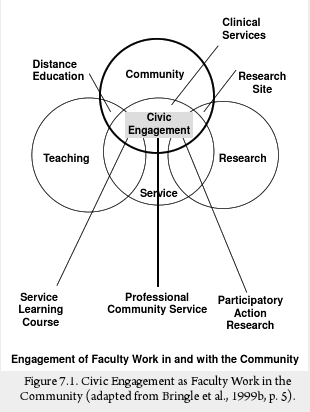 | Diagram from Bringle, R. (2010) The Teaching of Research and Other "Tools of the Trade". In: Cooksey, M.A. and Olivares, K.T. (eds.) Quick Hits for Service-Learning: Successful Strategies by Award-Winning Teachers. Indiana University Press, Bloomington, IN, United States of America. |
There is a powerful rationale that service learning is one structure through which the university can contribute to the public good and more specifically to needs in the local and global community. Other rationales for service learning include improved academic engagement, retention, the application of broader attributes and capabilities including social and collaborative skills and enhanced transitions between university study and the world of work.
Research that provides theoretically informed curriculum and pedagogical frameworks for service learning is in its infancy. We lack understanding of how students’ dispositions will affect the extent of their learning in intercultural environments. There is a need to develop a theoretical basis to service learning and student engagement in global perspectives to:
- Promote good practice
- Maximise the effectiveness of service learning as an intercultural learning tool for all students
- Normalise intercultural learning experiences, and
- Facilitate student interest in actively seeking out global perspectives.
1 McKinnery, K., Howery, C., Strand, K., Kain, E. and Berheide, C. (2004) Liberal Learning and the Sociology Major Updated: Meeting the Challenge of Teaching Sociology in the Twenty-First Century. New York: American Sociological Association. (Read online)
2 Rajaram, S.S. (2007) An Action-Research Project: Community Lead Poisoning Prevention. Teaching Sociology 35(2): 138-150. (Read online)
3 Hall, D. Hall, I., Cameron, A. and Green, P. (2004) Student volunteering and the active community: issues and opportunities for teaching and learning in sociology. Learning and Teaching in the Social Sciences (LATISS) 1(1): 33-50. (Read online)
4 Bringle, R. (2010) The Teaching of Research and Other "Tools of the Trade". In: Cooksey, M.A. and Olivares, K.T. (eds.) Quick Hits for Service-Learning: Successful Strategies by Award-Winning Teachers. Indiana University Press, Bloomington, IN, United States of America.