Give to JCU Give to Innovation & Discovery Archaeology in the Lao PDR
Archaeology in the Lao PDR
- MRCMHR
- Future Students
- JCU Global Experience
- International Students
- Student experience
- Open Day
- How to apply
- Pathways to university
- Living on Campus
- Courses
- Publications
- Mature students
- Scholarships
- Entry options
- JCU Families
- JCU Heroes Programs
- Aboriginal and Torres Strait Islander in Marine Science
- Elite Athletes
- Defence
- Capability.Co
- AI@JCU
- AALL
- Current Students
- Student Ambassador Program
- New students
- JCU Orientation
- LearnJCU
- Placements
- EDQS
- Unicare Centre and Unicampus Kids
- Graduation
- Off-Campus Students
- JCU Job Ready
- Safety and Wellbeing
- JCU Prizes
- Professional Experience Placement
- Employability Edge
- Art of Academic Writing
- Art of Academic Editing
- Careers and Employability
- Health, Wellbeing and Belonging
- Career Ready Plan
- Careers at JCU
- Partners and Community
- School Outreach and Widening Participation
- Alumni
- International partnerships
- About JCU
- Reputation and Experience
- Chancellery
- Governance
- Celebrating 50 Years
- Academy
- Indigenous Engagement
- Education Division
- Research Festival
- Graduate Research School
- Research Division
- Research and Innovation Services
- CASE
- College of Business, Law and Governance
- College of Healthcare Sciences
- College of Medicine and Dentistry
- College of Science and Engineering
- MPE
- Anthropological Laboratory for Tropical Audiovisual Research (ALTAR)
- Rural Remote and Tropical Health Systems
- Agriculture Technology and Adoption Centre (AgTAC)
- Advanced Analytical Centre
- AMHHEC
- Aquaculture Solutions
- AMHRA
- JCU Digital Wellbeing Group
- ARCSTA
- Lions Marine Research Trust
- Australian Tropical Herbarium
- Australian Quantum & Classical Transport Physics Group
- Boating and Diving
- Clinical Psychedelic Research Lab
- Centre for Tropical Biosecurity
- Centre for Tropical Bioinformatics and Molecular Biology
- CITBA
- CMT
- Centre for Disaster Solutions
- CSTFA
- Cyclone Testing Station
- The Centre for Disaster Studies
- Daintree Rainforest Observatory
- Fletcherview
- JCU Eduquarium
- JCU Turtle Health Research
- MARFU
- Orpheus
- TESS
- JCU Ideas Lab
- CADSI
- CNL
- TARL
- eResearch
- Indigenous Education and Research Centre
- Past Course and Subject Handbooks
- Estate
- Work Health and Safety
- Staff
- Discover Nature at JCU
- Cyber Security Hub
- Association of Australian University Secretaries
- Services Division
- Environmental Research Complex [ERC]
- Foundation for Australian Literary Studies
- Gender Equity at JCU
-
Give to JCU
-
Give to Support Students
- Student Food Pantry
- JCU Experiential Learning Fund
- JCU Engineering Futures Fund
- JCU Indigenous Student Support Fund
- JCU On-Campus Accommodation Fund
- JCU Student Hardship Fund
- JCU Orpheus Island Research Station
- JCU Fletcherview Research Station
- JCU Daintree Rainforest Observatory
- Prof Andrew Krockenberger Legacy
- Peter Leggat Memorial Fund
- Crozier Prize for Evolution
- Dr Maryanne Balanzategui Prize
-
Give to Innovation & Discovery
- Archaeology in the Lao PDR
- Alumni Angels Innovation Fund
- Library Special Collections
- Australian Tropical Herbarium
- JCU Turtle Health Research
- Dwarf Minke Whale Project
- Saving North Queensland Frogs
- Baby Sharks in a Changing World
- JCU Graduate Research Education
- Australian Institute of Tropical Health and Medicine
- Give to Research Stations
- Giving from America
- Impact
- What can I give?
- Bequests & Planned Giving
- Frequently asked questions
- Contact Us
-
Give to Support Students
- Indigenous Legal Needs Project
- Inherent Requirements
- IsoTropics Lab
- IT Services
- JCU Webinars
- JCU Events
- JCU Motorsports
- JCU Sport
- Library
- Mabo Decision: 30 years on
- Marine Geophysics Laboratory
- Office of the Vice Chancellor and President
- Outstanding Alumni
- Policy
- PAHL
- Queensland Research Centre for Peripheral Vascular Disease
- Rapid Assessment Unit
- RDIM
- Researcher Development Portal
- Roderick Centre for Australian Literature and Creative Writing
- Contextual Science for Tropical Coastal Ecosystems
- State of the Tropics
- Strategic Procurement
- Student profiles
- SWIRLnet
- TREAD
- TropEco for Staff and Students
- TropCOVID: Mapping COVID-19 Immunity in Far North Queensland
- TUDLab
- VAVS Home
- WHOCC for Vector-borne & NTDs
- Media
- Copyright and Terms of Use
- Australian Institute of Tropical Health & Medicine
- JCU Respect
- Pay review
- Research
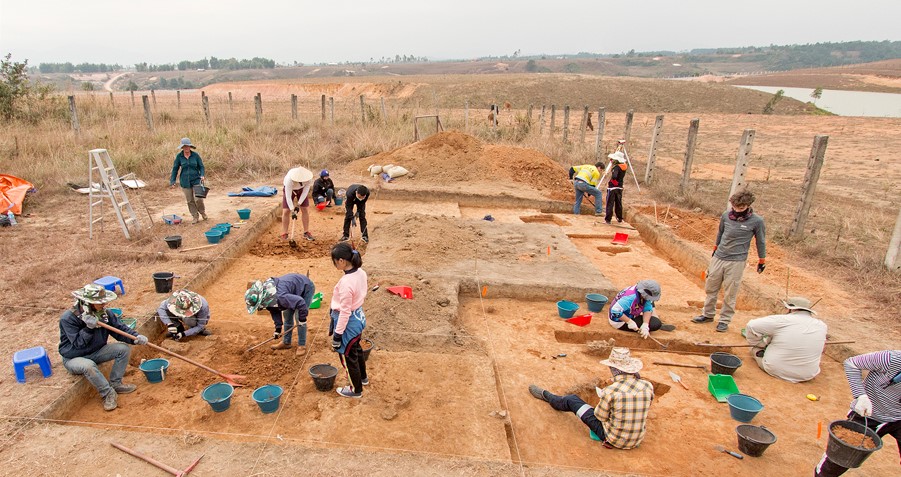
This ongoing project seeks to “fill the empty pages in the book of Laos’s past” by investigating the full sequence of human occupation from prehistory into the early historical period. With survey and excavation, we aim to trace how communities lived, how they buried their dead, and how they connected to wider regional networks.
The Lao PDR is a land of valleys, mountains, and rivers that has long been a cultural crossroads of mainland Southeast Asia. Yet, its archaeology and history remain among the least understood in the region. From enigmatic megalithic jars to hidden habitation sites and ritual caves, the cultural record of Laos is rich but largely unexplored.
Understanding the archaeology of northern Laos is essential for situating the country within the broader cultural history of mainland Southeast Asia. This region lay at the intersection of major routes of exchange, movement, and belief. By studying mortuary practices, settlements, and material culture, we can reveal how local traditions were shaped by, and contributed to, wider regional dynamics.
This research will not only uncover the origins of the famous stone jars, but also illuminate how societies across northern Laos adapted to environmental shifts, developed their own identities, and engaged with neighbouring cultures. In doing so, it strengthens heritage management, supports local communities, and deepens global recognition of Laos’s place in world history.
Our interdisciplinary team combines archaeology, bioarchaeology, GIS, and heritage studies with strong local collaboration. We will explore mortuary sites, caves, settlements, and megalithic landscapes to reconstruct a more complete picture of Laos’s past. Integrating cutting-edge science with oral histories and community knowledge ensures that research is grounded, rigorous, and meaningful to those who live alongside these ancient sites today.
Fieldwork in Laos is both challenging and vital. Your support provides equipment, logistics, and specialist analyses, as well as training opportunities for Lao archaeologists and students. By giving, you help us document and protect a cultural record that is disappearing under modern pressures, grow local expertise, and you join us in revealing how Laos fits into the grand narrative of Southeast Asian prehistory and history.
Your contribution is an investment in archaeology, and the preservation of heritage with significance for all humanity, especially for the people of Laos.