
JCU Ideas Lab Blog Student wellbeing through Virtual Reality
Supporting school student wellbeing through Virtual Reality
- MRCMHR
- Future Students
- JCU Global Experience
- International Students
- Student experience
- Open Day
- How to apply
- Pathways to university
- Living on Campus
- Courses
- Publications
- Mature students
- Scholarships
- Entry options
- JCU Families
- JCU Heroes Programs
- Aboriginal and Torres Strait Islander in Marine Science
- Elite Athletes
- Defence
- Capability.Co
- AI@JCU
- AALL
- Current Students
- Student Ambassador Program
- New students
- JCU Orientation
- LearnJCU
- Placements
- EDQS
- Unicare Centre and Unicampus Kids
- Graduation
- Off-Campus Students
- JCU Job Ready
- Safety and Wellbeing
- JCU Prizes
- Professional Experience Placement
- Employability Edge
- Art of Academic Writing
- Art of Academic Editing
- Careers and Employability
- Health, Wellbeing and Belonging
- Career Ready Plan
- Careers at JCU
- Partners and Community
- School Outreach and Widening Participation
- Alumni
- International partnerships
- About JCU
- Reputation and Experience
- Chancellery
- Governance
- Celebrating 50 Years
- Academy
- Indigenous Engagement
- Education Division
- Research Festival
- Graduate Research School
- Research Division
- Research and Innovation Services
- CASE
- College of Business, Law and Governance
- College of Healthcare Sciences
- College of Medicine and Dentistry
- College of Science and Engineering
- MPE
- Anthropological Laboratory for Tropical Audiovisual Research (ALTAR)
- Rural Remote and Tropical Health Systems
- Agriculture Technology and Adoption Centre (AgTAC)
- Advanced Analytical Centre
- Australian Institute of Tropical Health and Medicine
- AMHHEC
- Aquaculture Solutions
- AMHRA
- JCU Digital Wellbeing Group
- ARCSTA
- Lions Marine Research Trust
- Australian Tropical Herbarium
- Australian Quantum & Classical Transport Physics Group
- Boating and Diving
- Clinical Psychedelic Research Lab
- Centre for Tropical Biosecurity
- Centre for Tropical Bioinformatics and Molecular Biology
- CITBA
- CMT
- Centre for Disaster Solutions
- CSTFA
- Cyclone Testing Station
- The Centre for Disaster Studies
- Daintree Rainforest Observatory
- Fletcherview
- JCU Eduquarium
- JCU Turtle Health Research
- MARFU
- Orpheus
- TESS
- JCU Ideas Lab
- CADSI
- CNL
- TARL
- eResearch
- Indigenous Education and Research Centre
- Past Course and Subject Handbooks
- Estate
- Work Health and Safety
- Staff
- Discover Nature at JCU
- Cyber Security Hub
- Association of Australian University Secretaries
- Services Division
- Environmental Research Complex [ERC]
- Foundation for Australian Literary Studies
- Gender Equity at JCU
- Give to JCU
- Indigenous Legal Needs Project
- Inherent Requirements
- IsoTropics Lab
- IT Services
- JCU Webinars
- JCU Events
- JCU Motorsports
- JCU Sport
- Library
- Mabo Decision: 30 years on
- Marine Geophysics Laboratory
- Office of the Vice Chancellor and President
- Outstanding Alumni
- Policy
- PAHL
- Queensland Research Centre for Peripheral Vascular Disease
- Rapid Assessment Unit
- RDIM
- Researcher Development Portal
- Roderick Centre for Australian Literature and Creative Writing
- Contextual Science for Tropical Coastal Ecosystems
- State of the Tropics
- Strategic Procurement
- Student profiles
- SWIRLnet
- TREAD
- TropEco for Staff and Students
- TropCOVID: Mapping COVID-19 Immunity in Far North Queensland
- TUDLab
- VAVS Home
- WHOCC for Vector-borne & NTDs
- Media
- Copyright and Terms of Use
- Australian Institute of Tropical Health & Medicine
- JCU Respect
- Pay review
- Research
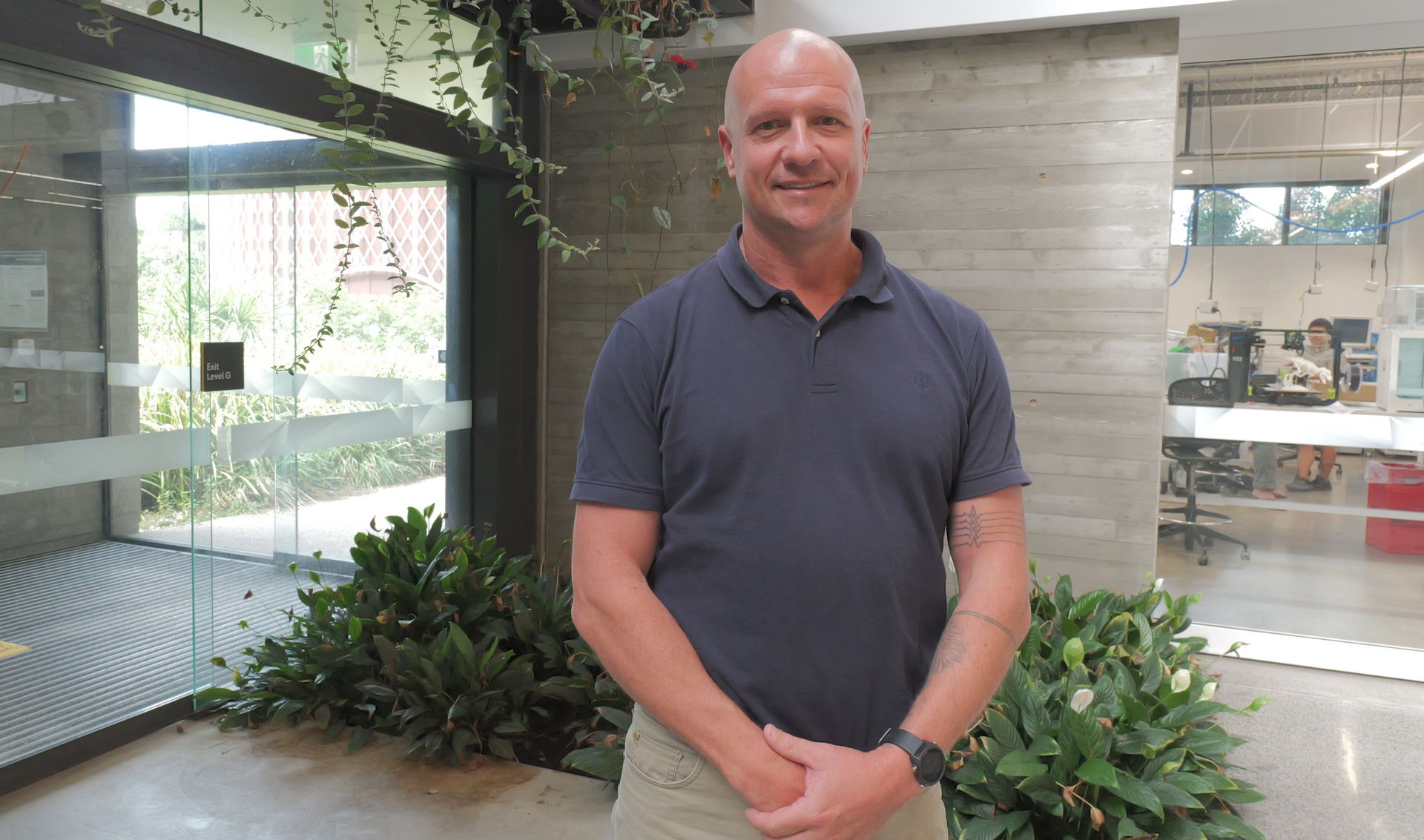
The transition from primary school to high school can be daunting for many students. Greg Millward, JCU Founder in Residence and future PhD@Work pilot participant, believes that his virtual reality (VR) wellbeing training will equip students with a better understanding of how character values can be used to support student wellbeing.
So far, VR headsets such as the Meta Quest 3 or the Apple Vision Pro are primarily known as expensive toys for gamers. Greg’s startup VGA (Virtual Guidance and Awareness), however, aims to offer a wellbeing program to senior primary and junior secondary students using VR headsets, and his concurrent PhD@Work research intends to scientifically prove that his delivery method works.
Classroom resilience via VR headsets
Greg, who works as a high school design teacher, has witnessed firsthand impactful topics that effect students. “The Australian Curriculum aims to embed personal and social capabilities within our schools. These programs are in use already, and they are generally called social-emotional learning (SEL) programs,” Greg says. “My program is building on that, covering classroom resilience, negative social interactions and mobile phone use,” Greg says.
Greg is also aware that teachers that are often overburdened with work already are tasked to deliver external SEL programs. “You have teachers that are worn out,” he says. “SEL is a very engaging topic where you need a lot of energy to deliver effectively. You have to interest the kids, and you have to get them all engaged and thinking about wellbeing topics.
“With wellbeing topics, the students can be reluctant to engage in, or they simply find it hard to open up about sensitive topics, especially if there are distractions from fellow students. This can be very challenging for the teacher,” Greg says. He thinks that these programs need to be delivered in a way that gets children engaged, and VR headsets may just be the perfect tool for the job.
Navigating troubling times in 3D
“The kids get to experience and witness other kids going through troubling times, and they get as close to the wellbeing topic as possible, without going through it themselves,” he says. “It's also an opportunity to speak about character values that can support students when navigating through these potentially tough times.”
This is where Greg’s program shines. “My VR program highlights character values that are expressed by other kids. We provide a definition of the concept, and then they see what it means in real life – via the VR headset.”
Greg thinks that the VR headset delivery supports children in making independent decisions. “If they can participate in a virtual experience where they've got no other kids talking out loud or giving their opinions on things, they get to experience it for themselves. This might just get them thinking a little bit more about it.”
Early trials indicate potential success
Greg says that he has conducted a small trial in a regional school with permission from the principal. “The results we've been getting so far have been great,” he says. “We are seeing increased results around social awareness and increased understanding of empathy for other people. It has improved their understanding of social impacts on others.”
That aside, Greg thinks that the cool factor of the VR headsets is a clear drawcard. “All the kids liked the headsets, and we had 100% engagement. They're all excited about it and recommended it for other students,” he says.
Combining PhD@Work research with a tech startup
Greg’s initial discussions with Education Queensland’s wellbeing department confirmed that SEL programs could be offered by third parties, such as his startup VGA, if they can prove they provide better outcomes than existing programs.
To prove that his method works, Greg would have to conduct scientific trials that have human ethics approval. Greg says that he shared his thoughts about the obstacles his startup is facing with Dr Sam Horseman, the head of the PhD@Work program. “And suddenly, it all fell into place when Sam said, ‘well, we're running a new program for people like you, PhD@Work. Are you interested in it?’ - And I said ‘yes’,” he says.
Helping schools to embrace VR learning
“Aside from testing the program on larger student groups, I’m looking to further develop additional units to help improve our students’ wellbeing,” he says. “Ideally, I’d like to see every school in Australia participate in my VR experience.”
Not only the students will benefit, but teachers would also benefit from the program, Greg says. “Using an external company like my startup would support teachers within the classroom. The expected outcome is an increase in student wellbeing, leading to reductions in poor student behaviour and reduced teacher administration workloads.
“Teachers could then reflect and improve on delivered curriculum,” Greg says. “If I can use VR to support our students’ social and emotional wellbeing, then I can’t think of a more fulfilling contribution to our society.”
Are you interested the PhD@Work pilot program? Get in touch with the team now.