
Everything You Need to Know About PEP
Information for Bachelor of Nursing Science and Bachelor of Nursing Science-Bachelor of Midwifery students
Professional experience placement (PEP) and Midwifery Practice Experience (MPE) are an integral component of the Bachelor of Nursing Science & Bachelor of Nursing Science/Bachelor of Midwifery program, to meet the Australian Health Practitioner Registration Agency (AHPRA) requirements for registration as a nurse or midwife.
PEP / MPE aims to integrate theoretical knowledge with clinical experiences and is designed to develop a beginning nurse or midwife who is:
- able to provide safe, competent evidence based and person/woman centred care;
- able to translate sound decision making into clinical judgement; and
- a consciously interactive and reflective professional.
Bachelor of Nursing Science (BNSc) students must have knowledge and clinical experience across a range of health settings, including but not limited to acute medical/surgical, aged care, community, mental health, and rural or remote locations.
Bachelor of Nursing Science–Bachelor of Midwifery (BNSc-BMid) students must also have knowledge and clinical experience of antenatal, postnatal, intrapartum, and neonatal care provision within the primary, tertiary, community, rural, and remote sectors.
PEP and MPE are allocated according to clinical placement availability, facility capacity, and the suitability of the learning environment to meet the subject learning objectives.
As outlined in Section 6.1 of the JCU Coursework Enrolment Procedure, students may be required to undertake placements away from the campus at which they are enrolled, and this may occur at the student’s own expense. This includes costs associated with travel, accommodation, and living expenses during placement. For equity across the cohort, students should expect to undertake up to at least one (1) of their allocated placements outside their main campus area.
Students enrolled in the Bachelor of Nursing Science – Bachelor of Midwifery (BNSc‑BMid) must also complete Continuity of Care Experiences (CCE). These hours are additional to PEP and form a compulsory component of the midwifery program.
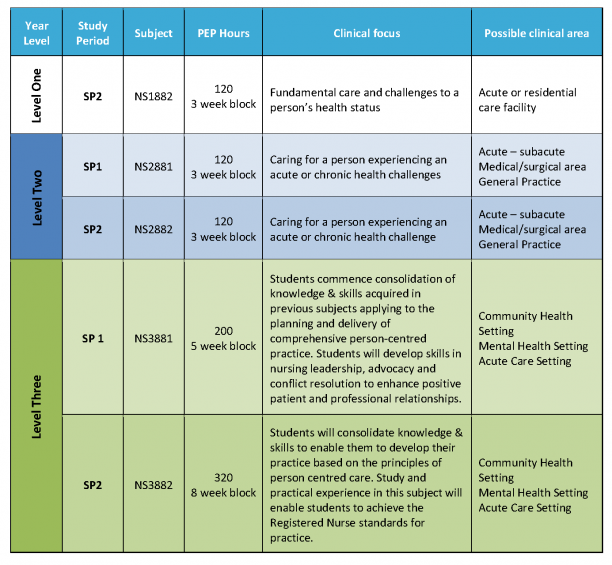
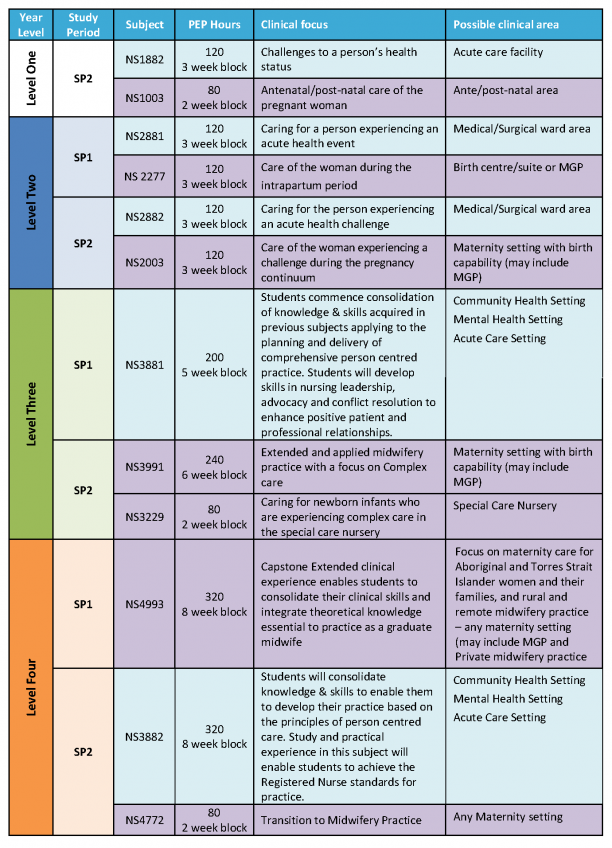
Students are encouraged to review the BNSc and BNSc‑BMid Year Planners to understand the timing, structure, and expectations of PEP and CCE across their program.
All undergraduate students who undertake a course that includes prescribed professional experience placements must be aware of the Professional Experience Placement Procedures for students.
*For BNSc students commencing BEFORE 2027
*For BNSc-BMid students commencing in 2023
PEP and MPE are compulsory components of clinical practice subjects and prepare you for professional registration and supports you to be 'work ready' on graduation.
To go on placement during your program, you’ll need to submit all relevant documentation. You should give yourself plenty of time to complete the placement requirements, as some steps take time to complete. You will re-use and renew several of these documents throughout your program and career as a health professional. Students are responsible for any costs associated with these requirements.
As a JCU student it is your responsibility to ensure all pre-placement requirements (PPRs) are met within the prescribed timeframe as per the Professional Experience Placement Requirements Procedure, otherwise sanctions may be applied to your enrolment in the course.
Students who have not submitted all PPRs are unable to attend placement. Please review Professional Experience Placement Mandatory Requirements guidelines and checklists for Nursing and Midwifery for pre-placement requirements and due dates.
Requirements for health placements may include:
- Immunisations and health screening
- licenses and certificates
- online training
- forms (eg. Student deed poll)
- Facility specific requirements
Please ensure you retain all hard copies of completed placement documents as some facilities may request to site these. It is your responsibility to produce these when requested.
JCU clinical identification badges - are issued to you via the clinical office.
Facility-Specific Online Learning Requirements
Students may also be required to complete additional online learning requirements prior to commencing their placement. Additional, facility-specific requirements are included on the Health Placements’ Nursing and Midwifery preparing for PEP information webpage. Generally, online orientation and learning activities (where applicable) must be completed 2 weeks prior to commencement of placement.
A failure to complete facility-specific online learning requirements may result in the healthcare facility deciding to stand the student down until their online learning is complete. This decision is however at the facility’s discretion and is based on facility policy, staffing requirements, orientation needs etc. If the facility does cancel the student’s placement due to failure to complete online learning requirements, the decision is considered final and cannot be overruled by the university.
PPR Contact Details
All pre-placement requirement (PPR) documents must be scanned and emailed to healthplacements@jcu.edu.au
For all Pre-Placement requirements please contact Professional Experience Placement Unit.
All queries related to placement should be directed to nursingclinical@jcu.edu.au
Our Team
Penny Coogan
Academic Lead - Professional Practice & Clinical Partnerships
Telephone: 07 4781 3263
Email: nursingclinical@jcu.edu.au
Location: 25-209, Bebegu Yumba (Douglas) campus, Townsville
Mary Lucas
Academic Lead – Midwifery Practice Experience
Telephone: 07 4781 4798
Email: mpe@jcu.edu.au (midwifery specific questions)
Location: 25-217, Bebegu Yumba (Douglas) campus, Townsville
Montanna Jones
Student Placement Officer
Telephone: 07 4781 4813 | 47814594
Email: nursingclinical@jcu.edu.au
Location: Bebegu Yumba (Douglas) campus
Placement Considerations
An important aspect of nursing at any stage of your career is only performing clinical skills within your scope of practice. Scope of practice can be defined as a skill or procedure for which you have the appropriate knowledge, psychomotor skills, and permission to perform.
Generally, a skill or procedure is within your scope of practice once you have received the theory and practice opportunities within clinical skills laboratories prior to performing the skill on PEP. Students are required to be familiar with each PEP practice level requirements.
Scope of Practice documents can be found in the subject site and in individual subject placement documentation.
It is a MANDATORY REQUIREMENT that all students complete the placement briefing video and quiz and attend the subject specific briefing session for each placement.
Non-attendance at these placement briefings may make you ineligible to proceed to placement.
If there is an unforeseen event that prevents a student from attending a placement briefing, it is the student’s responsibility to contact the subject coordinator to make alternative arrangements.
Students with more than 12 months since their previous placement are required to contact the clinical subject coordinator during week 1 of the study period. Students are required to demonstrate they have the necessary knowledge and skills to be able to proceed to placement.
InPlace is the platform used to manage all JCU’s placements.
The Health Placements team uses InPlace to:
- allocate students’ placements
- notify students of placement allocation
- co-ordinate and manage other placement-related processes.
Students can use InPlace to:
- review the status of PPRs
- check placement allocation, including the dates
- see placement history.
InPlace uses the contact details you add to the JCU student information system. Keep these current so the Health Placements Unit can easily contact you about your placement.
The Placements team only sends emails related to placement to your JCU email address. Please check your email regularly for placement communication.
Please remember your enrolment must remain current to access InPlace. Students are required to check this information on a regular basis as preference dates open will be advised via LearnJCU announcements.
Students also may submit a preference for a particular region or block from the published list by logging onto InPlace and submit preferences electronically. This can only be done at certain times and emails are sent by the WIL team to notify you of opening and closing dates.
Efforts are made by the Placements team to accommodate your preference requests; however this cannot be guaranteed.
Previous placements (in-town, out-of-town, medical, surgical, or community) are reviewed and considered when allocating each student’s placement to ensure equitable and educationally sound experiences.
Specific facility requests are to be emailed to nursingclinical@jcu.edu.au.
For any exceptions or extenuating circumstances considerations, please make an appointment to discuss these with Academic Lead: Professional Practice and Clinical Partnerships via nursingclinical@jcu.edu.au.
James Cook University Nursing and Midwifery (JCU N&M) is committed to nursing and midwifery students and those for whom they care and work during their placement. Placements are a full-time commitment and are an important component of nursing and midwifery students’ clinical and professional development. Nursing and midwifery students must be aware of risks associated with continuing in paid employment whilst on placement.
Work Health and Safety: It is expected JCU nursing and midwifery students will not undertake paid or volunteer employment whilst on placement as it poses an occupational and safety risk. Working whilst on placement results in fatigue and impairs the student's judgement and can lead to increased clinical risk for the person to whom the student is providing care, self-injury for the student, and additional supervision requirements for clinical staff.
Student agreement: JCU nursing and midwifery students sign a student placement agreement and by doing so agree not to work in paid or volunteer employment whilst undertaking their placement.
Communication: If a student has circumstances requiring they work they should make a time to meet with the Academic Lead for PEP / MPE as soon as possible to discuss options.
Work Commitments: Students enrol in clinical units at the beginning of semester. When enrolling in a clinical unit students are agreeing to be available for a clinical placement. It is expected that if students are given at least 6 weeks’ notice of their placement allocation students will be available to attend. Students should inform their employer of impending placement requirements before enrolling to ensure they can be absent from the workplace to undertake their placement. Students should inform their employer that they are not to be rostered during their placement period.
Non Compliance: If a student is found to be in paid or voluntary employment whilst on PEP the student will be counselled by their subject coordinator of the dangers to themselves and others.
Risk minimisation: If the student continues to work and it is judged by the Clinical Facilitator, Clinical Coach, or Nurse Unit Manager, and Subject Coordinator to be affecting their safety, performance, or posing a clinical risk to people or the organisation, they will be strongly advised to discontinue paid or voluntary employment. A student unable to heed advice may be removed from PEP. Removing the student from PEP is to minimise the risk of harm to people to whom the student is providing care, the student, the organisation, and James Cook University. Removal of a student from PEP will result in an Unsatisfactory (U) grade being awarded for PEP.
Appeals process: The student may at any time seek advice if they believe they have grounds to appeal a decision. The Head Nursing and Midwifery will advise the student of the outcome.
Essential Supporting Information
Internal
- JCU WHS-PRO-028 Student Placement Procedure
- JCU Health, Safety and Environment Policy
- JCU Student Code of Conduct
External
If a student has a physical or psychological health issue and/or disability that may pose a risk to themselves or others, they are advised to discuss this with the AccessAbility Services staff so that their needs can be discussed and if required reasonable adjustments implemented.
Students with a pre-existing health condition, disability, or allergy that may impact upon placement are required to provide a medical certificate stating they are ‘fit for professional placement’ prior to each placement commencement, or as agreed by PEP / MPE academic leads.
Students with allergies are to notify the PEP / MPE academic leads before each PEP if they have individual requirements that may need to be considered by healthcare facilities.
If a Clinical Facilitator/Preceptor/Coach is concerned about a student’s well-being while on placement, they will contact the PEP or MPE Academic Lead to discuss the appropriate process.
Students with Recent Health Issues
Students with a recent illness (within the last 2 months) requiring hospitalisation, ongoing medical treatment (including mental health conditions e.g., anxiety), a medical/surgical procedure, or recent commencement of medication that may affect performance are required to provide a medical certificate stating they are ‘fit for professional experience placement with no restrictions’ at least 2 weeks prior to placement commencement.
The certificate must be emailed to nursingclinical@jcu.edu.au
NB: If a student returns to their PEP without a ‘fit for professional experience placement’ medical certificate, the JCU N&M reserves the right to cease the student’s placement.
Any student who is currently on WorkCover from their paid employment must notify the PEP or MPE Academic Lead via nursingclinical@jcu.edu.au before the commencement of their placement. Notification must include a copy of the Workers’ Compensation Medical Certificate and should be provided as early as possible so that appropriate steps can be taken.
If the WorkCover certificate includes restrictions, the student will not be able to attend placement until WorkCover has ceased and full medical clearance is provided, or their treating doctor supplies written clearance confirming they are fit for placement with no restrictions.
Please note:
- Students on WorkCover are reviewed on a case‑by‑case basis, and comparisons with other students should not be made.
- If it is identified that a student is on WorkCover and has not followed the notification process outlined above, it will be assumed that restrictions are in place, and the student will be removed from PEP until appropriate clearance is provided.
If you intend to enrol in a subject which contains placement while you are pregnant, it is important to notify nursingclinical@jcu.edu.au as soon as possible.
The placement team is responsible for ensuring you are not placed at a venue or unit which might put you or your baby's health at risk, for example, at an oncology or radiology unit.
If your pregnancy is confirmed while you are on placement, and you have concerns regarding the location, please contact your placement PEP facilitator/coach or the PEP / MPE Academic Lead as a matter of urgency.
Lactation Breaks
Lactation breaks are available for students who choose to combine placement and breastfeeding. Lactation breaks are specifically for:
- expressing breast milk
- feeding the baby (either on or away from the work site).
Lactation breaks can be accessed when other specified breaks are not suitable. Students combining work and breastfeeding may be granted up to a total of one-hour lactation break per working day.
The one-hour lactation breaks include travelling time for students who take lactation breaks away from the facility. Lactation breaks do not contribute to your PEP hours.
Lactation breaks are to be taken at times appropriate to the student and the ward/department/facility. The flexibility women need to breastfeed, or express milk is to be considered in the timing of lactation breaks. For example, some students may require two 30-minute lactation breaks, whereas a one-hour lactation break may be required by other students.
Clinical placements are designed to maximise learning and ensure completion of mandatory clinical hours. To meet AHPRA requirements, you must attend all rostered shifts and make up any missed hours.
- Bachelor of Nursing students: minimum 800 hours
- Bachelor of Nursing Science–Bachelor of Midwifery students: minimum 800 nursing hours and 1,040 midwifery hours
A nursing or midwifery roster is a schedule of staffing in clinical areas that includes shift times, staff names and locations.
Shifts changes must not be negotiated unless approved by the Discipline Leads for PEP and MPE, clinical assessor or midwifery manager.
Know your shift times
You must be aware of your allocated shift times before arriving on placement. This allows you to plan travel, organise personal responsibilities, and provide safe, effective care.
- Know your allocated shift times before arriving on placement so you can plan travel, organise personal responsibilities, and provide safe, effective care.
- You will receive your roster at least one week prior to placement. If you have not received it, contact nursingclinical@jcu.edu.au
- Shift types may include early/morning, afternoon/evening, or night shifts, and may also occur on weekends or public holidays.
- If you are unsure of start or finish times, confirm these with your clinical facilitator.
- Placement weeks commence on Monday morning and may include shifts that finish the following Monday morning.
- All rostered PEP days are 8–12 hours in duration, excluding a 30‑minute meal break.
General roster guidelines
- Students can be allocated a maximum of 48hrs per week and a maximum of 88 hours per fortnight.
- BNSc & BNSc/BMid students minimum break: 8-hour break between clinical placement shifts.
- BNSc/BMid students at least 10 hours of rest between a non-placement clinical care and the start of the next shift. For example:
- Midwifery group practice: 4 hours antenatal clinic (08:00–12:00) + intrapartum care (15:00–23:30) = 12 hours worked; next shift not before 09:00
Preparedness for placement
- Come prepared and attend for the entire allocated shift
You are expected to remain present and engaged for the full duration of each shift. Staying for the entire allocated time allows you to participate in handover and gain exposure to a full range of learning opportunities.
If you wish to extend your shift for any reason, discuss this with your clinical assessor.
- Are well rested before each shift
Arriving well rested is essential for maintaining focus, providing safe care, and managing the physical and emotional demands of clinical practice. Avoid unsafe practices that compromise your wellbeing and patient safety, for example, moving directly from a paid shift to a placement shift or working overnight on assignments before an early shift.
BNsc/BMid students
Dual Degree students are permitted to work up to a maximum of 12 hours per shift. This may be broken up across the day, for example when working in midwifery group practice and includes all clinical activities performed on that day, whether part of a rostered shift, midwifery group practice or continuity of care engagement. Following any 12-hour shift, a minimum rest break of 10 hours is required, before commencing another shift.
To avoid confusion, check with the clinical assessor or your midwifery clinical partner.
Continuity of care experiences
Students undertaking continuity-of-care experiences (CoCEs) must follow these rostering guidelines to manage fatigue. Consider the impact of CoCE attendance on your ability to attend rostered shifts. Your rostered placement hours take priority over CoCEs.
In the event of your sustaining an injury/accident within the clinical facility while performing placement duties, students need to do the following:
- Notify your clinical assessor immediately.
- Follow the clinical facility’s workplace accident and injury policy.
- Notify the PEP or MPE Academic Lead email: nursingclinical@jcu.edu.au.
- Provide a copy of the clinical facility’s workplace accident and injury documentation to nursingclinical@jcu.edu.au.
All work-related incidents must be reported on RiskWare within 24 hours of the incident occurring. If full details of the incident or injury are not available within this time frame, the essential details as they are known should be submitted first, with updates when more additional details become available.
Students often have particular interests in specific clinical areas and may have personal contacts within various facilities. However, students are not permitted to source their own Professional Experience Placement (PEP). This requirement is in place because:
- The University must have a formal legal agreement with the facility or overarching organisation.
- The University must also have a nursing/midwifery‑specific agreement in place.
- The University is responsible for ensuring appropriate clinical facilitation and support for all students.
- Many facilities will only liaise directly with universities regarding PEP arrangements, and individual student contact can jeopardise future placement opportunities.
If you do have a contact within a facility you are interested in, or someone has indicated that a placement may be possible, please notify the Academic Lead: Professional Practice and Clinical Partnerships at nursingclinical@jcu.edu.au, who will investigate whether the placement can be considered. Please note that we cannot guarantee that such a placement will be approved. All PEP decisions are based on individual student circumstances and the University’s commitment to equity.
BNSc/BMid students: If you are working with, or have been approached by, a privately practising midwife, you must notify the midwifery academic team. This ensures the University can confirm whether a Student Placement Agreement (SPA) is already in place or initiate one if required.
Important: Students are strongly advised not to make holiday or travel arrangements at any time when placement may be allocated. Preferences are not guaranteed and students must be available to attend placement at a time scheduled by the university.
Your placement will be advised via JCU InPlace Student Placement Management System. JCU Nursing and Midwifery is committed to providing you with support for your period of study. Your placement is allocated based on your enrolment, completion of all PPR’s, and takes into consideration your placement history.
Once your placement is allocated it is not possible to move into another block unless you have unforeseen or exceptional circumstances.
Students must be prepared to attend placement when required (Professional Experience Placement Procedures, 5.1.2.6) . Circumstances considered a normal part of life are not accepted as reasons for not attending placement. These include, but are not limited to:
- travel, transport, or accommodation requirements
- work or business commitments
- parenting responsibilities (except where covered under 5.1.2.7)
- weddings or celebratory events
- sporting commitments (unless part of an approved elite program)
- holidays or non‑urgent family commitments
- requests for exemptions to study or prepare for assessments or examinations.
Variations to your placement allocation will only be considered in the following circumstances:
- If you have a AccessAbility Plan
- If you are the registered carer for a sick or disabled dependent child or relative, accompanied by documented evidence
- You have a major health problem requiring frequent and specialised treatment which is only available at certain locations, accompanied by documented evidence
- For other highly extenuating medical, compassionate or special circumstances outside of your control, and where there was no opportunity to plan ahead.
If you require a specific block for placement, you must submit a Missed Placements Application (MPA) with appropriate supporting documentation by the due date.
If you have unforeseen or exceptional circumstances you can request a variation to placement by emailing nursingclinical@jcu.edu.au to arrange a meeting to discuss your requirements.
NB: Students are not able to swap professional experience placements.
Students must declare any pre‑existing relationships with a placement facility when that relationship could influence their placement performance and/or assessment. This information enables the PEP or MPE Academic Lead to plan placements that minimise any potential impact on the student’s learning experience, performance, or assessment outcomes.
To ensure students are provided with educationally valuable and professionally appropriate clinical opportunities, students are not permitted to undertake placement within their own specific work area. Students must notify nursingclinical@jcu.edu.au if:
- a close family member works in a clinical area where the student may be allocated,
- the student is employed in that area, or
- the student has previously been an inpatient in that area.
This requirement ensures appropriate supervision, maintains assessment integrity, and supports equitable placement allocation.
Please review, complete and submit your Conflict of Interest.
If a student changes either their name or gender information during the degree, the Academic Lead: Professional Practice needs to be advised.
Name Change
- Submit a Change of Name request online (student login required).
Gender Change
- Submit a Change of Gender request online (student login required). This also covers any changes to your name or title.
While some rural and remote facilities offer student accommodation, this is not the case in all areas. Before submitting your placement preferences, please read the information sent out via email regarding accommodation.
Students are responsible for covering any accommodation costs associated with their placement. While exact expenses are difficult to predict, we recommend budgeting approximately $2,500 per placement, depending on the length of the placement.
To request accommodation after you have received your allocation:
- Email nursingclinical@jcu.edu.au requesting information regarding accommodation at a specific facility from the placement team.
- The Clinical Placement Officer will notify you by email if accommodation is available.
Where accommodation is arranged by the placement team, you may be required to provide proof of identification on arrival. Some facilities also require an upfront payment or deposit.
Demand for student accommodation is high, and late requests may mean that accommodation cannot be secured.
Behavioural expectations in agency accommodation
Students are expected to understand and comply with all accommodation regulations set by the host agency.
If any disruptive or destructive behaviour occurs while staying in accommodation provided by an out‑of‑town agency:
- The student(s) involved will be required to compensate the agency for any property damage.
- The College will not organise future accommodation for those students. As a result, the student will be responsible for arranging and paying for any out‑of‑town accommodation required to complete the clinical components of their course.
Further disciplinary action may be instigated. Please refer to 5.1.3 During Placement section of the
Professional Experience Placement Procedures for students and the JCU Student Code of Conduct Policy.
It is essential you are fully aware of and adhere to the AHPRA social media policy (2019) and JCU Social Media Policy. Please ensure you read these policies carefully and understand your responsibilities under them.
Although the JCU Social Media policy specifically discusses clinical applications for health professionals; its expectations apply to all aspects of the course. This includes interactions with academic, clinical, and administration staff, facilitators, preceptors, and fellow students. Any breach of these policies is considered serious and will be investigated by the course coordinator.
NB: Please review these policies alongside the NMBA Code of Conduct for Nurses and NMBA Code of Conduct for Midwives. as together they outline the professional standards and behaviours expected of all students throughout the program including while on professional experience placement.
JCU provides a comprehensive range of supports to ensure students feel safe, guided, and well‑supported throughout their Professional Experience Placement (PEP). These supports are available to assist with clinical learning, professional behaviour, wellbeing, and any challenges that may arise during placement.
Supports available to students include:
- Clinical Facilitator, Clinical Partner, or Clinical Coach/Preceptor These staff are directly connected to your placement site and provide day‑to‑day supervision, feedback, and guidance. They support you in developing clinical skills, navigating workplace expectations, and meeting assessment requirements.
- Academic Lead: Professional Practice (JCU) Provides oversight of professional practice across the program. This role supports students with concerns related to clinical expectations, professional behaviour, and placement standards.
- Relevant Subject Coordinator Oversees the academic and assessment components of the subject. They can clarify assessment requirements, address academic concerns, and support students experiencing difficulties that may impact placement performance.
Student Wellbeing During PEP
JCU is committed to supporting the health, wellbeing, and safety of all students throughout their Professional Experience Placement (PEP). In addition to academic and clinical support, students have access to a wide range of wellbeing services designed to assist with personal, emotional, financial, and practical challenges that may arise during placement.
JCU Student Equity and Wellbeing Unit
- JCU Wellbeing and Counselling Service Free, confidential counselling for concerns related to placement, stress, mental health, relationships, or any personal matters affecting your wellbeing or academic performance. Students can access short‑term therapeutic support, wellbeing resources, and referral pathways when needed.
- AccessAbility Services Support for students with temporary or ongoing health conditions, disabilities, injuries, or learning needs. AccessAbility can assist with reasonable adjustments, placement support plans, and strategies to ensure safe and equitable participation in PEP.
- Financial Wellbeing Support Guidance on managing financial pressures during placement, including information on grants, scholarships, budgeting resources, and job opportunities that may help reduce financial stress.
- Health and Lifestyle Resources Evidence‑based information on nutrition, sleep, relationships, sexual health, and maintaining healthy routines, all of which can be impacted during demanding placement periods. These resources help students maintain balance and personal wellbeing while on PEP.
- Respect, Safety and Wellbeing Information and support related to safety, respectful behaviour, responding to critical incidents, and accessing help if you feel unsafe or experience concerning behaviour during placement. This includes pathways for reporting and receiving support.
- Legal Advice and Advocacy Free legal advice for students who may need support with personal matters, tenancy issues, employment concerns, or other legal questions that arise during their studies or placement.
- Belonging and Community Support Opportunities to connect with peers, join social groups, and engage with JCU’s inclusive community. Feeling connected and supported socially can significantly improve wellbeing during challenging placement periods.
- Campus Safety and Security Information and support related to personal safety, security services, and emergency response relevant for students undertaking placements on or near campus.
Financial Support Information
Students may become unwell before or during their PEP / MPE. If a student is not fit for practice, they must follow due process for notifications of absence from PEP / MPE.
Students who miss placement for whatever reason must inform the facility as per the instructions during orientation, nursingclinical@jcu.edu.au and the subject coordinator as soon as possible. Please ensure you follow:
Students can miss one (1) day during their placement without requiring supporting documentation. If any additional or subsequent days are missed, supporting documentation will be required and uploaded to the Absence from PEP page in the Pebble Pad documentation.
Respiratory Illness
Students with any respiratory symptoms (such as a sore throat, headache, fever, shortness of breath, muscle aches, cough or runny nose) are not to attend their professional experience placement. Students will be required to undertake a rapid antigen test (RAT) and provide the result to nursingclinical@jcu.edu.au.
- If the result is positive, students cannot return to placement until at least 5 days has passed since either the onset of acute respiratory infection symptoms or the positive COVID-19 test (whichever was first).
- If the result is negative, students can return to placement if:
- they no longer have acute respiratory symptoms
- have gone for at least 24 hours without a fever, without using fever-reducing painkillers such as paracetamol or ibuprofen, and
Gastroenteritis
Queensland Health Gastroenteritis Emergency Department fact sheet
Students should not return to placement until 48hours after the last episode of diarrhoea or vomiting.
Students who develop symptoms of gastroenteritis while working with patients who have the same symptoms should report their illness to their Supervisor and/or the Infection Control Department.
Illness or Injury during PEP
Any unforeseen or exceptional circumstances involving PEP are referred to Academic Lead: Professional Practice. Unforeseen or exceptional circumstances are those which are beyond the student’s control or for which there was no opportunity to prepare in advance. Unforeseen or exceptional circumstances may include, but are not limited to, the following circumstances:
- illness of the student or a close relative
- unanticipated personal circumstances of a compelling nature
- unanticipated and significant work-related circumstances of a compelling nature; and
- sporting commitments for recognised elite athletes.
If your illness or injury is:
- One or two days, then you must provide nursingclinical@jcu.edu.au and your subject coordinator with a medical certificate that adheres to the supporting documentation requirements.
- Three consecutive days or more, please speak with the Academic Lead: Professional Practice to discuss make up hours.
Elite athletes
- Elite athletes need to advise Academic Lead: Professional Practice as soon as your status is confirmed so appropriate PEP arrangements can be accommodated. Refer to the Defence Force, National Service and Elite Athlete Friendly University Procedure for further information.
Australian Defence Forces personnel
- Australian Defence Forces Personnel expected to be deployed during the PEP period are to advise the Academic Lead: Professional Practice as soon as details are known. Wherever possible, alternative arrangements will be made for your PEP. Refer to the Defence Force, National Service and Elite Athlete Friendly University Procedure for further information.
100% attendance during your placement is compulsory. Any absences (even if it is only for one hour) must be completed in order for you to meet the subject requirements and be awarded your grade.
It is the student’s responsibility to notify the relevant people (refer to Absence from PEP/Absence from MPE flowchart).
All efforts are made to have hours completed as close to the PEP allocations dates as possible. If this is not able to be facilitated, hours may have to be carried hour to the next scheduled placement during which time students will remain on an interim placement pending (PP) grade.
Placement hours must be completed within 12months of the original placement allocation.
Clinical Completion Hours Process
Clinical completion hours are added at the beginning of the next placement block. Using the example below:
- Outstanding hours from previous subject: 8 hours
- Hours required for current placement subject: 120 hours
- Hours negotiated for current placement: 128 hours
The process is as follows:
- Verification of previous subject hours: The Clinical Completion Hours (CCH) timesheet will be verified for the previous subject, and the 8 outstanding hours will be recorded on the CCH timesheet found inside the previous subject.
- Submission of CCH timesheet: Once the CCH timesheet has been verified, the student must email the subject coordinator to notify them of the completion. This will alert the SC that this can be reviewed and the subject grade finalised.
- Continuation of PEP: The student must document the CCH in their current placement documents as 0h0m with NSXXXX CCH in the comments. The next rostered shift is the commencement of their current placement.
An Action Plan for Professional Experience Placement (APPEP) may be implemented to support a Bachelor of Nursing Science or Bachelor of Nursing Science–Bachelor of Midwifery student’s readiness for placement (PEP / MPE). The APPEP is designed to strengthen a student’s professional behaviours, skills, or knowledge prior to placement, ensuring they can demonstrate safe, respectful, and appropriate practice when caring for people and working with healthcare professionals in the clinical environment.
For students with an identified performance concern, the APPEP provides structured strategies to address and resolve these issues before the student attends placement.
Criteria
An APPEP will be initiated when a student is performing below the expected standard during clinical skills workshops. This may include:
- Unsatisfactory attendance
- Inadequate skill performance
- Unprofessional behaviour during class
Process
The subject coordinator is responsible for developing the APPEP and identifying the specific skill, practice, or knowledge deficit requiring improvement.
For concerns related to clinical skills or professional practice, the student will usually be required to demonstrate safe and competent performance of the relevant skill with the subject coordinator (or delegate) before commencing placement.
The student is responsible for organising their own practice sessions during self‑directed learning times. Attendance at these sessions will be monitored by the subject coordinator.
Students may not proceed to PEP / MPE if an active APPEP is in place or has not been satisfactorily completed.
It is the College of Health Science’s responsibility to ensure students’ practice is safe and professional whilst on placement. It is therefore important to have a structured, objective system in place to manage any at risk, underperforming, unsafe or unprofessional behaviours arising while students participate in placement.
Students are undertaking BNSc or BNSc-BMid to learn and develop to be a registered nurse or registered midwife. Australian Nursing Standards Assessment Tool or Australian Midwifery Standard Assessment Tool items which reflect the NMBA Registered nurses practice standards and Registered midwives competency standards are used to assess students during PEP. It is possible a student’s learning ability is developing slowly or their practice level is of concern to the clinical facilitator, partner, coach or registered nurse or midwife. This constitutes a student ‘at risk’ of failure due to underperformance.
Students should be receiving feedback related to their clinical practice and professional behaviours from Day 1 of placement.
During the first week if specific issue/s are identified; these are discussed with the student by the clinical assessor with the support of a clinical facilitator/educator or coach. Students are provided with specific examples and strategies to guide and support the student to achieve the expected standard.
Clinical facilitator, clinical coach or partner keeps anecdotal notes.
The clinical assessor / facilitator / coach / partner or preceptor will:
- Document the preceding events and their concerns using the ANSAT or AMSAT assessment criteria.
- Discuss with the student components of the ANSAT or AMSAT assessment tool they are performing at a satisfactory standard.
- Discuss with the student the area/s of concern on ANSAT or AMSAT assessment tool.
- Counsel the student about the specific unacceptable clinical practice or behaviour(s).
- Discuss appropriate level of clinical performance and / or behaviour and establish a clear expectation, modification of behaviour, and support available to assist the student to progress towards satisfactory practice for their year level.
- Establish a time frame (generally 2-3 shifts) the student is required to demonstrate an improvement and moving towards achieving a minimum 3 rating on the formative ANSAT or AMSAT assessment tool.
- Notify the subject coordinator and the Academic Lead: Professional Practice.
- Set a time for a follow-up discussion with the student at the end of the time frame.
Following the implementation of additional supports, if the student continues to demonstrate clinical practice or behaviours at an unsatisfactory standard, a Supported Learning Plan will be implemented.
A Supported Learning Plan (SLP) is a structured approach to supporting students who are not demonstrating the expected standard of clinical performance during professional experience placement (PEP). The SLP identifies areas requiring improvement, establishes clear and achievable learning objectives, and outlines the strategies and support available to assist the student in meeting the required professional standards.
The SLP is developed by the subject coordinator in consultation with the relevant clinical facilitator, clinical coach or preceptor, and is communicated to the student in writing.
A SLP will be developed for a student who is unable to meet the formative ANSAT or AMSAT to the appropriate level.
The SLP format, duration, and learning objectives to be achieved will be determined by the subject coordinator in consultation with the clinical facilitator, clinical coach, or preceptor, and based on the student’s individual learning needs.
- A SLP may occur at any time during PEP. Ideally, it should be developed when early indicators identify the student is not demonstrating a satisfactory standard.
- The SLP’s duration will normally be a minimum of three (3) days.
- The clinical facilitator, clinical coach or partner, or preceptor provides notification of underperformance assessment. The subject coordinator develops a SLP which is provided to the Clinical Facilitator, Clinical Coach, or Preceptor, and student involved.
If the student achieves the SLP’s learning outcomes, the student will have successfully completed the SLP and the SLP is completed.
A Clinical Review is a formal assessment of a student's clinical performance undertaken when the student has not achieved the required standard following a Supported Learning Plan (SLP), or when further unsatisfactory performance is identified after the successful completion of an SLP.
The review provides an opportunity for the student's performance to be independently assessed against the relevant subject learning outcomes and professional standards for practice.
The subject coordinator determines the arrangements for the Clinical Review in consultation with the relevant clinical facilitator, clinical coach or preceptor. The student is formally notified in writing of the review, the performance standards being assessed and the possible outcomes.
If a student does not achieve the learning outcomes and/or NMBA standards for practice stated in a Supported Learning Plan, they will be notified of such in writing by the subject coordinator and enter the Clinical Review process.
The student will be formally notified of the scheduled clinical review, in writing, by the subject coordinator. A copy of the notification will be provided to the student, Clinical Facilitator, Clinical Coach, and/or Preceptor.
Successful Clinical Review
If the student achieves the learning outcomes stipulated for the clinical review, the student will have successfully completed the Clinical Review. The Clinical Review is redeemed and the student will remain on a SLP until PEP completion. The subject coordinator will notify all parties associated with the Clinical Review of redemption. No alteration to the student's progress will occur.
If at any time during the remainder of that PEP the student is again identified as not meeting the subject learning objectives and/or the NMBA Standards for practice at the appropriate level, they will not be given any further opportunities to redeem the Clinical Review and receive an unsatisfactory grade for PEP.
Unsuccessful Clinical Review
Following the Clinical Review, if the student's performance is not at the level required, this will result in an unsatisfactory grade being recorded for the PEP and the student will be immediately withdrawn from PEP.
The subject coordinator will notify all parties associated with the Clinical Review involved of the Clinical Review’s outcome.
Unsafe professional experience is defined as:
- inadequate knowledge base to sustain safe practice
- inadequate performance of any skill, including communication
- unprofessional behaviour that places people at risk of physical harm, unreasonable emotional distress or neglect
- unlawful or unethical behaviour
- incorrect medication administration.
The clinical facilitator, coach, partner, or RN or RM will notify the PEP / MPE Academic Lead in writing of the circumstances requiring student’s withdrawal from placement. Students may be able to return on a Supported Learning Plan once the matter has been discussed with the Subject Coordinator and PEP or MPE Academic Lead.
A student who demonstrates unsafe clinical practices will immediately be withdrawn from the PEP venue.
The following flowchart can be used to guide Clinical Facilitators (CF), Clinical Coaches (CC) and Partners (CP), or Preceptors of JCU BNSc or BNSc-BMid students when a student is underperforming during their professional experience placement (PEP). The flowchart below demonstrates the communication pathway and process for management of concerns regarding student progress, ability to meet learning needs or inability to meet NMBA practice standards.
Students will be asked to complete a Student Evaluation of placement Learning Experience at the completion of placement. This evaluation is confidential between students and the College of Healthcare Sciences. Your placement feedback assist the Course Coordinators, Subject Coordinators, Academic Leads for PEP and MPE, and Facilities ensure placement continues to be a positive learning experience for the student.
However, if substantial relationship issues between the student and their clinical assessor is interfering with the student’s ability to meet the subject learning outcomes and/or of the Course overall, the student is encouraged to discuss these firstly with their clinical assessor directly.
If resolution is not obtained, the Subject Coordinator and PEP or MPE Academic Leads are available to facilitate discussions at the student and/or the clinical assessors request. Students are encouraged to contact the Subject Coordinator (NPXXXX) or Academic Lead: Professional Practice 0472801747 or via email nursingclinical@jcu.edu.au, at the earliest possible opportunity, for support, if they perceive that they have a problem with the clinical assessor or the facility while they are on placement.