
RDIM Step 3 - Archive Archiving and Publishing Guide Identify Data for Archiving
Identify Data for Archiving
- MRCMHR
- Future Students
- JCU Global Experience
- International Students
- Student experience
- Open Day
- How to apply
- Pathways to university
- Living on Campus
- Courses
- Publications
- Mature students
- Scholarships
- Entry options
- JCU Families
- JCU Heroes Programs
- Aboriginal and Torres Strait Islander in Marine Science
- Elite Athletes
- Defence
- Capability.Co
- AI@JCU
- AALL
- Current Students
- Student Ambassador Program
- New students
- JCU Orientation
- LearnJCU
- Placements
- EDQS
- Unicare Centre and Unicampus Kids
- Graduation
- Off-Campus Students
- JCU Job Ready
- Safety and Wellbeing
- JCU Prizes
- Professional Experience Placement
- Employability Edge
- Art of Academic Writing
- Art of Academic Editing
- Careers and Employability
- Health, Wellbeing and Belonging
- Career Ready Plan
- Careers at JCU
- Partners and Community
- School Outreach and Widening Participation
- Alumni
- International partnerships
- About JCU
- Reputation and Experience
- Chancellery
- Governance
- Celebrating 50 Years
- Academy
- Indigenous Engagement
- Education Division
- Research Festival
- Graduate Research School
- Research Division
- Research and Innovation Services
- CASE
- College of Business, Law and Governance
- College of Healthcare Sciences
- College of Medicine and Dentistry
- College of Science and Engineering
- MPE
- Anthropological Laboratory for Tropical Audiovisual Research (ALTAR)
- Rural Remote and Tropical Health Systems
- Agriculture Technology and Adoption Centre (AgTAC)
- Advanced Analytical Centre
- Australian Institute of Tropical Health and Medicine
- AMHHEC
- Aquaculture Solutions
- AMHRA
- JCU Digital Wellbeing Group
- ARCSTA
- Lions Marine Research Trust
- Australian Tropical Herbarium
- Australian Quantum & Classical Transport Physics Group
- Boating and Diving
- Clinical Psychedelic Research Lab
- Centre for Tropical Biosecurity
- Centre for Tropical Bioinformatics and Molecular Biology
- CITBA
- CMT
- Centre for Disaster Solutions
- CSTFA
- Cyclone Testing Station
- The Centre for Disaster Studies
- Daintree Rainforest Observatory
- Fletcherview
- JCU Eduquarium
- JCU Turtle Health Research
- MARFU
- Orpheus
- TESS
- JCU Ideas Lab
- CADSI
- CNL
- TARL
- eResearch
- Indigenous Education and Research Centre
- Past Course and Subject Handbooks
- Estate
- Work Health and Safety
- Staff
- Discover Nature at JCU
- Cyber Security Hub
- Association of Australian University Secretaries
- Services Division
- Environmental Research Complex [ERC]
- Foundation for Australian Literary Studies
- Gender Equity at JCU
- Give to JCU
- Indigenous Legal Needs Project
- Inherent Requirements
- IsoTropics Lab
- IT Services
- JCU Webinars
- JCU Events
- JCU Motorsports
- JCU Sport
- Library
- Mabo Decision: 30 years on
- Marine Geophysics Laboratory
- Office of the Vice Chancellor and President
- Outstanding Alumni
- Policy
- PAHL
- Queensland Research Centre for Peripheral Vascular Disease
- Rapid Assessment Unit
-
RDIM
- Introduction
- RDIM Overview
- My Responsibilities
- Research Data JCU Platform
- Step 1 - Plan
- Step 2 - Manage
- Step 3 - Archive
- Step 4 - Publish
- Step 5 - Reuse
- Step 6 - Review
- Step 7 - Dispose
-
Terminology
- Access Conditions (Open, Conditional, Restricted)
- Active Data
- Active Storage and Collaboration Options
- Citations
- Collaborator
- Completed Data
- Conditional Access
- Confidentiality
- Consent
- Contracts
- Copyright
- Creative Commons Licence
- Creative Commons Zero (CC0)
- Custodian
- Custodianship
- Data
- Data Creator
- Data Custodian
- Data Manager
- Digital Object Identifier (DOI)
- Data Package
- Data Papers
- Data Publication
- Data Record
- Data Repositories
- Data Retention
- Data Storage - Active Data or Working Data
- Data Storage - Completed Data
- Data Visualisation
- Data Wrangling (Cleaning)
- De-identifying Data
- Digital Object Identifier (DOI)
- DIKW Model
- Documentation
- DOI Minting Services
- Embargo
- Ethics and Ethical Clearance
- FAIR Data Principles
- File Formats
- File Names
- Folder Structures
- HDR Candidate
- Information
- Intellectual Property
- JCU Researcher
- Lead Investigator
- Moral Rights
- Open Access
- Primary Advisor
- Primary Materials
- Privacy and Personal Information
- Repositories
- Research Data
- Research (Data and Information) Asset
- Research (Data and Information) Asset Lifecycle
- Research Data JCU Platform
- Research Data Management Plan (RDMP)
- Research Information
- Research Project
- Restricted Access
- Retention
- Retention Rules for Specific Data Types
- Sensitive Data
- Storage
- Supporting Documents
- Triangulation, Data Linkage and Integrating Authorities
- Version Control
- Working Data
- Wrangling (Cleaning) Data
- Frequently Asked Questions
- Information Sheets
- Training Videos
- Site Map
- Contact Us
- Researcher Development Portal
- Roderick Centre for Australian Literature and Creative Writing
- Contextual Science for Tropical Coastal Ecosystems
- State of the Tropics
- Strategic Procurement
- Student profiles
- SWIRLnet
- TREAD
- TropEco for Staff and Students
- TropCOVID: Mapping COVID-19 Immunity in Far North Queensland
- TUDLab
- VAVS Home
- WHOCC for Vector-borne & NTDs
- Media
- Copyright and Terms of Use
- Australian Institute of Tropical Health & Medicine
- JCU Respect
- Pay review
- Research
Do I Need to Archive My Data?
🔙 Back to Table of Contents
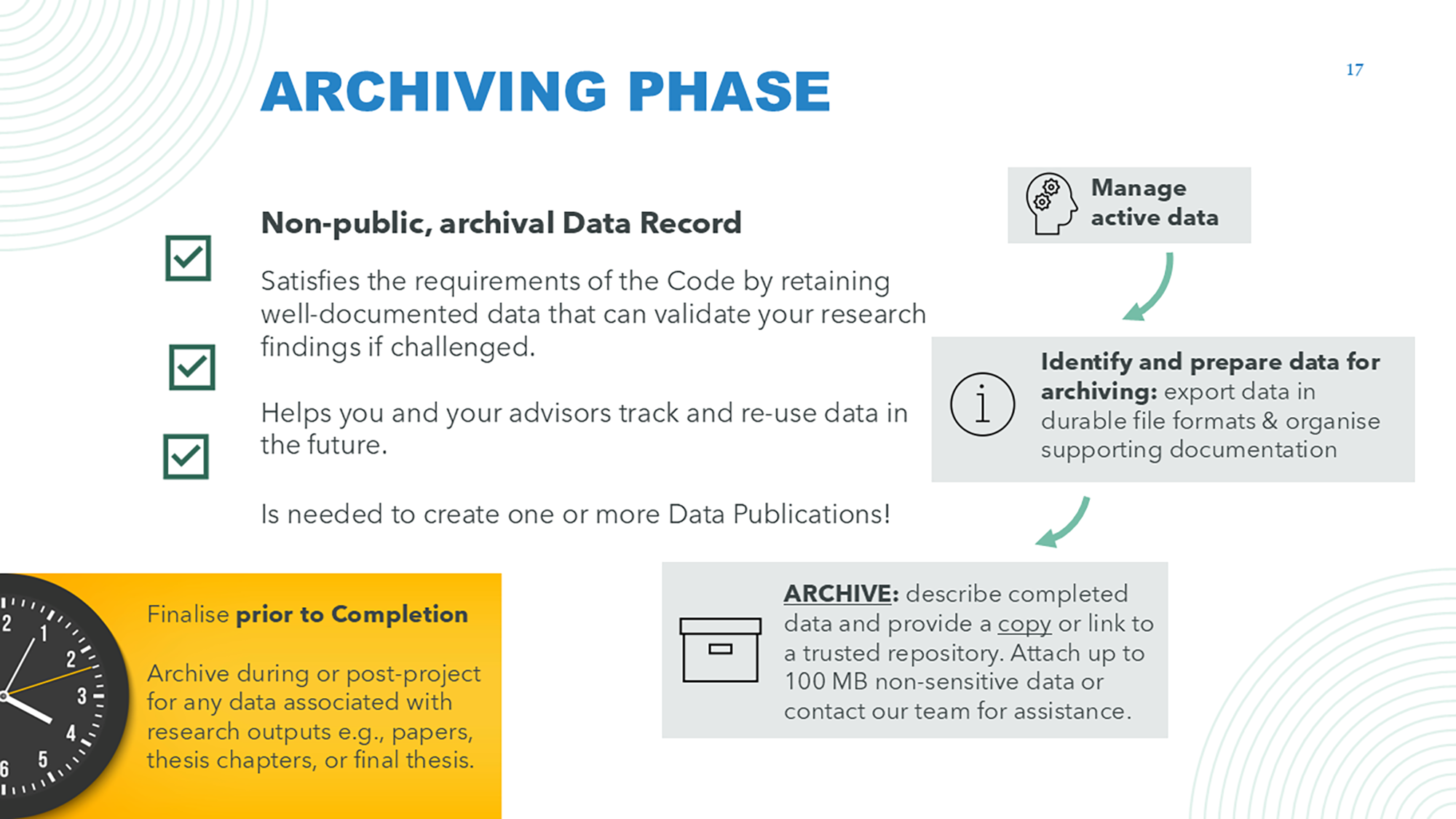
Archiving involves creating a non-public, archival Data Record in Research Data JCU to describe your data and either store it within the platform or record its location elsewhere.
Archiving your data allows you (and your advisors or research team) to keep track of it, use it for future research, and uphold its integrity if challenged. A Data Record is also required to create one or more Data Publications.
You should archive any data you generated that is needed to validate or reproduce findings, or that may support future research. This typically includes raw and completed data, as well as any supporting documentation.
As a rule, you need to manage your working data and any third-party data you use during your project, but you don’t need to archive it.
Here is a slide (screenshot) from the RTN workshop explaining why and when to archive your data:
Do I qualify for an exemption?
You may be eligible for an exemption if:
- Your project did not generate data
(No Data Record required)
E.g. all relevant data is already included in your thesis/exegesis.
- Your data is under ethics or contractual restrictions that prevent storage viaResearch Data JCU
(A Data Record is still required — include the data’s location, e.g. URL, file path, or physical storage info)
🔍 What do you mean by “did not generate data”? What counts as research data in my discipline?
It's highly likely you've generated research data. However, in some cases, all of the data is already included in your output (e.g. your thesis or exegesis) and doesn’t need to be archived separately.
We have an information sheet with case studies from the creative arts, history and ethnographic fieldwork—as well as the general principles that apply across disciplines:
🧾 InfoSheet - Identifying Data for Archiving
The general principles are:
- If you need to refer to something in your research output that you have generated, then it is research data
- Working notes, reflections and observations that are used to develop your findings or creative output, but that are not required for validation (referred to) generally do not constitute research data in this context
- Academic referencing can be used for external source documents and materials, and these do not need to be archived.
If you’re unsure, reach out to the Research Data team!
📧 Email: researchdata@jcu.edu.au
Note: You still need a Research Management Plan (RDMP)—this will help you decide what data inputs will be used, what working materials and research data (if any) will be generated, and how best to manage them.
Apply for an exemption (HDR Candidates)
🔐 ServiceNow (login required):
- Exemption Request Form - Submit your exemption request here.
Please provide a brief explanation e.g., “Desktop review of publicly available policies; no data generated that is not included in my thesis.” - Knowledge Base Article - Data Archiving Exemptions for HDR candidates
For detailed guidance on eligibility criteria and actions, see this article, It includes a decision guide and examples to help you determine whether an exemption applies.
🖨️ Save or Print: You can save or print this page as a PDF using Ctrl+P (Windows) or Cmd+P (Mac).
🔙 Back to Table of Contents