
Advanced Analytical Centre Analytical Facilities All Instruments Laser ablation
Laser ablation
- MRCMHR
- Future Students
- JCU Global Experience
- International Students
- Student experience
- Open Day
- How to apply
- Pathways to university
- Living on Campus
- Courses
- Publications
- Mature students
- Scholarships
- Entry options
- JCU Families
- JCU Heroes Programs
- Aboriginal and Torres Strait Islander in Marine Science
- Elite Athletes
- Defence
- Capability.Co
- AI@JCU
- AALL
- Current Students
- Student Ambassador Program
- New students
- JCU Orientation
- LearnJCU
- Placements
- EDQS
- Unicare Centre and Unicampus Kids
- Graduation
- Off-Campus Students
- JCU Job Ready
- Safety and Wellbeing
- JCU Prizes
- Professional Experience Placement
- Employability Edge
- Art of Academic Writing
- Art of Academic Editing
- Careers and Employability
- Health, Wellbeing and Belonging
- Career Ready Plan
- Careers at JCU
- Partners and Community
- School Outreach and Widening Participation
- Alumni
- International partnerships
- About JCU
- Reputation and Experience
- Chancellery
- Governance
- Celebrating 50 Years
- Academy
- Indigenous Engagement
- Education Division
- Research Festival
- Graduate Research School
- Research Division
- Research and Innovation Services
- CASE
- College of Business, Law and Governance
- College of Healthcare Sciences
- College of Medicine and Dentistry
- College of Science and Engineering
- MPE
- Anthropological Laboratory for Tropical Audiovisual Research (ALTAR)
- Rural Remote and Tropical Health Systems
- Agriculture Technology and Adoption Centre (AgTAC)
-
Advanced Analytical Centre
- About us
- Commercial and external clients
-
Analytical Facilities
-
All Instruments
- X-ray Powder Diffraction (XRD)
- X-ray Fluorescence (XRF)
- Scanning Electron Microscopy (SEM)
- Inductively Coupled Plasma-Mass Spectrometer (ICP-MS)
- Laser ablation
- Inductively Coupled Plasma-Atomic Emission Spectrometer (ICP-AES)
- Gas Chromatography-Liquid Chromatography (GC/LC)
- Additional Equipment
- Laser Scanning Confocal Microscopy (LSCM)
- Advanced Analytical Centre
- Multicollector-Inductively Coupled Plasma-Mass Spectrometer (MC-ICP-MS)
- Electron Probe Microanalyser (EPMA or Microprobe)
- Sample Requirements
- Techniques and Facilities
-
All Instruments
- Staff
- Safety
-
Resources
- Element-to-stoichiometric oxide conversion factors
- Gunshot residue (GSR)
- FAQ ICP
- FAQ Organic
- SEM images of local insects – N.Queensland
- False coloured images
- Notes on sample preparation of biological material for SEM
- Routine XRF element analysis @ AAC
- How to view/edit element maps from Jeol 8200 EPMA
- Standard ICP element analysis @ AAC
- FAQ - XRD/XRF
- Other JCU Facilities
- Contact the AAC
- Australian Institute of Tropical Health and Medicine
- AMHHEC
- Aquaculture Solutions
- AMHRA
- JCU Digital Wellbeing Group
- ARCSTA
- Lions Marine Research Trust
- Australian Tropical Herbarium
- Australian Quantum & Classical Transport Physics Group
- Boating and Diving
- Clinical Psychedelic Research Lab
- Centre for Tropical Biosecurity
- Centre for Tropical Bioinformatics and Molecular Biology
- CITBA
- CMT
- Centre for Disaster Solutions
- CSTFA
- Cyclone Testing Station
- The Centre for Disaster Studies
- Daintree Rainforest Observatory
- Fletcherview
- JCU Eduquarium
- JCU Turtle Health Research
- MARFU
- Orpheus
- TESS
- JCU Ideas Lab
- CADSI
- CNL
- TARL
- eResearch
- Indigenous Education and Research Centre
- Past Course and Subject Handbooks
- Estate
- Work Health and Safety
- Staff
- Discover Nature at JCU
- Cyber Security Hub
- Association of Australian University Secretaries
- Services Division
- Environmental Research Complex [ERC]
- Foundation for Australian Literary Studies
- Gender Equity at JCU
- Give to JCU
- Indigenous Legal Needs Project
- Inherent Requirements
- IsoTropics Lab
- IT Services
- JCU Webinars
- JCU Events
- JCU Motorsports
- JCU Sport
- Library
- Mabo Decision: 30 years on
- Marine Geophysics Laboratory
- Office of the Vice Chancellor and President
- Outstanding Alumni
- Policy
- PAHL
- Queensland Research Centre for Peripheral Vascular Disease
- Rapid Assessment Unit
- RDIM
- Researcher Development Portal
- Roderick Centre for Australian Literature and Creative Writing
- Contextual Science for Tropical Coastal Ecosystems
- State of the Tropics
- Strategic Procurement
- Student profiles
- SWIRLnet
- TREAD
- TropEco for Staff and Students
- TropCOVID: Mapping COVID-19 Immunity in Far North Queensland
- TUDLab
- VAVS Home
- WHOCC for Vector-borne & NTDs
- Media
- Copyright and Terms of Use
- Australian Institute of Tropical Health & Medicine
- JCU Respect
- Pay review
- Research
If you have used this instrument please cite using the following:
James Cook University Advanced Analytical Centre. year. Laser Ablation. Townsville, Queensland, Australia. https://dx/doi.org/10.25903/94fx-zc67
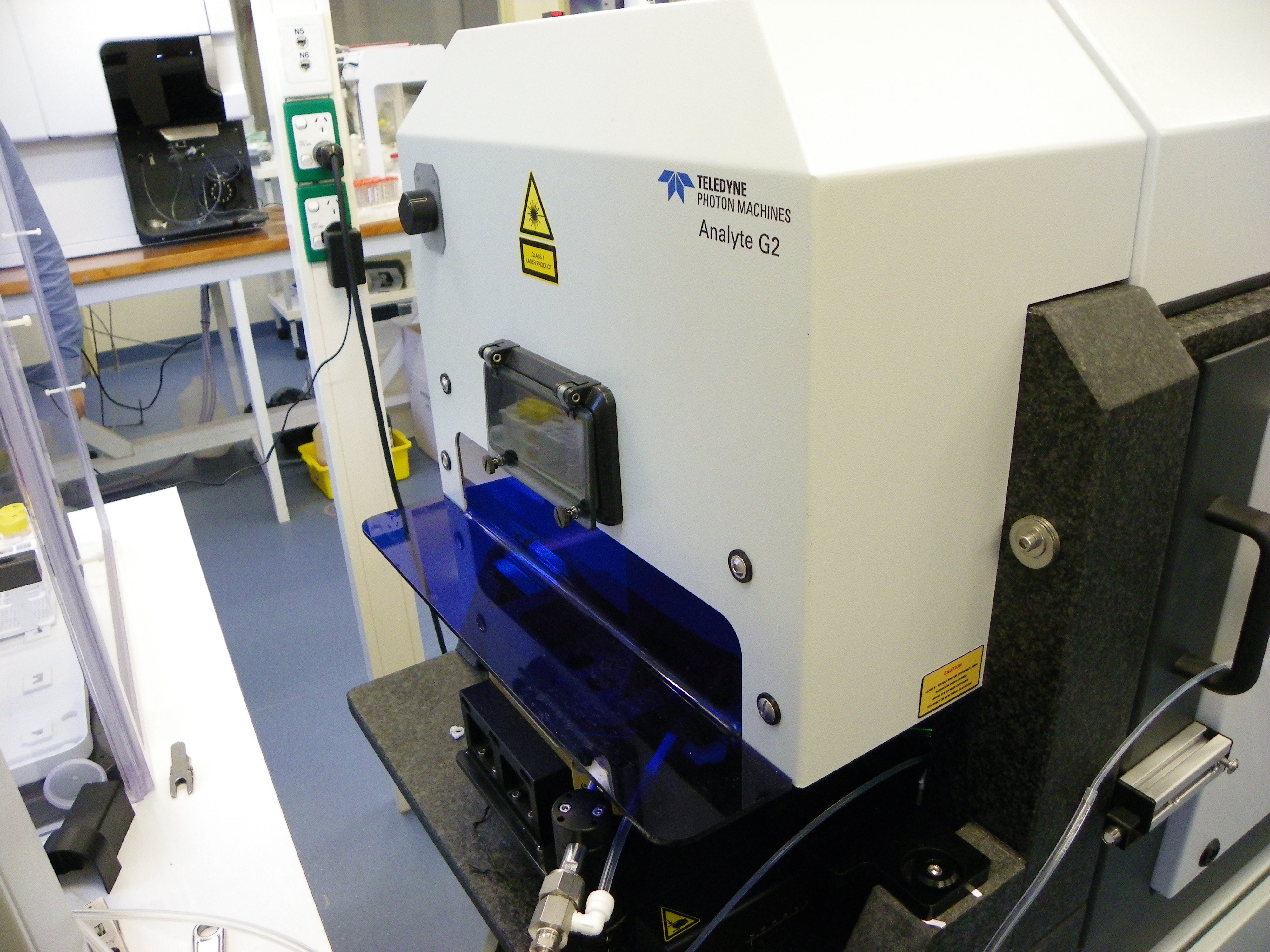
About the Technique
When coupled to an Inductively Coupled Plasma (ICP) source, laser ablation enables in-situ elemental or isotopic micro-analysis of engineered, geochemical, or biological materials.
Using a short-wavelength (193 nm) laser allows a wide range of material types to be sampled with very high spatial resolution.
Samples can be examined over small areas — such as individual mineral grains — directly from the solid material, eliminating the need for bulk chemical digestions. Larger areas can also be analysed, with spot sizes ranging from 1 μm to 400 μm depending on the application.
Analyses can be conducted as down-hole profiles (through the depth of a sample), as line scans across surfaces, or to create detailed elemental maps.
Current Instumentation
Sample requirements
Laser ablation material is typically mounted on glass slides or in epoxy resin mounts. These are then cut and polished prior to ablation.
For further information contact Dr Huiqing (Jeffrey) Huang