
Indigenous Education and Research Centre Our Research Digital Futures and Artificial Intelligence
Digital Futures and Artificial Intelligence
- Future Students
- JCU Global Experience
- International Students
- Student experience
- Open Day
- How to apply
- Pathways to university
- Living on Campus
- Courses
- Publications
- Mature students
- Scholarships
- Entry options
- JCU Families
- JCU Heroes Programs
- Aboriginal and Torres Strait Islander in Marine Science
- Elite Athletes
- Defence
- Capability.Co
- AI@JCU
- AALL
- Current Students
- Student Ambassador Program
- New students
- JCU Orientation
- LearnJCU
- Placements
- EDQS
- Unicare Centre and Unicampus Kids
- Graduation
- Off-Campus Students
- JCU Job Ready
- Safety and Wellbeing
- JCU Prizes
- Professional Experience Placement
- Employability Edge
- Art of Academic Writing
- Art of Academic Editing
- Careers and Employability
- Health, Wellbeing and Belonging
- Career Ready Plan
- Careers at JCU
- Partners and Community
- School Outreach and Widening Participation
- Alumni
- International partnerships
- About JCU
- Reputation and Experience
- Chancellery
- Governance
- Celebrating 50 Years
- Academy
- Indigenous Engagement
- Education Division
- Graduate Research School
- Research Division
- Research and Innovation Services
- CASE
- College of Business, Law and Governance
- College of Healthcare Sciences
- College of Medicine and Dentistry
- College of Science and Engineering
- MPE
- Anthropological Laboratory for Tropical Audiovisual Research (ALTAR)
- Rural Remote and Tropical Health Systems
- Agriculture Technology and Adoption Centre (AgTAC)
- Advanced Analytical Centre
- AMHHEC
- Aquaculture Solutions
- AMHRA
- JCU Digital Wellbeing Group
- ARCSTA
- Lions Marine Research Trust
- Australian Tropical Herbarium
- Australian Quantum & Classical Transport Physics Group
- Boating and Diving
- Clinical Psychedelic Research Lab
- Centre for Tropical Biosecurity
- Centre for Tropical Bioinformatics and Molecular Biology
- CITBA
- CMT
- Centre for Disaster Solutions
- CSTFA
- Cyclone Testing Station
- The Centre for Disaster Studies
- Daintree Rainforest Observatory
- Fletcherview
- JCU Eduquarium
- JCU Turtle Health Research
- MARFU
- Orpheus
- TESS
- JCU Ideas Lab
- CADSI
- CNL
- TARL
- eResearch
-
Indigenous Education and Research Centre
- Experience and prepare for uni
- Study with IERC at JCU
-
New and current students
- Students - Indigenous Peer Assisted Learning (IPAL) Tutoring Program
- Indigenous Student support staff and services
- Fees and financial support
- Making the move from home to JCU
- Getting ready for your first day
- Welcome to Orientation at the IERC
- Expand your social life and build your resume
- External and online students
- Exam preparation, support and tips
- Tutors - Indigenous Peer Assisted Learning (IPAL) Tutoring Program
- Information for families
- News and Events
- Scholarships
- Student Success Stories
- Our Research
- Indigenous Research Support Network
- About our centre
- Discover JCU's IERC
- Past Course and Subject Handbooks
- Estate
- Work Health and Safety
- Staff
- Discover Nature at JCU
- Cyber Security Hub
- Association of Australian University Secretaries
- Services Division
- Environmental Research Complex [ERC]
- Foundation for Australian Literary Studies
- Gender Equity at JCU
- Give to JCU
- Indigenous Legal Needs Project
- Inherent Requirements
- IsoTropics Lab
- IT Services
- JCU Webinars
- JCU Events
- JCU Motorsports
- JCU Sport
- Library
- Mabo Decision: 30 years on
- Marine Geophysics Laboratory
- Office of the Vice Chancellor and President
- Outstanding Alumni
- Policy
- PAHL
- Queensland Research Centre for Peripheral Vascular Disease
- Rapid Assessment Unit
- RDIM
- Researcher Development Portal
- Roderick Centre for Australian Literature and Creative Writing
- Contextual Science for Tropical Coastal Ecosystems
- State of the Tropics
- Strategic Procurement
- Student profiles
- SWIRLnet
- TREAD
- TropEco for Staff and Students
- TUDLab
- VAVS Home
- WHOCC for Vector-borne & NTDs
- Media
- Copyright and Terms of Use
- Australian Institute of Tropical Health & Medicine
- JCU Respect
- Pay review
- Research
Exploring how education systems can better recognise capability, connect learning with practice and create pathways for future generations.
Indigenous Futures Project
Reimagining how capability is developed, recognised and supported across the life course.
From the margins to the centre
Despite significant investment in education, many Indigenous learners continue to face barriers to participation, progression and completion, particularly in regional and remote Australia.
The Indigenous Futures Project explores a simple but important question: How can education systems better recognise, develop and support the capabilities people need to succeed on their own terms?
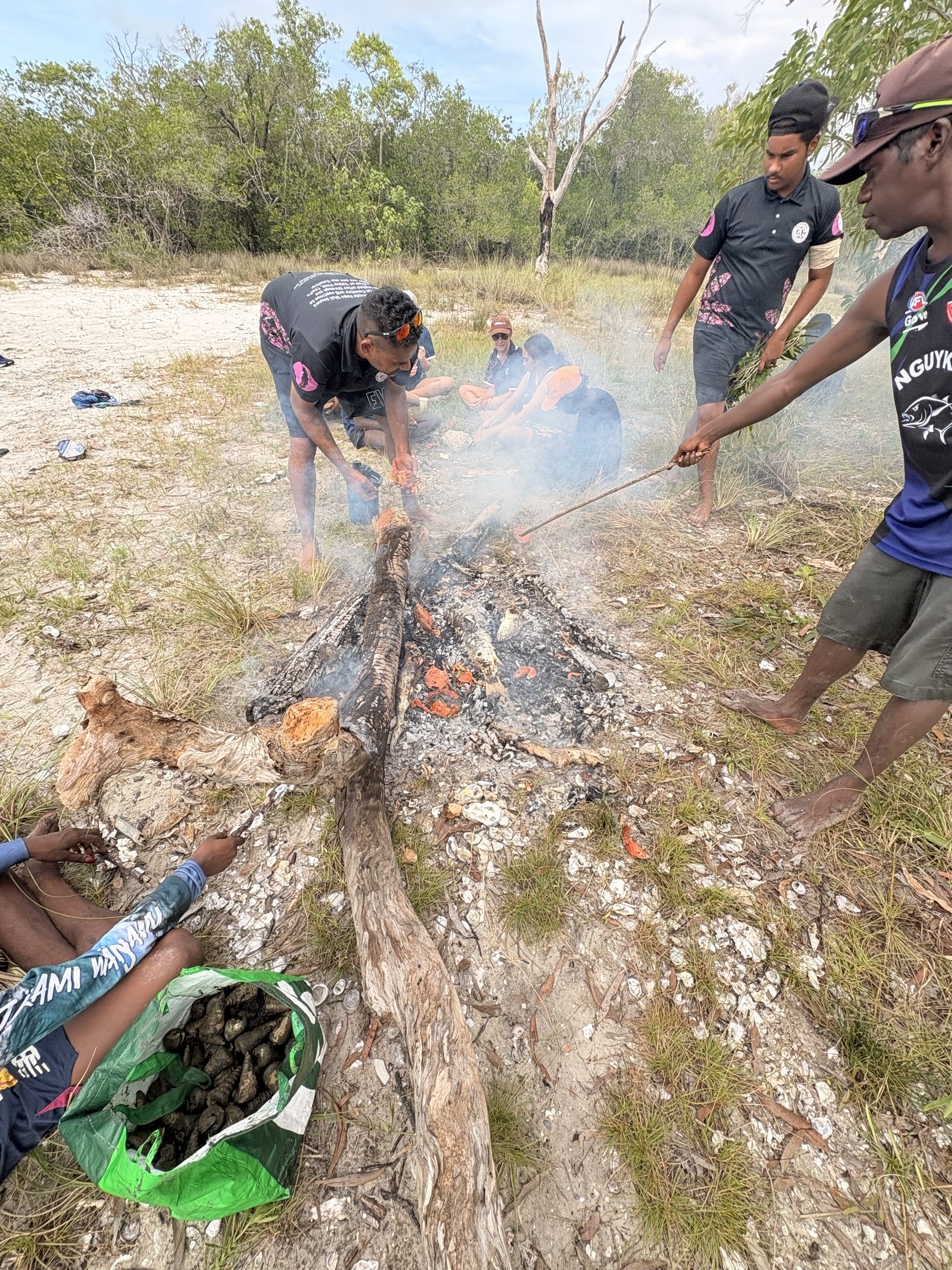
Research suggests that success is not determined by ability alone. It is influenced by how people develop confidence, agency, persistence and the capacity to navigate increasingly complex learning, work and community environments.
The Indigenous Futures Project brings together decades of research to investigate how education systems can strengthen learning pathways, recognise existing capability and create new opportunities for future generations.
Forty Years of Building Capability
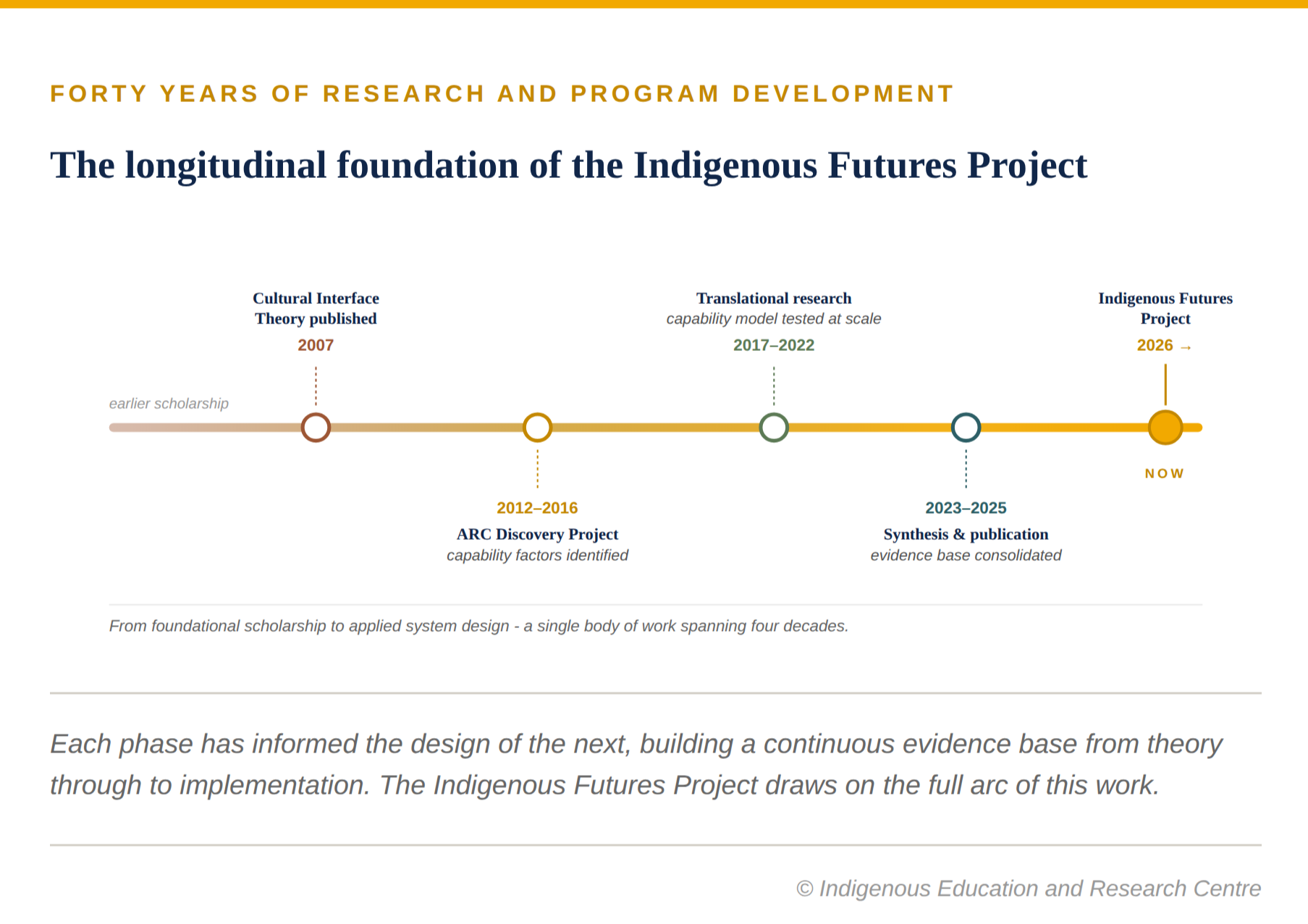
The Indigenous Futures Project draws on four decades of research, scholarship and practical intervention exploring how capability is developed, recognised and supported across the life course.
This body of work spans foundational scholarship, the development of the Cultural Interface framework, large-scale intervention research, studies of learner capability and educational success, and the exploration of new approaches to learning and qualification design.
Together, these contributions provide the foundation for the Indigenous Futures Project and its exploration of how education systems can better recognise, support and sustain capability over time.
A Foundational Concept: The Cultural Interface
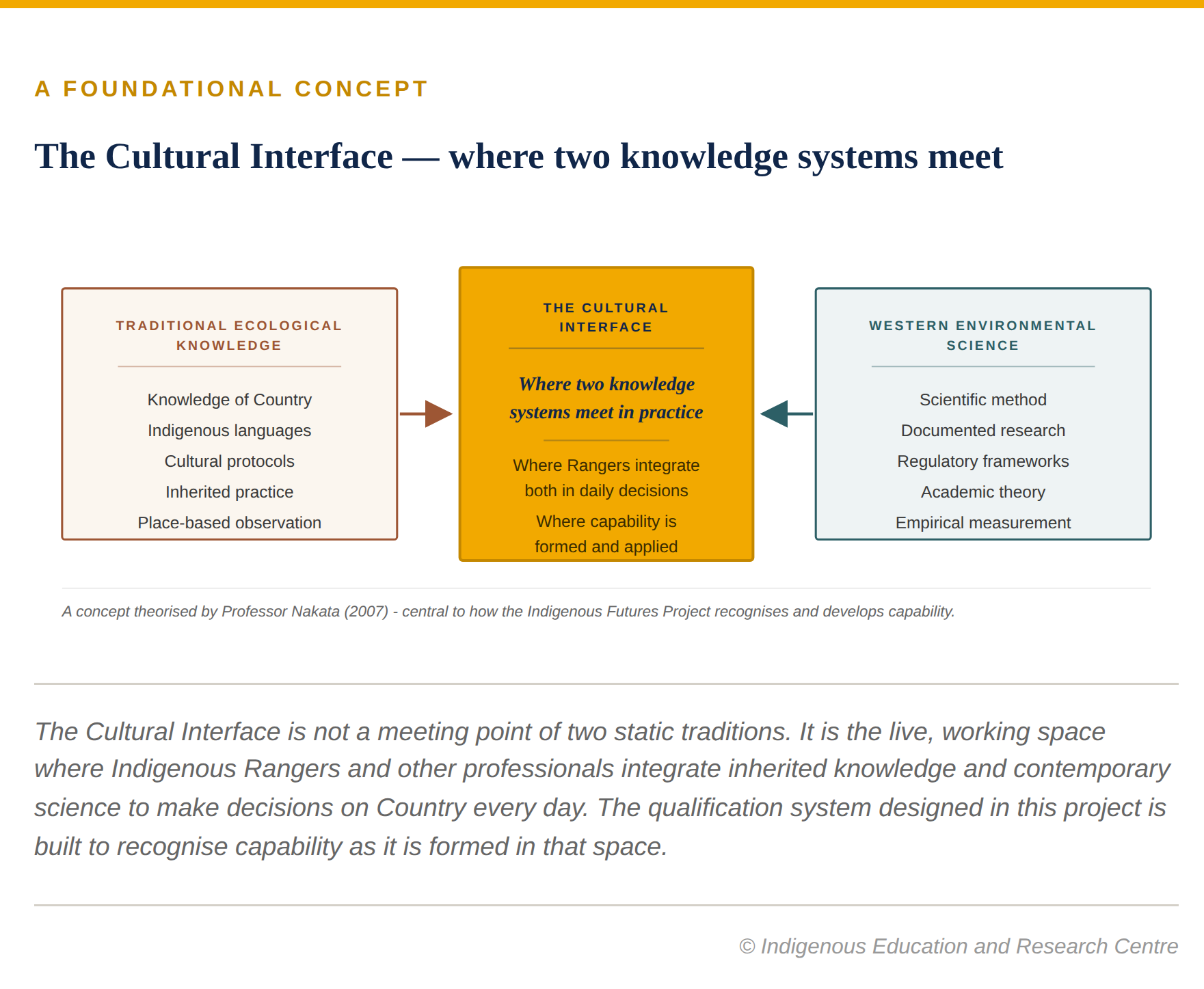
The Indigenous Futures Project is grounded in Professor Martin Nakata's concept of the Cultural Interface.
The Cultural Interface describes the complex space where Indigenous knowledge systems, Western knowledge systems, lived experience and contemporary practice intersect. It is not a fixed meeting point between two separate worlds, but a dynamic environment that people navigate every day.
For learners, communities and professionals, this means drawing on multiple sources of knowledge, understanding different ways of knowing, and applying them in real-world contexts.
The Cultural Interface provides a framework for understanding how capability is developed, applied and strengthened over time. It recognises that learning does not occur in a single setting or through a single knowledge system. Instead, capability emerges through the ongoing interaction between knowledge, experience, relationships and practice.
This concept provides the intellectual foundation for the Indigenous Futures Project and its exploration of how education systems can better recognise and support capability throughout the life course.
Current Frontier
Investigating new approaches to learning, recognition and qualification design
The Indigenous Futures Project explores how education systems might better recognise the capabilities people develop through learning, work and community life.
Rather than relying solely on traditional models of study, this work investigates how existing capability could be recognised, supported and connected to formal qualifications.
Drawing on adaptive systems, emerging technologies and place-based learning environments, this work investigates whether new approaches to qualification design can better reflect the ways people learn and apply knowledge in practice.
The aim is not to replace existing education systems, but to examine how they might be extended to create more flexible pathways between lived expertise, formal recognition and lifelong learning.
Pilot Implementation
Indigenous Ranger Degrees
The first pilot of this work is underway through the development of Indigenous Environmental Management and Indigenous Land Management degrees.
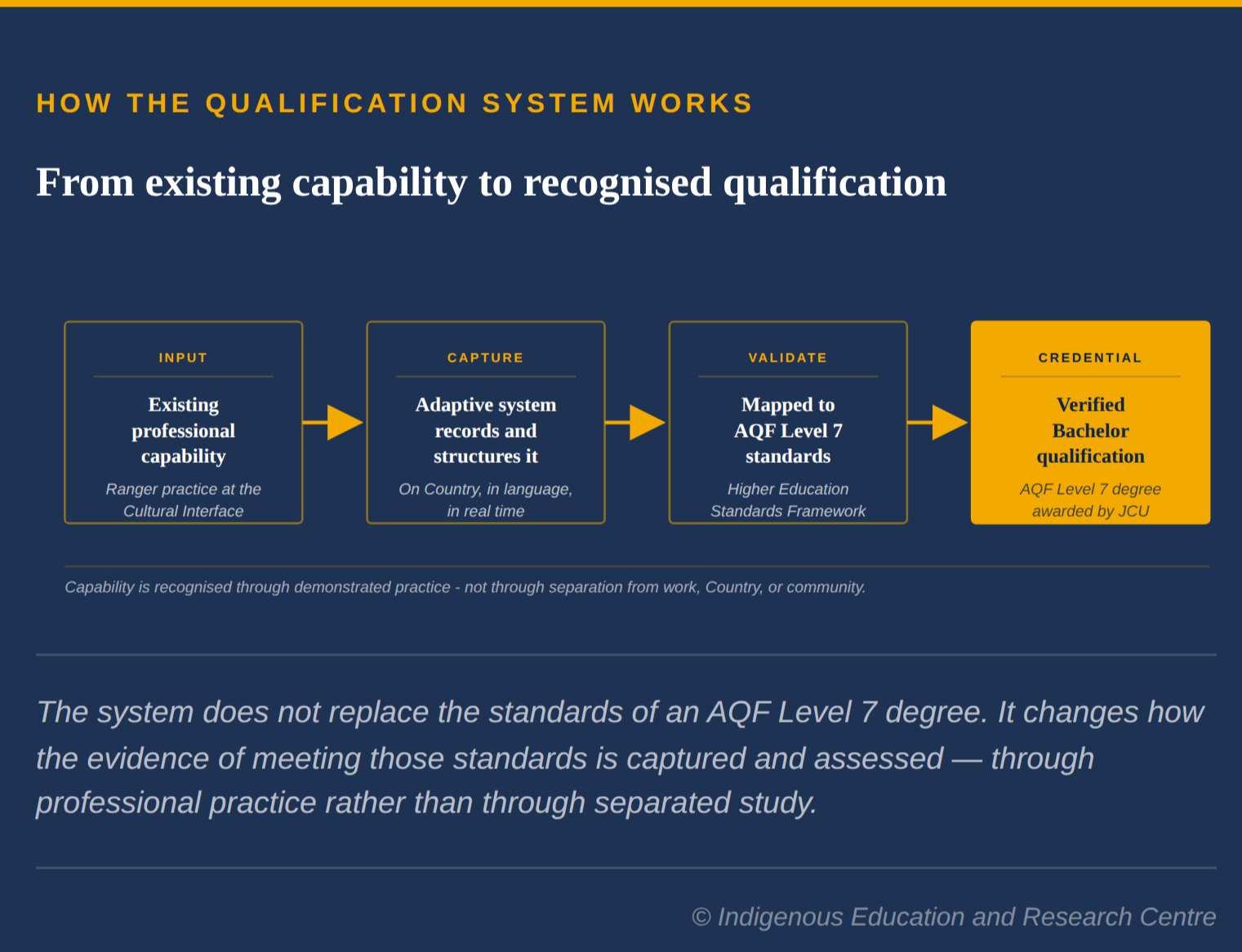
Working in partnership with Indigenous Rangers and their communities, the project is examining how existing knowledge, skills and professional experience can be recognised within formal qualification pathways.
Indigenous Rangers provide a valuable context for this work. Their roles require them to draw on Indigenous knowledge, contemporary environmental science, community priorities and professional practice, often simultaneously.
Learning takes place on Country, through language, culture and ongoing practice. This creates an opportunity to investigate how capability developed in real-world settings might be recognised and connected to formal qualifications.
Rather than testing learners against a predefined curriculum alone, the pilot is exploring whether professional practice itself can provide evidence of learning and capability while meeting higher education standards.
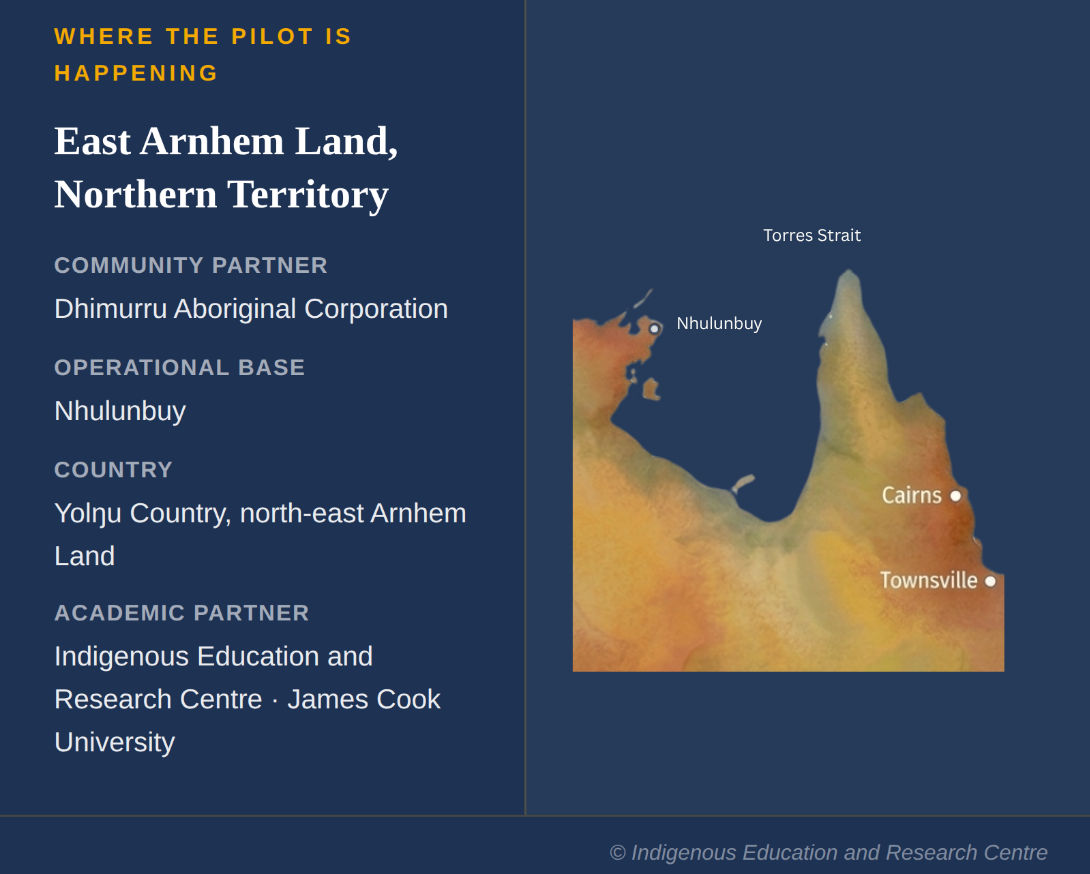
The pilot is being developed through partnerships with community organisations, researchers and education providers.
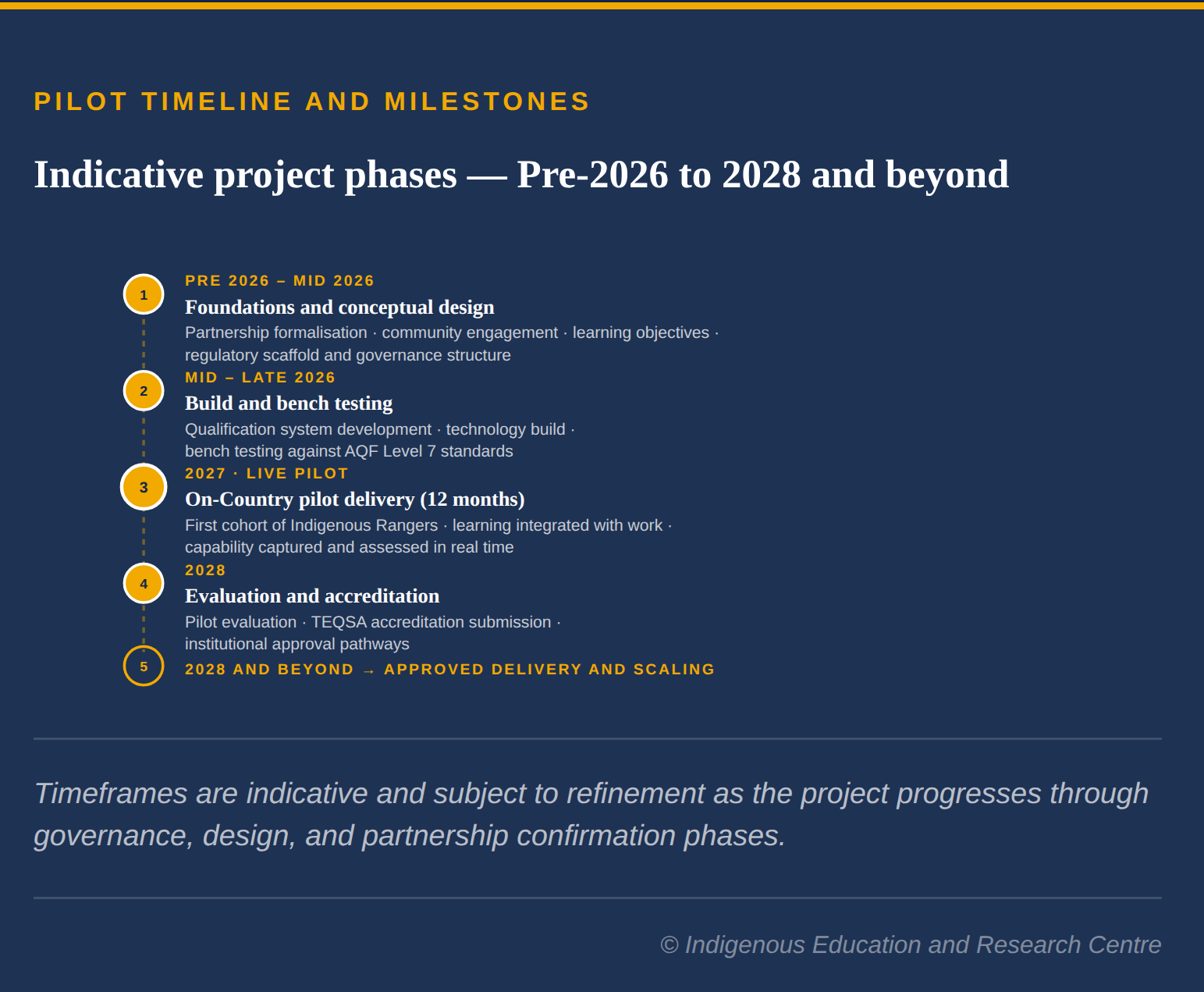
Over the coming years, the project will examine how capability developed through professional practice can be recognised within formal qualification pathways, while maintaining the standards required of higher education.
The pilot will help inform future approaches to learning, recognition and qualification design in diverse educational and community contexts.
Capability Development Across the Education System
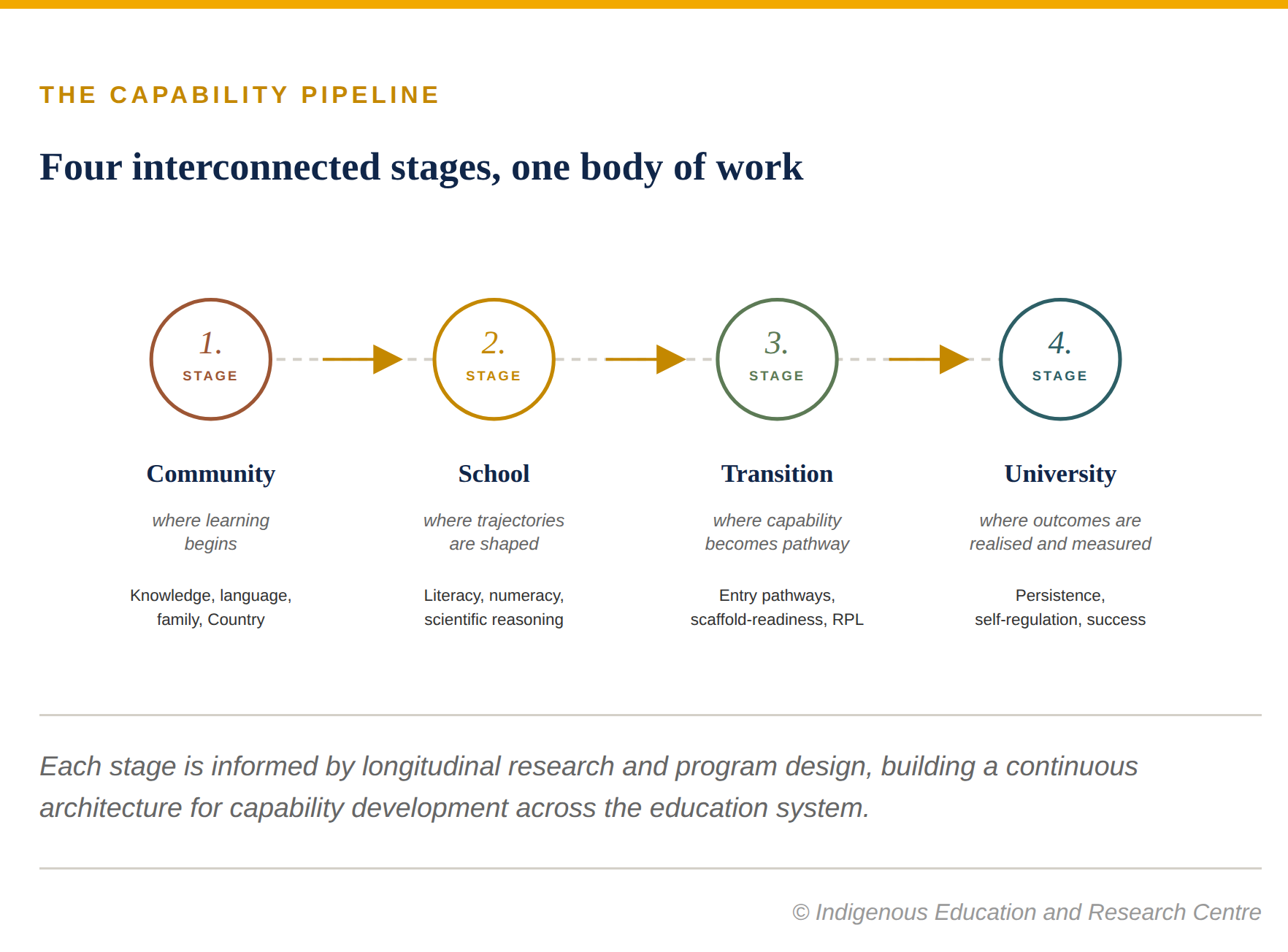
Four stages, one continuous journey
The Indigenous Futures Project is built on a simple idea: capability develops over time.
Research conducted across community, school, transition and university settings has helped identify the factors that support learning, participation and success across the life course.
Together, these stages provide a framework for understanding how opportunities for success are shaped over time.
 The practical application of this work can be seen through a range of education and capability-building initiatives delivered in partnership with schools, communities and education providers.
For more information: Building Educational Capacities for STEM Success
Research in Action
The Indigenous Futures Project provides a foundation for future research and innovation across education, capability development and emerging technologies.
Working with schools, communities and education providers to strengthen learner capability, educational participation and long-term success.
Investigating how adaptive systems, artificial intelligence and emerging technologies may support future approaches to learning, capability development and qualification design.
Additional initiatives currently under development will continue to extend this work into new sectors, industries and learning environments.
Why This Matters
While this work is grounded in Indigenous education and community contexts, it addresses questions that are increasingly relevant across education systems worldwide.
As education systems respond to changing social, professional and technological environments, the Indigenous Futures Project contributes to broader conversations about learning, capability and opportunity across the life course.
Selected Evidence Base
Nakata, M., & Biggs, S. (2026). From the margins to the centre: How AI can transform education from the ground up
Nakata, M. (2025). From access and participation to student success: A decade of research on building Indigenous academic self-efficacy to close the gap in higher education
Nakata, M., & Nakata, V. (2022). Supporting Indigenous students to succeed at university: A resource for the higher education sector
Nakata, M., Nakata, V., Day, A., Martin, G., & Peachey, M. (2019). Indigenous undergraduates’ use of supplementary tutors: Developing academic capabilities for success in higher education studies
Nakata, M. (2007). The Cultural Interface