
Our Research
- MRCMHR
- Future Students
- JCU Global Experience
- International Students
- Student experience
- Open Day
- How to apply
- Pathways to university
- Living on Campus
- Courses
- Publications
- Mature students
- Scholarships
- Entry options
- JCU Families
- JCU Heroes Programs
- Aboriginal and Torres Strait Islander in Marine Science
- Elite Athletes
- Defence
- Capability.Co
- AI@JCU
- AALL
- Current Students
- Student Ambassador Program
- New students
- JCU Orientation
- LearnJCU
- Placements
- EDQS
- Unicare Centre and Unicampus Kids
- Graduation
- Off-Campus Students
- JCU Job Ready
- Safety and Wellbeing
- JCU Prizes
- Professional Experience Placement
- Employability Edge
- Art of Academic Writing
- Art of Academic Editing
- Careers and Employability
- Health, Wellbeing and Belonging
- Career Ready Plan
- Careers at JCU
- Partners and Community
- School Outreach and Widening Participation
- Alumni
- International partnerships
- About JCU
- Reputation and Experience
- Chancellery
- Governance
- Celebrating 50 Years
- Academy
- Indigenous Engagement
- Education Division
- Research Festival
- Graduate Research School
- Research Division
- Research and Innovation Services
- CASE
- College of Business, Law and Governance
- College of Healthcare Sciences
- College of Medicine and Dentistry
- College of Science and Engineering
- MPE
- Anthropological Laboratory for Tropical Audiovisual Research (ALTAR)
- Rural Remote and Tropical Health Systems
- Agriculture Technology and Adoption Centre (AgTAC)
- Advanced Analytical Centre
- Australian Institute of Tropical Health and Medicine
- AMHHEC
- Aquaculture Solutions
- AMHRA
- JCU Digital Wellbeing Group
- ARCSTA
- Lions Marine Research Trust
- Australian Tropical Herbarium
- Australian Quantum & Classical Transport Physics Group
- Boating and Diving
- Clinical Psychedelic Research Lab
- Centre for Tropical Biosecurity
- Centre for Tropical Bioinformatics and Molecular Biology
- CITBA
- CMT
- Centre for Disaster Solutions
- CSTFA
- Cyclone Testing Station
- The Centre for Disaster Studies
- Daintree Rainforest Observatory
- Fletcherview
- JCU Eduquarium
- JCU Turtle Health Research
- MARFU
- Orpheus
- TESS
- JCU Ideas Lab
- CADSI
- CNL
- TARL
- eResearch
-
Indigenous Education and Research Centre
- Experience and prepare for uni
- Study with IERC at JCU
-
New and current students
- Students - Indigenous Peer Assisted Learning (IPAL) Tutoring Program
- Indigenous Student support staff and services
- Fees and financial support
- Making the move from home to JCU
- Getting ready for your first day
- Welcome to Orientation at the IERC
- Expand your social life and build your resume
- External and online students
- Exam preparation, support and tips
- Tutors - Indigenous Peer Assisted Learning (IPAL) Tutoring Program
- Information for families
- News and Events
- Scholarships
- Student Success Stories
- Research and Projects
- Indigenous Research Support Network
- About our centre
- Discover JCU's IERC
- Past Course and Subject Handbooks
- Estate
- Work Health and Safety
- Staff
- Discover Nature at JCU
- Cyber Security Hub
- Association of Australian University Secretaries
- Services Division
- Environmental Research Complex [ERC]
- Foundation for Australian Literary Studies
- Gender Equity at JCU
- Give to JCU
- Indigenous Legal Needs Project
- Inherent Requirements
- IsoTropics Lab
- IT Services
- JCU Webinars
- JCU Events
- JCU Motorsports
- JCU Sport
- Library
- Mabo Decision: 30 years on
- Marine Geophysics Laboratory
- Office of the Vice Chancellor and President
- Outstanding Alumni
- Policy
- PAHL
- Queensland Research Centre for Peripheral Vascular Disease
- Rapid Assessment Unit
- RDIM
- Researcher Development Portal
- Roderick Centre for Australian Literature and Creative Writing
- Contextual Science for Tropical Coastal Ecosystems
- State of the Tropics
- Strategic Procurement
- Student profiles
- SWIRLnet
- TREAD
- TropEco for Staff and Students
- TropCOVID: Mapping COVID-19 Immunity in Far North Queensland
- TUDLab
- VAVS Home
- WHOCC for Vector-borne & NTDs
- Media
- Copyright and Terms of Use
- Australian Institute of Tropical Health & Medicine
- JCU Respect
- Pay review
- Research
Addressing complex challenges through Indigenous knowledge, research partnerships and scholarship that informs policy, practice and futures.
Research Addressing Complex Challenges
Research at the Indigenous Education and Research Centre addresses complex challenges affecting Indigenous communities, education systems and policy environments across Northern Australia and beyond, with expertise spanning Indigenous knowledge systems, governance, education, climate futures, health and justice.
Supported by more than $5 million in Australian Research Council (ARC) funding and nationally competitive fellowships, the IERC has established a strong record of research excellence and collaboration.
Our projects examine the complexities of the Cultural Interface and contribute knowledge that informs policy, practice and future directions.
RESEARCH AREA | FOCUS | OUTCOMES AND IMPACT |
|---|---|---|
| Indigenous Knowledge Systems and Innovation | Application of Indigenous knowledge to challenges such as climate change, biodiversity and sustainable development | Contributes to locally grounded and globally relevant solutions, informing environmental policy and sustainable practice |
Climate Futures and Country | Indigenous land and sea management, climate adaptation and mobility, particularly in the Torres Strait and northern Australia | Supports community-led responses to climate change and informs regional and national adaptation strategies |
Governance and Economic Futures | Indigenous governance, native title, settlement agreements and economic self-determination | Informs policy and governance frameworks that support political autonomy, economic development and long-term community outcomes |
Education and Capacity Building | Indigenous student success, pathways, institutional practices and pedagogical models | Strengthens education systems and builds long-term community capability through improved access, participation and outcomes |
Intergenerational Health and Justice | Wellbeing across health, justice, education and child protection systems, with a focus on children and young people | Supports more effective, coordinated approaches across systems to improve long-term wellbeing and life outcomes |
Current Projects
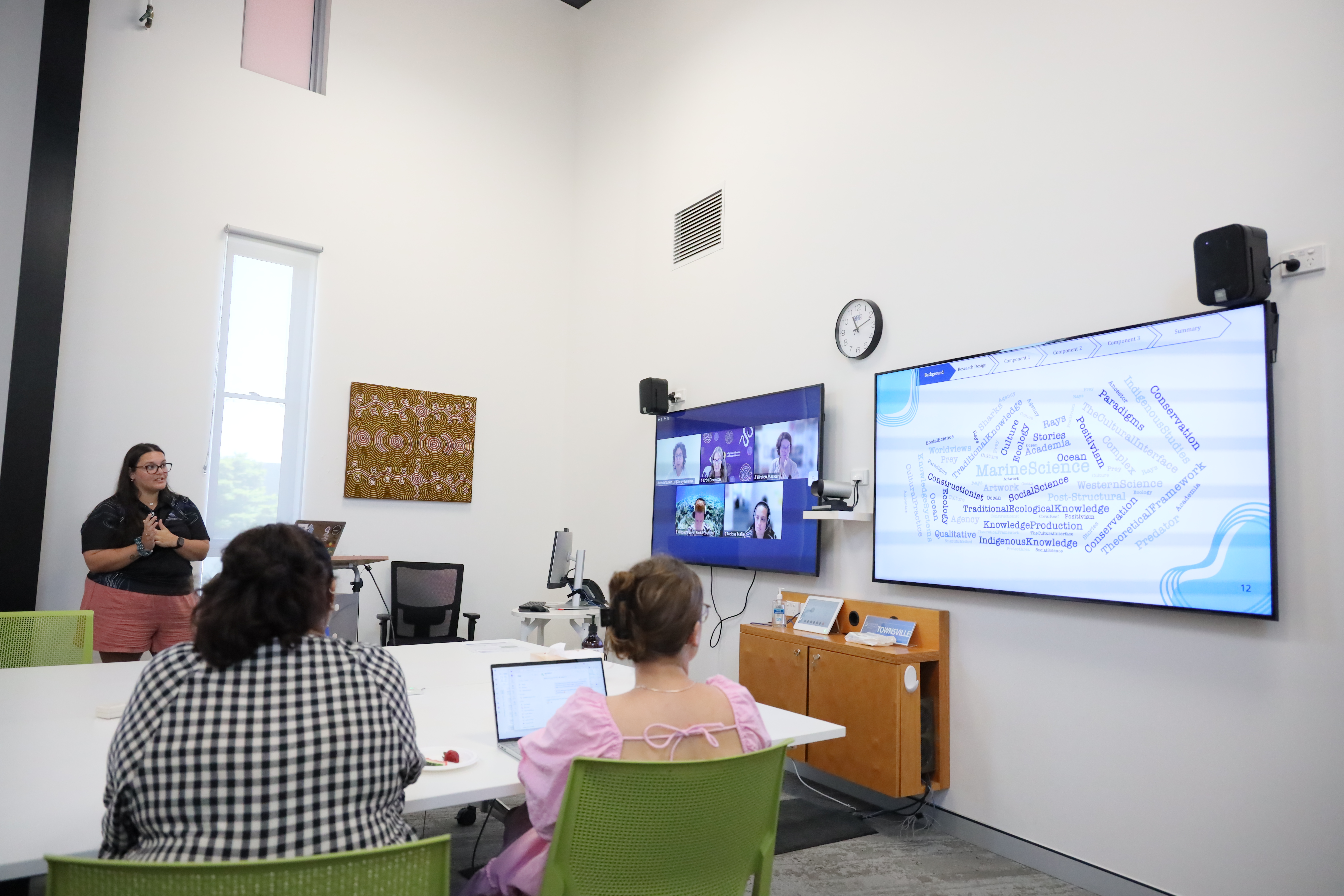
Our research portfolio spans education, climate futures, governance, health and Indigenous knowledge systems.
Explore the projects currently underway and see how research is contributing to policy, practice and future directions.
Featured Research Projects
The IERC's research also informs a range of projects exploring future approaches to learning, capability development and Indigenous futures. Featured research projects include Digital Futures and Artificial Intelligence, and Education Innovation, which investigate how research can contribute to new ways of understanding learning, educational systems and opportunities for future generations.
Research in Practice
Research at the IERC is more than individual projects. It is built through partnerships, contributes to policy and practice, supports future researchers and creates impact across communities and systems.
IERC research is built on longstanding partnerships with Aboriginal and Torres Strait Islander organisations, government, industry and international collaborators. These partnerships are central to how research is designed, governed and delivered.
Community partnerships include work with Torres Strait Islander organisations such as the Torres Strait Island Regional Council (TSIRC) and Torres Strait Regional Authority (TSRA), as well as Aboriginal organisations including NAILSMA and Dhimurru. Engagement also extends to Prescribed Body Corporates (PBCs) and Native Title groups.
Research is co-designed with partners, with communities guiding priorities, governance and outcomes. This includes collaborative research, training and the development of employment pathways linked to research activity.
The IERC works closely with local, state and federal government to contribute to evidence-based policy and program development. Partnerships with industry support the application of research in areas such as land and sea management, health and economic development, translating knowledge into practical and sustainable outcomes.
Internationally, the IERC engages across the Oceania and Asia-Pacific regions, supporting knowledge exchange and comparative Indigenous research in areas of shared priority, including climate change and community resilience.
IERC research creates impact across community, policy, practice and scholarship, with outcomes that are relevant, applied and sustained.
At the community level, co-designed research supports capability development and delivers locally relevant solutions aligned to community priorities, including work with Torres Strait Islander and Aboriginal communities.
At the policy level, research contributes to national and regional policy discussions, including input into debates such as the 2023 Voice Referendum and broader agendas around economic self-determination.
In practice, IERC research has led to the development of tools and frameworks, including research ethics tools and knowledge translation models that are adopted in training and professional contexts beyond the University.
Scholarly impact is reflected in contributions to global Indigenous research, including the development of new theoretical frameworks and high-impact publications.
The IERC is committed to developing Indigenous research capability and leadership across communities, organisations and the research sector.
For Higher Degree by Research (HDR) candidates and professionals seeking to extend their careers, the IERC offers a research environment grounded in Indigenous knowledge, community partnership and real-world impact. Candidates are supported to develop and lead their own research, from shaping a research question through to delivering a project that contributes new knowledge to their field.
Support is provided through experienced supervision, Indigenous-focused research intensives, and communities of practice that connect researchers, students and community partners. This approach strengthens research capability while maintaining strong links between research, community priorities and applied outcomes.
Research training extends beyond the University, supporting Indigenous participation in knowledge production and research leadership across communities and organisations. This contributes to a broader model where research, teaching and support are closely aligned.
Our advisors have expertise in a wide range of fields within and beyond Indigenous Studies. These include: Indigenous law, politics and policy; public health; social work and public health; Indigenous childhoods; Indigenous education and students, Indigenous curriculum and higher education; political theory, including comparative political theory, the cultural interface; communities of practice and knowledge translation.
For further research opportunities, contact the JCU Graduate Research School for research and funding opportunities, research advisors, and candidature enrolment and management.
Research News and Events
Research at the IERC extends beyond individual projects. It is built through partnerships, contributes to policy and practice, supports future researchers and creates impact across communities and systems.
Explore recordings, presentations and workshops that showcase the breadth of research undertaken through the IERC. Covering higher degree research, researcher development, community-led projects, partnerships and the Indigenous Research Support Network, these resources offer insight into the people, ideas and collaborations shaping Indigenous-led research across Northern Australia and beyond.
Supervision of Indigenous Research and Higher Degree Researchers
Australian Council of Graduate Research talk with JCU's Indigenous Education and Research Centre
In this webinar discussion, experienced JCU advisors of Indigenous research students and projects share insights on enhancing both student and advisor capabilities. Professor Martin Nakata (Deputy Vice Chancellor, Indigenous Education & Strategy), Associate Professor Sana Nakata (Head of Research, IERC), and Dr Ailie McDowall (Senior Lecturer and HDR Convenor, IERC) also highlight how the IERC is supporting Indigenous higher degree researchers.
Strengthening Research Partnerships in Zenadth Kes
On Country in Masig: Co-Design Workshop March 2025
The ARC Centre of Excellence for Indigenous and Environmental Histories and Futures joined Gur A Baradharaw Kod (GBK) for a powerful on-Country workshop on Masig (Yorke Island). With all 22 PBCs represented, the gathering focused on climate impacts, cultural governance, and research priorities. Professor Felicia Watkin leads the CIEHF–GBK partnership. Watch the video featuring Masig PBC Chair, Yessie Mosby, and the spirit of the gathering.
Connect with Our Research Team
Whether you're interested in collaboration, postgraduate study or learning more about our research, we'd love to hear from you.